

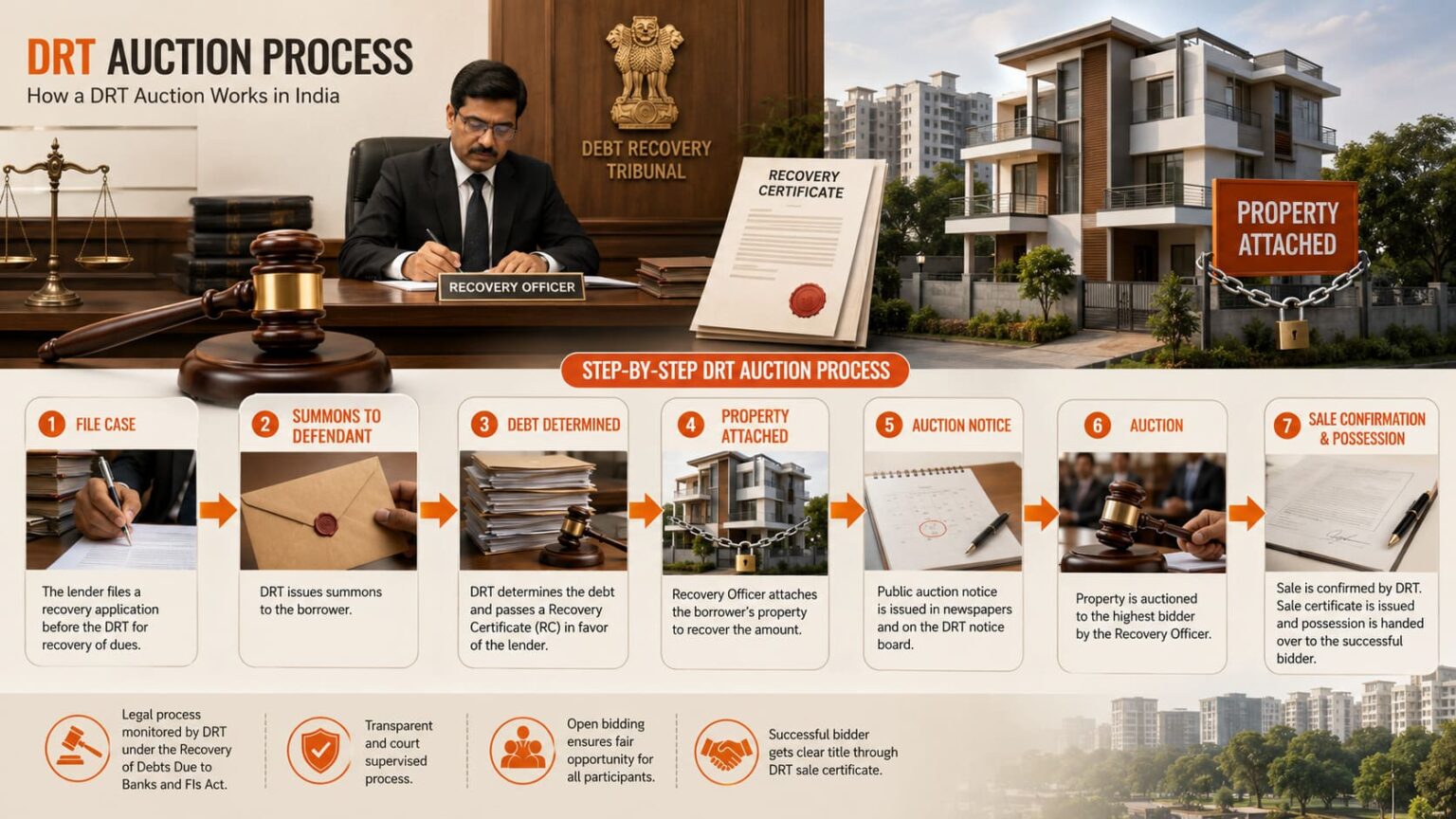
A DRT auction sale is the sale of a borrower’s or guarantor’s property through the Debt Recovery Tribunal’s recovery mechanism to recover unpaid bank dues.
DRT stands for Debts Recovery Tribunal, a specialised tribunal established to adjudicate and facilitate the recovery of debts owed to banks and financial institutions.
How Does a DRT Auction Work?
A bank or financial institution first files a recovery application before the DRT. After examining the loan documents, repayments, interest calculations and objections raised by the borrower, the Tribunal determines the amount legally recoverable.
The DRT then issues a Recovery Certificate specifying the amount due. The certificate is sent to a Recovery Officer, who can recover the debt by attaching and selling eligible assets of the borrower or guarantor.
The usual DRT auction process includes:
- Issuance of the Recovery Certificate
- Attachment of the property by the Recovery Officer
- Property valuation and fixation of the reserve price
- Publication of the sale proclamation or auction notice
- Bidder registration, KYC verification and payment of EMD
- Conduct of the physical auction or e-auction
- Acceptance of the highest bid, subject to confirmation
- Payment of the balance sale amount
- Confirmation of sale and issuance of the sale certificate
- Delivery of possession to the successful purchaser
The exact EMD, payment period and auction conditions will be stated in the individual sale notice.
DRT Auction vs SARFAESI Auction
A SARFAESI auction is normally conducted directly by the secured bank through its authorised officer. Section 13 of the SARFAESI Act allows a secured creditor to enforce its security interest after following the prescribed procedure.
A DRT auction, on the other hand, is conducted by the DRT Recovery Officer based on a Recovery Certificate issued by the Tribunal.
In simple terms:
- SARFAESI auction: The bank sells the mortgaged secured property.
- DRT auction: The Recovery Officer sells attached assets to recover the debt certified by the Tribunal.
Why Would a Bank Approach DRT When It Can Use SARFAESI?
A bank does not always have to obtain a DRT order before initiating SARFAESI proceedings. However, it may approach the DRT for several reasons.
Recovery Beyond the Mortgaged Property
SARFAESI primarily helps the bank enforce the property or asset given as security. If the auction amount is insufficient to clear the entire debt, the bank may use the DRT process to recover the remaining amount from other legally attachable assets.
For example, if the total debt is ₹2 crore but the mortgaged property is sold for ₹1.4 crore, the bank may pursue recovery of the remaining ₹60 lakh through the DRT process.
Unsecured Loans or Inadequate Security
When the loan is unsecured or the available security is insufficient, the bank cannot simply sell unrelated properties under SARFAESI. It must establish the debt before the DRT and obtain a Recovery Certificate before other assets can be attached.
Multiple Borrowers and Guarantors
A DRT case can cover the bank’s broader claim against borrowers, co-borrowers and guarantors. This may allow recovery from different parties and eligible assets instead of relying only on one mortgaged property.
Cases Where SARFAESI Does Not Apply
The SARFAESI Act contains certain exclusions and legal conditions. When the security or transaction falls outside its scope, the bank may have to rely on the DRT recovery mechanism.
Among the situations where the SARFAESI Act cannot be used are cases involving:
- Security created over agricultural land
- Secured financial assets of ₹1 lakh or less
- Cases where the amount still due is below 20% of the principal amount plus interest.
In such circumstances, the bank may have to rely on the DRT recovery process or another legally available remedy.
Parallel Recovery Proceedings
Banks may use DRT proceedings and SARFAESI action at the same time because the two remedies can operate alongside each other. However, all amounts recovered must be adjusted against the outstanding debt. The bank cannot recover the same amount twice.
Is Buying a DRT Auction Property Safe?
A DRT auction is conducted under legal authority, but that does not automatically make the property free from disputes or possession problems.
Before bidding, buyers should verify:
- Ownership and title documents
- Property boundaries and actual extent
- Existing mortgages and encumbrances
- Pending court or tribunal cases
- Tenants, occupants or third-party claims
- Property tax, electricity and association dues
- Physical possession status
- Conditions mentioned in the auction notice
- Pending challenges against attachment or sale
The highest bid may also require confirmation from the Recovery Officer.
A borrower, guarantor, co-owner or third party may challenge the auction, and physical possession may take longer than the issuance of the sale certificate.
For a smoother and safer property purchase, thorough due diligence is essential. Verified.RealEstate’s team combines AI-powered verification and document analysis with on-site property checks to identify legal, financial and physical risks before the transaction.
Conclusion
A DRT auction sale is a tribunal-controlled sale of attached property for recovering a bank’s legally determined debt. Although banks can directly enforce secured assets under the SARFAESI Act, they may approach the DRT when they need to recover a shortfall, proceed against guarantors, deal with unsecured debt or attach assets beyond the original mortgage.
DRT auction properties may be available at attractive reserve prices, but buyers should never assume that they are automatically dispute-free or ready for immediate possession. Proper legal, title and physical due diligence is essential before participating.
Disclaimer: This article provides general information and should not be treated as legal advice. Auction procedures and buyer obligations may vary depending on the case, tribunal order and sale notice.