

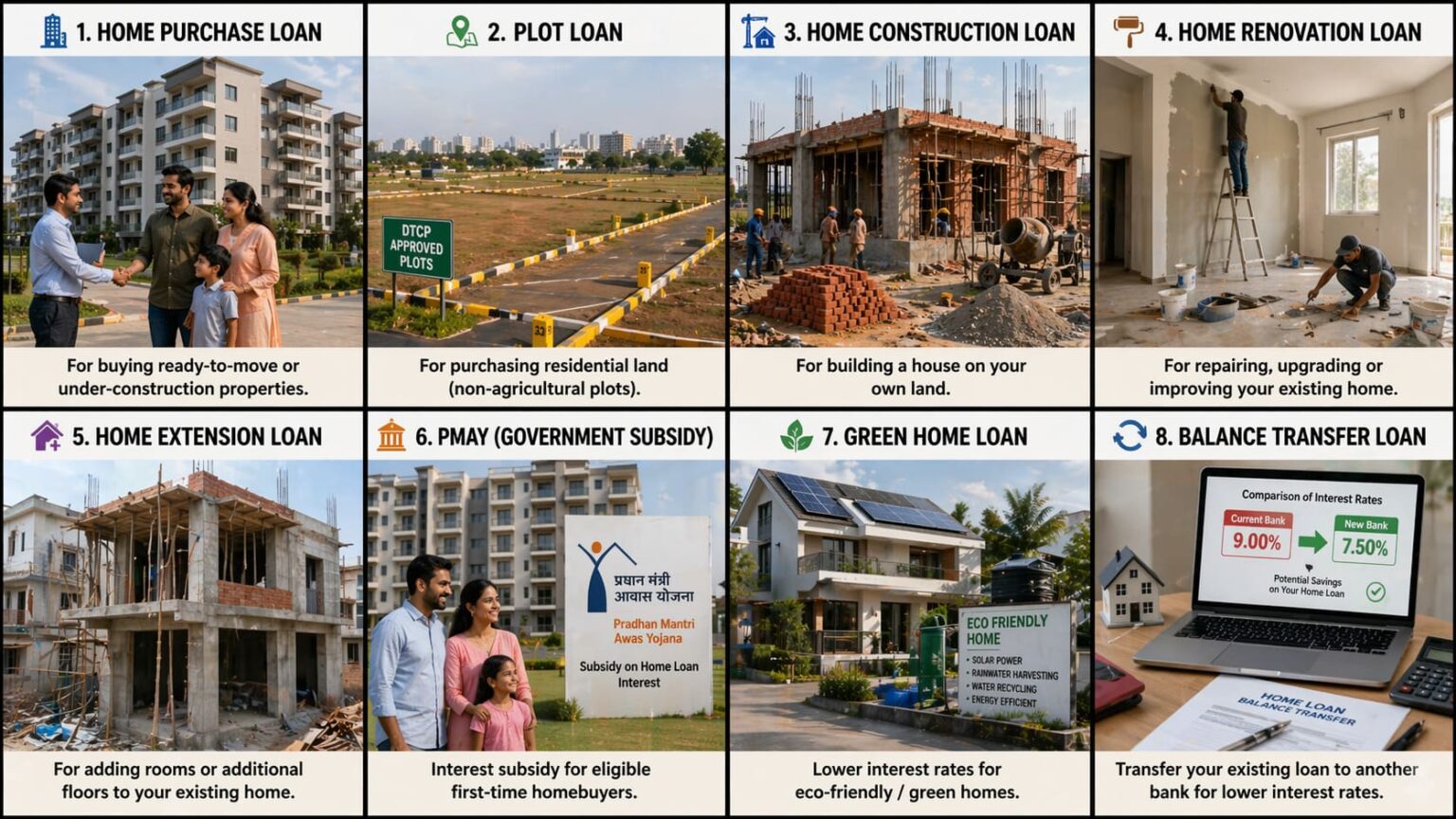
📌 Understanding Home Loan Types in India
Home loans in India are not one-size-fits-all. Banks and housing finance companies offer different loan types based on your purpose, income profile, and financial strategy.
Whether you’re buying a flat, constructing a house, renovating, or even earning without formal salary proof—there’s a loan designed for you.
🏗️ 1. Purpose-Based Home Loans (Based on What You Need)
🏢 Home Purchase Loan
- For buying ready-to-move or under-construction properties
- Covers up to 80–90% of property value
- Offered by banks like State Bank of India, HDFC Bank, and ICICI Bank
👉 Best for: Buying flats, villas, or resale properties
🌆 Plot Loan
- For purchasing residential land (non-agricultural)
- Construction usually required within 2–3 years
👉 Best for: Future home construction planning
🏗️ Home Construction Loan
- For building a house on your own land
- Funds released in stages based on construction progress
- Requires approved building plan
👉 Best for: Independent house construction
🔧 Home Renovation / Improvement Loan
- For repairs and upgrades like painting, flooring, plumbing
- Lower interest than personal loans
👉 Best for: Upgrading existing homes
🧱 Home Extension Loan
- For adding rooms or extra floors
- Bank checks structural feasibility
👉 Best for: Expanding your house as family grows
💰 2. Financial Strategy-Based Loans (To Save or Optimize)
🔄 Home Loan Balance Transfer
- Shift loan to another bank with lower interest
- Ideal if rate difference ≥ 0.5%
👉 Benefit: Lower EMI and total interest
➕ Top-Up Home Loan
- Additional loan on your existing home loan
- Lower interest than personal loans
👉 Use for: Education, business, emergencies
💡 Loan Against Property (LAP)
- Mortgage your existing property for a loan
- Can be used for any purpose
👉 Loan value: ~60–75% of property value
⚙️ Fixed, Floating & Hybrid Loans
- Fixed: Stable EMI
- Floating: Changes with RBI rates
- Hybrid: Mix of both
👉 Most borrowers today prefer floating + prepayment strategy
👤 3. Borrower-Specific Loan Types
👨👩👧 Joint Home Loan
- Taken with spouse or family members
- Increases eligibility + tax benefits
👉 Common in urban markets like Chennai
🌍 NRI Home Loan
- For Non-Resident Indians
- Requires NRE/NRO accounts for repayment
👉 Popular for investment in Indian real estate
👩 Women-Specific Home Loans
- Slightly lower interest rates
- Additional benefits in some cases
👉 Encourages property ownership in women’s name
🏡 Reach Home Loans (For Informal Income group)
- For individuals without salary slips or formal income proof
- Income assessed via cash flow, business activity, and field checks
👉 Best for:
- Self-employed
- Small traders
- Daily wage earners
👉 Key benefit:
- Expands home loan access to the unorganized sector
🌾 Rural Housing Loans
- For homes in villages and semi-urban areas
- Often supported by government schemes
👉 Important for Tier-2 and Tier-3 locations
🏛️ 4. Government & Special Scheme Loans
🏠 PMAY (Pradhan Mantri Awas Yojana)
- Government subsidy on interest
- Income eligibility: ₹3L–₹18L
- Savings up to ₹2.5 lakh
👉 Best for: First-time homebuyers
🌱 Green Home Loans
- For eco-friendly homes (solar, water recycling, etc.)
- Lower interest by ~0.05%–0.10%
👉 Best for: Sustainable housing buyers
⏳ 5. Special Situational Loans
🌉 Bridge Loan
- Short-term loan to buy new property before selling old one
- Duration: 6–24 months
👉 Helps manage timing gaps in property transactions
🧠 How to Choose the Right Loan
Instead of focusing on “which loan is best,” ask:
- What is your purpose? (buy, build, renovate)
- What is your income type? (salaried or informal)
- Do you need flexibility or cost savings?
📊 Simple Decision Guide
| Situation | Suitable Loan |
|---|---|
| Buying a flat | Home Purchase Loan |
| Buying land | Plot Loan |
| Building house | Construction Loan |
| Renovating home | Improvement Loan |
| Expanding home | Extension Loan |
| No income proof | Reach Loan |
| Reduce EMI | Balance Transfer |
| Need extra funds | Top-Up / LAP |
| First-time buyer | PMAY |
| Eco-friendly home | Green Loan |
⚡ Final Takeaway
Home loans in India are modular—they combine:
- Purpose
- Borrower profile
- Financial strategy
👉 The smartest borrowers don’t just pick a loan—they structure it to minimize interest and maximize flexibility.