

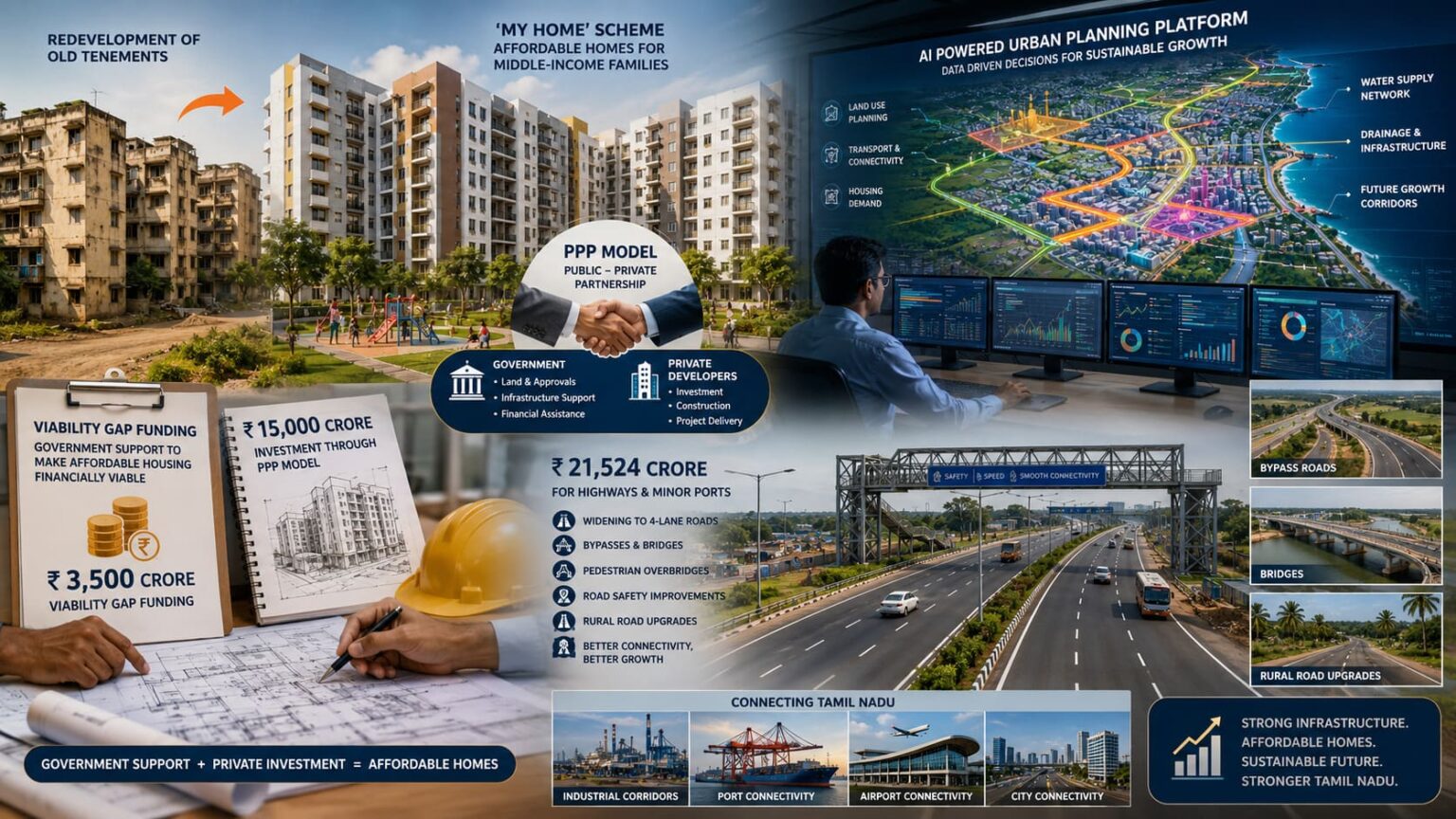
In the Tamil Nadu Budget 2025–26, presented in the State Assembly by Finance Minister Thangam Thennarasu under the leadership of Chief Minister M.K. Stalin, major investments have been announced in housing, roads and urban development.
The budget has been prepared with the goal of improving living conditions, strengthening infrastructure, and accelerating economic growth across cities and towns, which could in turn have a significant impact on property demand, land value appreciation, and overall real estate development across the State.
🏠 ‘My Home’ Scheme for Middle-Income Families
The government has announced the My Home scheme to construct affordable houses for middle-income families over the next seven years.
The scheme will involve:
- ₹15,000 crore investment through the Public–Private Partnership model
- ₹3,500 crore as 1Viability Gap Funding
- Participation from private developers
- Government financial support to keep projects commercially workable
Under the PPP model, private companies may build the houses, while the government may provide land, approvals, infrastructure or financial assistance.
The ₹3,500 crore VGF will help cover the financial gap when affordable selling prices are not enough to recover the full construction cost.
However, details such as project locations, house prices, eligibility conditions and application procedures are yet to be announced.
🏢 Redevelopment of Old Tenements
The government has also proposed redeveloping old and ageing tenements.
Tenements are low-cost housing flats generally built by the government for economically weaker families.
The redevelopment could replace unsafe buildings with better housing, roads, drainage and basic facilities.
🧠 AI-Powered Urban Development & Comprehensive Masterplan
A key emerging focus in Tamil Nadu’s urban strategy is the integration of AI-powered planning systems and a comprehensive masterplan approach for cities and towns.
The government is expected to increasingly use artificial intelligence and data-driven tools to analyse population growth, traffic patterns, land use, and infrastructure demand in real time. This can help in:
- Designing more efficient housing layouts
- Optimising road networks
- Identifying future growth corridors with greater accuracy
The comprehensive masterplan framework aims to ensure that key urban components are not planned in isolation but in a coordinated manner, such as:
- Housing
- Transport
- Water supply
- Drainage
- Commercial development
By combining AI-based insights with long-term urban planning, the State can potentially:
- Reduce congestion
- Improve livability
- Ensure better integration of new housing projects (like the “My Home” scheme) with employment hubs, transit systems, and essential services
Overall, this approach is expected to play a crucial role in shaping sustainable and future-ready cities across Tamil Nadu.
🛣️ ₹21,524 Crore for Highways and Minor Ports
The government has allocated ₹21,524 crore to the Highways and Minor Ports Department.
Of this, ₹9,300 crore has been earmarked under the Comprehensive Road Infrastructure Development Programme.
The proposed works include:
- Widening State highways into four-lane roads
- Constructing bypass roads
- Building bridges and pedestrian overbridges
- Improving road safety
- Upgrading panchayat and panchayat union roads
- Improving the overall quality of roads
Another ₹250 crore has been allocated to repair badly damaged roads through performance-based maintenance contracts.
🚧 Tamil Nadu’s Bigger Road Vision
Apart from the Budget allocation, Tamil Nadu has proposed a ₹1.37 lakh crore road development blueprint covering around 4,543 km, aimed at significantly upgrading the State’s road infrastructure and improving long-distance and regional connectivity.
In addition, the National Highways Authority of India (NHAI) is also planning an investment of nearly ₹1 lakh crore for about 2,500 km of national highways in the State, which will further strengthen key highway corridors and reduce travel time across major routes.
Together, these projects are expected to greatly enhance connectivity to airports, ports, industrial hubs, and major cities, thereby supporting trade, logistics efficiency, and overall economic growth in the region.
📈 What It Means for Real Estate
Better roads and housing projects can increase property demand in developing locations.
Areas near:
- New bypass roads
- Four-lane highways
- Industrial corridors
- Airports and ports
- Upcoming housing projects
may see more residential and commercial development.
However, property prices may not rise immediately. The real impact will depend on the final road alignments, project approvals, land acquisition and completion timelines.
🚀 Space-Tech District and ‘Arivagam’ AI City Announced
Tamil Nadu has proposed developing Thoothukudi and Tirunelveli as Space Technology Investment Districts, using the upcoming ISRO rocket launch facility at Kulasekarapattinam as the main growth centre.
The government will also establish a common technical facility with IN-SPACe to support space companies, startups and research institutions.
Alongside this, a dedicated AI Technology City called “Arivagam” has been announced to attract investment in artificial intelligence, deep-tech and quantum technologies.
- 🚀 Space-technology districts planned in Thoothukudi and Tirunelveli
- 🛰️ Common technical facility for space companies and startups
- 🤖 “Arivagam” AI Technology City proposed
- 🎓 AI university and international skill-development centre planned
- 💻 Semiconductor labs, incubators and residential facilities included
- 💰 ₹5 crore allocated for the project’s feasibility study
To Sum Up
Tamil Nadu’s Budget gives strong importance to affordable housing and road connectivity.
The My Home scheme, redevelopment of old housing colonies, AI-driven urban planning, and major highway investments could create new real estate opportunities across the State. But buyers and investors should wait for official project locations and detailed government guidelines before making decisions.
- Viability Gap Funding is government financial support given to make an important but otherwise unprofitable project commercially workable. ↩︎