

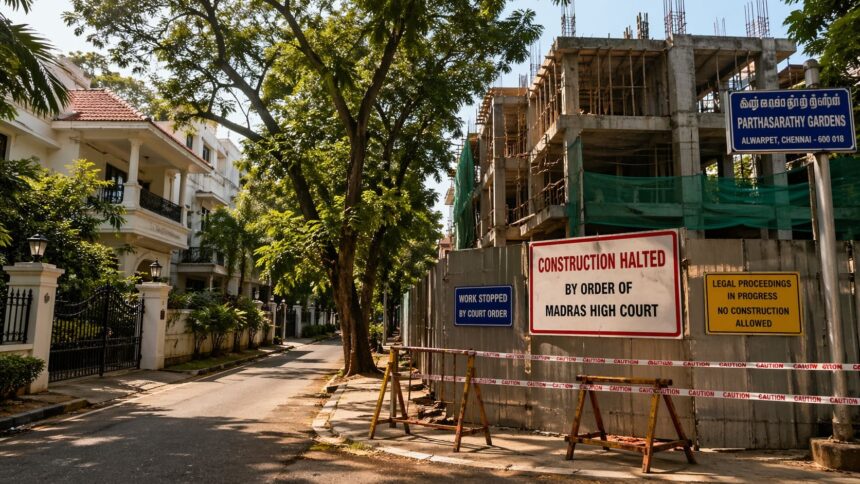
🏙️ The Case at a Glance
In a significant ruling, the Madras High Court refused permission for a multi-storey apartment project in Parthasarathy Gardens, Alwarpet (Chennai).
The dispute arose when planning permission was granted by CMDA to construct:
- A four-storey building
- Two apartments per floor
However, local residents challenged this approval—and the Court ruled in their favor.
🏗️ Background of the Property
- The layout was originally developed in 1968
- Developed by Menaka Parthasarathy
- Approved as a residential layout by Chennai Corporation
Key Layout Conditions (1968)
- Only one dwelling unit per plot
- Construction limited to two-thirds of the plot area
👉 These conditions formed the foundation of the locality’s planning identity
⚖️ What the Madras High Court Held
Justice V. Lakshminarayanan ruled:
Multi-storey apartments cannot be allowed
Unless the original layout conditions are legally modified
❌ CMDA’s Argument Rejected
CMDA argued that:
- The layout conditions were overridden by
Tamil Nadu Combined Development and Building Rules, 2019
Court’s response:
“This argument is nothing but a red herring.”
Meaning:
- New building rules do NOT cancel old layout conditions
- Both operate separately
🔒 Key Legal Principle Explained
Layout conditions are permanent unless changed properly
- Layout rules:
- Control density and land use
- Building rules:
- Control how construction is done
👉 One cannot override the other
📜 The Most Critical Legal Requirement (Section 54)
The Court emphasized that any change must follow:
👉 Section 54 of the
Tamil Nadu Town and Country Planning Act, 1971
This requires:
- Official proposal for modification
- Public notice
- Opportunity for objections
- Hearing affected residents
❌ What Went Wrong in This Case
CMDA:
- Did not follow Section 54
- Assumed new rules automatically apply
👉 This made the approval legally invalid
🌳 Environmental Concerns Raised
Residents argued:
- The layout has:
- Trees
- Green spaces
- Original intent was to maintain:
- Ecological balance
- Low-density living
Court’s stance:
- Accepted that layout planning is tied to environmental protection
⚖️ Final Judgment
- Planning permission granted to the developer → ❌ QUASHED
- However:
Court allowed future possibility:
- CMDA can approve again
- But only if it follows Section 54 properly
🏙️ Why This Case Matters in Chennai
In areas like:
- Alwarpet
- Mylapore
- RA Puram
There is increasing:
- Bungalow → Apartment redevelopment
👉 This judgment sends a clear message:
You cannot change neighbourhood character without legal process
🏗️ Practical Lessons for Developers
Before starting any redevelopment:
✔ Check original layout approval
✔ If restrictive → apply for modification
✔ Follow Section 54 process strictly
👉 Otherwise, even approved projects can fail in court
🧾 Critical Lessons for Property Buyers
Before buying an apartment in such areas:
✔ Ask for original layout approval copy
✔ Verify if layout modification was done legally
✔ Don’t rely only on:
- CMDA approval
- RERA registration
👉 Because this case proves:
Even legally approved projects can be cancelled later
💡 Strategic Takeaway
This judgment reinforces a powerful principle:
Planning permission is not enough—legal foundation matters more
And most importantly:
Skipping proper legal procedure is enough to stop a project entirely
🧠 Legal Terms Explained (Simple One-Line Meanings)
- Layout Condition – Rules fixed when land is first divided into plots
- Dwelling Unit – A single house or residential unit
- TNCDBR 2019 – Rules that control how buildings are constructed in Tamil Nadu
- Section 54 – Legal process to officially change layout rules with public involvement
- Quashed – Cancelled by the court
- Writ Petition – A case filed in High Court to challenge a government decision
- Red Herring – A misleading or irrelevant argument