


1. Introduction
The A-Register is a foundational land record maintained at the village or town level by the Tamil Nadu Revenue Department. While documents like Patta and Chitta change with ownership, the A-Register serves as a permanent government record of land parcels and their classification, often referenced during disputes, mutations, and verifications.
If you’re buying land or verifying inherited property, the A-Register is one of the key documents that shows the history and category of the land, even if ownership has changed hands multiple times.
2. What is the A-Register?
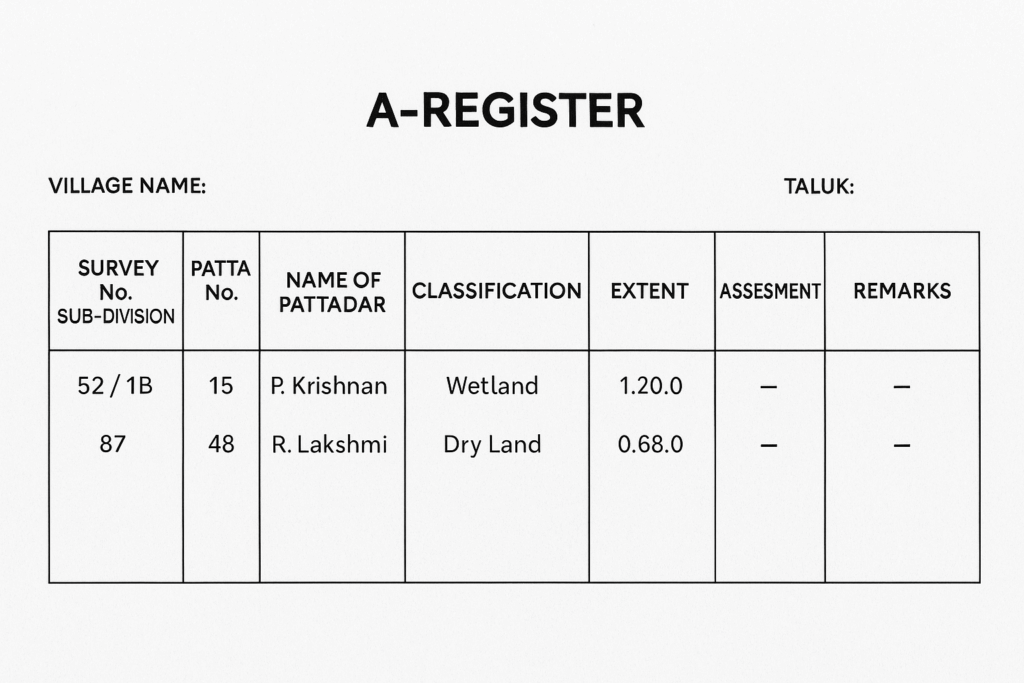
The A-Register (also called the Village Account No. 2) is a manual or digital register maintained at the Village Administrative Office or Taluk Office. It is part of Tamil Nadu’s revenue land records system and lists landholdings under specific survey numbers.
It does not show the current owner’s name like a Patta does. Instead, it maintains:
- Original recorded owner or pattadar
- Type of land (wet/dry)
- Classification (residential, agricultural, poramboke, etc.)
- Extent (area in hectares/acres)
- Tax assessment and usage
3. What does the A-Register Contain?
Here’s a breakdown of a typical A-Register entry:
| Field | Description |
|---|---|
| Village Name | Name of the revenue village |
| Survey Number/Sub-Division | The unique plot identification number |
| Patta Number | Patta linked at time of record entry |
| Name of Pattadar | Original landholder at time of first entry |
| Land Classification | Wetland, dry land, commercial, OSR, poramboke, etc. |
| Extent | Total land area in hectares or sq. ft. |
| Assessment | Government tax or cess applicable |
| Remarks Column | Mutation status, subdivisions, litigation notes (if any) |
4. Why is the A-Register Important?
While not considered a conclusive title document, the A-Register plays a crucial role in verifying land for:
- Property mutation and subdivision
- Verification of land classification (especially to check for poramboke or government land)
- Mapping for road projects and OSR lands
- Title chain examination before registration
- Legal dispute references and DRO verifications
It also helps distinguish between private patta lands and common lands, temple lands, or water bodies.
5. A-Register vs Patta vs Chitta
| Feature | A-Register | Patta | Chitta (pre-2015) |
|---|---|---|---|
| Shows Ownership? | No (shows historical pattadar) | Yes (current owner) | Yes (but now merged into Patta) |
| Land Classification? | Yes | No | Yes |
| Official Use | Revenue record | Title proof for owner | Obsolete in digital era |
| Where Stored | VAO / Taluk Office | Taluk Office / TN e-Services | Old village records |
| Used For Mutation? | Yes | Yes | Historical only |
6. How to View or Access the A-Register?
The A-Register is not always available online but can be accessed through:
- A visit to the Village Administrative Officer (VAO)
- Request at Taluk Office with property survey number
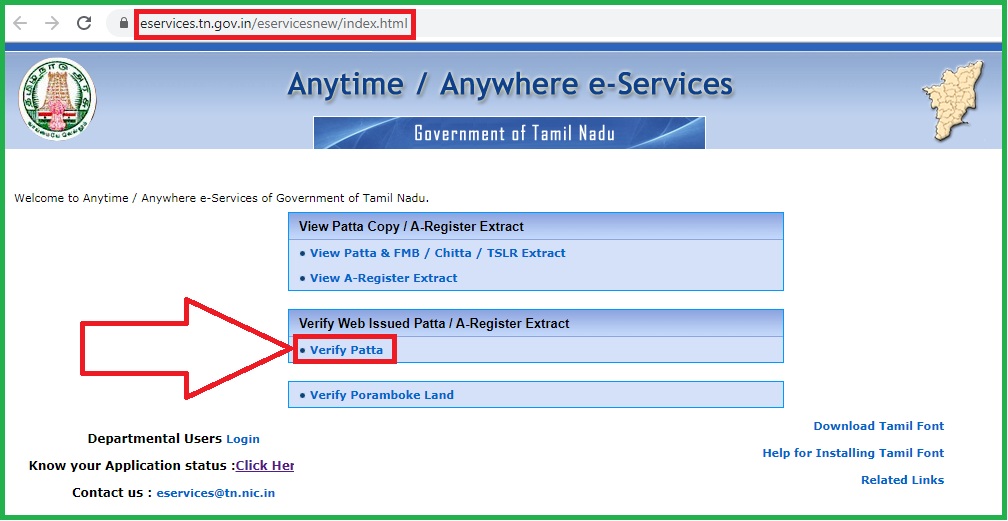
- Digitally through eservices.tn.gov.in, depending on the district
Step-by-step (if available online):
- Visit https://eservices.tn.gov.in
- Navigate to “Patta/Chitta/A-Register Extract”
- Select District, Taluk, Village
- Enter Survey Number/Sub-Division Number
- Submit with OTP for download
7. Can the A-Register be Tampered?
While A-Registers are considered official records, tampering can occur when:
- Mutation entries are not updated
- Village-level records aren’t digitized
- Layouts are approved on outdated classifications
Always match A-Register data with:
- Encumbrance Certificate (EC)
- Latest Sale Deed
- CMDA/DTCP layout approval
- Patta (if current)
Verified.RealEstate checks what sellers hide — we dig into the A-Register before you dig into your wallet.
8. Conclusion
The A-Register is the base layer in Tamil Nadu’s land verification stack. It holds key information on land type, extent, and classification that may not appear in a Patta or Sale Deed.
Before buying any land—especially plots claimed to be “converted residential”—always verify the A-Register extract at the source.
It may just save you from a multi-lakh rupee mistake.