

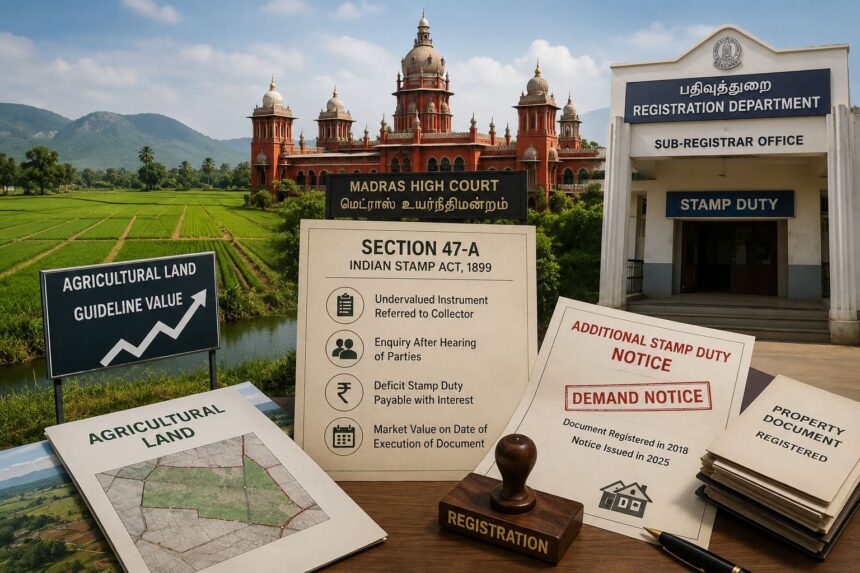
In a significant development for property owners and farmers across Tamil Nadu, the Madras High Court has reiterated that registration authorities cannot arbitrarily enhance the market value of a property years after a document has been registered and demand additional stamp duty without following the procedure prescribed under law.
The observations came in the backdrop of a case where a property document registered in 2018 was reportedly subjected to an additional stamp duty demand in 2025 on the ground that the property’s market value had been undervalued.
The court’s remarks have reignited discussions on the scope of Section 47-A of the Indian Stamp Act, 1899, and the powers of registration authorities in determining property values.
Farmers Challenge Arbitrary Increase in Guideline Values
The issue also stems from a petition filed before the Madurai Bench of the Madras High Court by:
- Abel Moorthy, President of the Abdul Kalam Scientific Farmers Protection Association; and
- Kasimayan, a resident of Thirumangalam in Madurai district.
The petitioners argued that farmers across Tamil Nadu are facing severe difficulties due to steep increases in the guideline value of agricultural lands.
According to the petition:
- Farming has become increasingly unviable.
- Many farmers are compelled to sell their agricultural lands to meet expenses such as children’s education, marriages and family obligations.
- The Registration Department has increased the guideline value of agricultural lands many times above the actual market value.
- As a result, prospective buyers are reluctant to purchase these properties, making it difficult for farmers to sell their lands.
The petitioners alleged that the arbitrary revision of guideline values by the Registration Department has adversely affected farmers and sought judicial intervention.
What Did the High Court Say?
During the hearing, the High Court reportedly referred to a case where:
- A document was registered in 2018.
- An additional stamp duty demand notice was issued in 2025.
- The District Registrar determined that the market value of the property was higher than the value adopted at the time of registration.
The court observed that the power to determine and revise market values vests with the competent statutory authorities and cannot be exercised arbitrarily by a District Registrar.
The judges reportedly noted that a registration authority cannot assume powers that are not conferred under the law and must strictly follow the statutory procedure.
Can a Registered Document Be Reopened Years Later?
All registered documents remain permanent public records and can be examined by authorities under certain circumstances.
However, the authorities cannot simply revisit an old registration and demand additional stamp duty because they now believe the property should have been valued higher.
The proper legal procedure under Section 47-A must be followed, and the determination of market value cannot be made arbitrarily.
Section 47-A of the Indian Stamp Act
Section 47-A of the Indian Stamp Act, as applicable in Tamil Nadu, deals with cases where the market value or consideration stated in a document is suspected to be undervalued.
The provision allows:
- The Registering Officer to refer a document to the Collector if there is reason to believe that the market value has not been truly set forth.
- The Collector to conduct an enquiry after hearing the parties and determine the correct market value and deficit stamp duty, if any.
- The authorities to examine certain documents to verify whether proper stamp duty has been paid.
Importantly, the law provides that the market value of a property must be determined based on the price the property would have fetched in the open market on the date of execution of the document.
Section 47 The following section shall be inserted, namely:–
INDIAN STAMP ACT, 1899 (TAMIL NADU AMENDMENT)
\
“47-A. Instruments of conveyance, etc., under-valued, how to be dealt with.–
\
(1) If the registering officer appointed under the Indian Registration Act, 1908 (Central Act XVI of 1908) while registering any instrument of conveyance, exchange or gift has reason to believe that the market value of the property which is the subject-matter of conveyance, exchange or gift has not been truly set forth in the instrument, he may after registering such instrument, refer the same to the Collector for determination of the market value of such property and the proper duty payable thereon.
\
(2) On receipt of a reference under sub-section (1) the Collector shall, after giving the parties a reasonable opportunity of being heard and after holding an enquiry in such manner as may be prescribed by rules made under this Act, determine the market value of the property which is the subject-matter of conveyance, exchange or gift and the duty as aforesaid. The difference, if any, in the amount of duty, shall be payable by the person liable to pay the duty.
\
(3) The Collector may suo motu, within two years from the data of registration of any instrument of conveyance, exchange or gift not already referred to him under sub-section (1) call for and examine the instrument for the purpose of satisfying himself as to the correctness of the market value of the property which is the subject-matter of conveyance, exchange or gift and the duty payable thereon and if after such examination, he has reason to believe that the market value of such property has not been truly set forth in the instrument, he may determine the market value of such property and the duty as aforesaid in accordance with the procedure provided for in sub-section (2). The difference, if any, in the amount of duty, shall be payable by the person liable to pay the duty:
\
Provided that nothing in this sub-section shall apply to any instrument registered before the date of the commencement of the Indian Stamp (Madras Amendment) Act, 1967.
\
(4) Any person aggrieved by an order of the Collector under sub-section (2) or sub-section (3) may appeal to the appellate authority specified in sub-section (5). All such appeals shall be preferred within such time, and shall be heard and disposed of in such manner, as may be prescribed by rules made under this Act.
\
(5) The appellate authority shall be–
\
(i) in the City of Madras, the Madras City Civil Court; and
\
(ii) elsewhere–
\
(a) the Subordinate Judge, or if there are more than one Subordinate Judge, the principal Subordinate Judge having jurisdiction over the area in which the property concerned is situated; or
\
(b) if there is no such Subordinate Judge, the District Judge having jurisdiction over the area aforesaid.
Explanation.–For the purpose of this Act, market value of any property shall be estimated to be the price which in the opinion of the Collector or the appellate authority, as the case may be, such property would have fetched or fetch, if sold in the open market on the date of execution of the instrument of conveyance, exchange or gift.”.]
Why Is This Judgment Important?
The observations of the High Court could provide significant relief to property owners and farmers because they reinforce several important principles:
- Property values cannot be revised retrospectively without following due process.
- Additional stamp duty demands cannot be made merely on a change of opinion.
- Market value has to be assessed as on the date of execution of the document.
- Registration authorities cannot unilaterally determine property values outside the framework prescribed under the law.
Impact on Farmers and Landowners
For thousands of farmers and landowners in Tamil Nadu, the issue goes beyond stamp duty.
Excessively high guideline values can:
- Reduce the number of potential buyers.
- Delay property transactions.
- Increase registration costs.
- Create financial hardship for families that need to sell land to meet urgent expenses.
The case has therefore reopened the debate on whether guideline values truly reflect market realities, particularly in rural and agricultural areas.
The Bigger Message
The proceedings before the Madras High Court serve as an important reminder that while the government has powers to prevent undervaluation and protect revenue, those powers must be exercised strictly in accordance with the law.
For property owners, the judgment highlights the importance of understanding their rights under Section 47-A and seeking legal remedies if additional demands are raised years after a document has already been registered.