

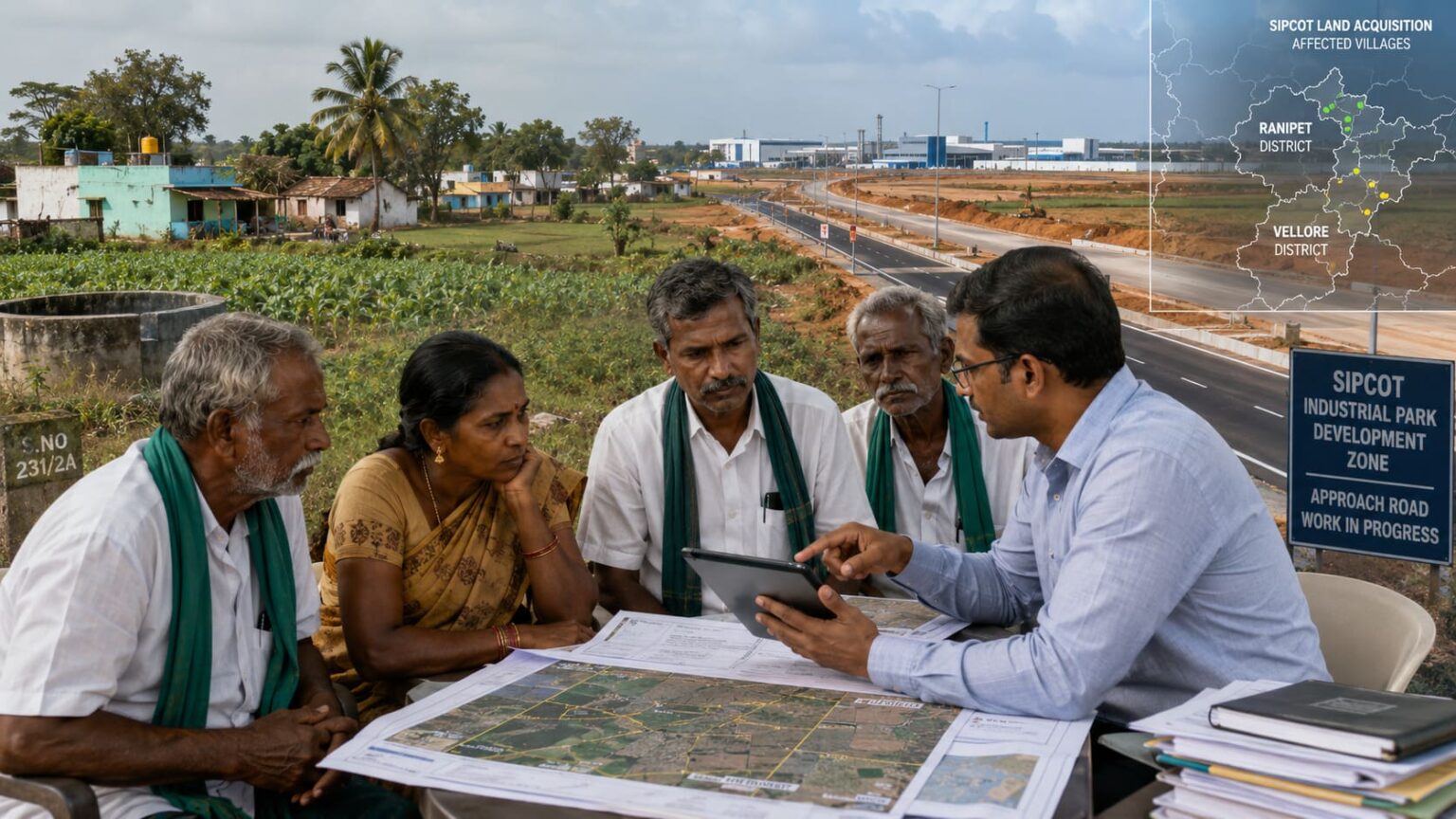
Tamil Nadu’s SIPCOT Expansion: What Has Happened?
The Tamil Nadu Government has issued formal land acquisition notifications for SIPCOT-related industrial projects in Ranipet and Vellore districts. These official notices were published in the Tamil Nadu Government Gazette Extraordinary in February 2026.
The key point is that these notices are not just about a future proposal. The official wording confirms that the listed lands are being acquired under Section 3(1) of the Tamil Nadu Acquisition of Lands for Industrial Purposes Act, 1997. This makes the process a formal land acquisition step for industrial purposes.
IPCOT’s Larger Industrial Expansion Plan
Tamil Nadu’s industrial growth is now moving into a wider expansion phase, with SIPCOT planning to create a 45,000-acre land bank over five years to meet the needs of future investors and entrepreneurs. This includes both upcoming and proposed industrial parks, with a special focus on industrially backward districts. Along with its existing 40 industrial parks, SIPCOT is also working on 21 new industrial parks across the State, covering a total extent of 21,404.11 acres. This shows why land acquisition, road access and industrial park development have become key parts of Tamil Nadu’s investment and employment strategy.
Why Is the Land Being Acquired?
The land is being acquired for SIPCOT industrial expansion and related road infrastructure.
In Ranipet, the acquisition is mainly connected to the formation of a new approach road to Panapakkam SIPCOT Industrial Park. Panapakkam is already an important industrial location because SIPCOT had earlier planned a large industrial park of about 1,200 acres, including a proposed Mega Leather Park of around 300 acres within that area.
SIPCOT’s official land details page also lists SIPCOT Industrial Park, Panapakkam under different categories, including MLFAC-SEZ, MLFAC, and General. This shows that Panapakkam is part of SIPCOT’s active industrial land framework.
Ranipet District: Areas Affected
In Ranipet district, the February 2026 official notifications relate to the new approach road to Panapakkam SIPCOT Industrial Park.
The affected taluk is Nemili Taluk.
| District | Taluk | Village | Extent Mentioned |
|---|---|---|---|
| Ranipet | Nemili | Reddivalam | 2.1211 hectares |
| Ranipet | Nemili | Veliyanallur | 5.1261 hectares |
| Ranipet | Nemili | Thenmambakkam | 5.4135 hectares |
Together, the official records show around 12.6607 hectares, or roughly 31.28 acres, being acquired for the approach road-related project.
Vellore District: Areas Affected
In Vellore district, the acquisition relates to SIPCOT Industrial Park and Approach Road, Magimandalam.
The affected taluk is Katpadi Taluk.
| District | Taluk | Village / Area | Extent Mentioned |
|---|---|---|---|
| Vellore | Katpadi | Magimandalam, Block 03 | 6.7950 hectares |
| Vellore | Katpadi | Magimandalam, Block 05 | 11.1450 hectares |
| Vellore | Katpadi | Magimandalam, Block 08 | 7.4250 hectares |
| Vellore | Katpadi | Vinnampalli / related schedule area | 2.2063 hectares |
The visible acquisition extent for the Vellore/Katpadi side is around 27.5713 hectares, or roughly 68.13 acres. The official schedule also includes references connected with Mutharasi Kuppam in the Vellore acquisition records.
What Types of Land and Assets Are Affected?
The acquisition records show that the affected land is not limited to empty or unused land. The listed properties include both dry land and wet land, along with several physical and agricultural assets.
The affected assets include:
Concrete houses, cement sheet houses, thatched sheds, borewells, square wells, pumpsets, drip irrigation systems, fish ponds, cattle sheds, fencing, pipelines, electric poles and electric service connections.
The records also list several trees and plantations, including teak, mango, coconut, neem, guava, sapota, lemon, tamarind and other trees.
This is why the issue has become sensitive for landowners and farmers. It is not only about the land value. It is also about houses, wells, irrigation systems, trees and livelihood-linked improvements.
Landowners affected by such acquisitions should carefully understand their legal rights, verify whether their land and assets have been correctly recorded, and seek clarity on compensation, objections, rehabilitation benefits and appeal options before accepting any acquisition-related decision.
Connection With Tata Motors and JLR Plant in Panapakkam
Panapakkam has also become important because of the Tata Motors and Jaguar Land Rover manufacturing facility.
In February 2026, reports stated that the Tamil Nadu Chief Minister inaugurated Tata Motors’ new passenger vehicle and JLR manufacturing plant at Panapakkam in Ranipet district. The project was reported as a ₹9,000 crore investment, with expected employment generation of around 5,000 jobs.
This shows why the Panapakkam SIPCOT area is being developed as a major industrial zone. However, the official acquisition notices discussed here are specifically about land required for SIPCOT industrial purposes and approach road formation.
Are Landowners and Farmers Opposing the Acquisition?
Yes, there is reported opposition, especially around the Magimandalam / Katpadi belt in Vellore district.
A news report dated 11 February 2026 said Naam Tamilar Katchi coordinator Seeman opposed the proposed SIPCOT industrial estate in the Mahimandalam region. The report said he criticised the government for moving to acquire farmland in Mahimandalam and neighbouring villages, including Mettupalayam, Thathireddipalli, Ammavarapalli and Balamathur, without proper consultation with affected farmers.
The main reasons for opposition are:
1. Loss of Agricultural Land
Farmers and local residents are concerned that fertile agricultural land may be converted into industrial land. Their concern is that once farmland is acquired, farming families may permanently lose their source of income.
2. Loss of Livelihood
Many affected lands contain wells, borewells, pumpsets, drip irrigation systems, trees and other agricultural assets. For farmers, these are not just property items. They are part of their working livelihood.
3. Fear of Displacement
The opposition is also linked to fear that families who depend on these lands may be pushed out or forced to move away from their traditional occupation.
4. Concern Over Consultation
Reports mention allegations that affected farmers were not properly consulted before the acquisition process moved forward. This is one of the main complaints in many land acquisition disputes.
5. Environmental and Pollution Concerns
The Vellore region already has public concern around industrial pollution, especially around leather and other industries. A January 2026 report said farmers in the Vellore region had raised concerns about Palar river pollution and called for action against nearby leather and other factories.
Because of this background, some farmers fear that new industrial development could affect water bodies, farmland, air quality and local ecology.
Is There Strong Protest Evidence in Ranipet?
For the Ranipet / Panapakkam approach road acquisition, official records clearly confirm acquisition in villages such as Reddivalam, Veliyanallur and Thenmambakkam.
So the factual position is:
Vellore / Magimandalam side: reported farmer and political opposition exists.
Ranipet / Panapakkam approach road side: official acquisition is confirmed, but strong organised protest evidence is not clearly available from the checked sources.
Rule on Acquisition of Multi-Crop Irrigated Land
Under Section 10 of the RFCTLARR Act, 2013, irrigated multi-crop land should generally not be acquired. It can be acquired only in exceptional circumstances, as a demonstrable last resort, and only within limits notified by the State Government. If such land is acquired, an equivalent area of culturable wasteland must be developed for agriculture, or an equivalent amount must be deposited for investment in agriculture to protect food security. Linear projects such as roads, railways, highways, canals and power lines are treated differently under the proviso to Section 10.
For Tamil Nadu, notified limits under Section 10 state that acquisition of irrigated multi-cropped land or agricultural land should not exceed 20% of the total extent of such land/agricultural land in the district or State, as applicable.
Compensation: What the Official Records Say
The official records state that compensation will be paid from funds controlled or managed by the Managing Director of SIPCOT.
However, the records do not explain the full compensation formula. For affected owners, the final compensation may depend on many details, including:
Survey number, subdivision number, land classification, actual extent acquired, market value, structures, houses, wells, borewells, trees, standing crops, irrigation systems and other improvements.
This is why landowners must check whether every asset on their land has been correctly recorded in the acquisition schedule.
Where Can Landowners Check the Details?
The official notices state that the land plans are available for inspection at the offices of the concerned Special District Revenue Officer (Land Acquisition) and Special Tahsildar (Land Acquisition).
For Ranipet, the relevant offices mentioned are the Special DRO (LA), Ranipet and Special Tahsildar (LA), Unit, Ranipet.
For Vellore, affected owners should check with the land acquisition offices handling the Magimandalam SIPCOT Industrial Park and Approach Road acquisition.
Landowners who are unsure how to access or verify these records can also seek assistance from Verified.RealEstate, which can help them obtain relevant land acquisition details, survey information, ownership records and asset-related entries from the concerned offices.
Why This Matters for Landowners
This acquisition is not just a normal infrastructure update. It affects land, houses, agricultural assets, water sources, trees and village livelihoods. At the same time, the government is pushing SIPCOT expansion as part of industrial growth, job creation and investment development.
The conflict is clear:
The government sees industrial expansion and road connectivity. Landowners and farmers see loss of land, livelihood, trees, water sources and long-term security.
Both sides cannot be understood only through one angle. The official records confirm the legal acquisition process. News reports confirm that some farmers and political voices are opposing the move, mainly because of agricultural livelihood and environmental concerns.
Conclusion
The February 2026 SIPCOT acquisition records confirm that lands in Ranipet and Vellore districts are being acquired for industrial parks and approach roads. The affected areas include Reddivalam, Veliyanallur and Thenmambakkam in Ranipet, and Magimandalam, Vinnampalli and related areas in Vellore.
While farmer opposition is more clearly reported around the Vellore side, affected landowners in all areas should verify their survey numbers, land extent, ownership details, structures, wells, trees and other assets before responding to the compensation process.
Abbreviations Used
SIPCOT – State Industries Promotion Corporation of Tamil Nadu, the government agency that develops industrial parks in Tamil Nadu.
JLR – Jaguar Land Rover, an automobile brand linked to the Tata Motors facility at Panapakkam.
MLFAC – Mega Leather Footwear and Accessories Cluster, an industrial cluster category linked to Panapakkam SIPCOT land use.
SEZ – Special Economic Zone, an area notified for specific industrial or export-oriented economic activity.
DRO (LA) – District Revenue Officer for Land Acquisition, the official authority handling land acquisition-related records and proceedings.