

SC Allows Unstamped Sale Agreement as Evidence
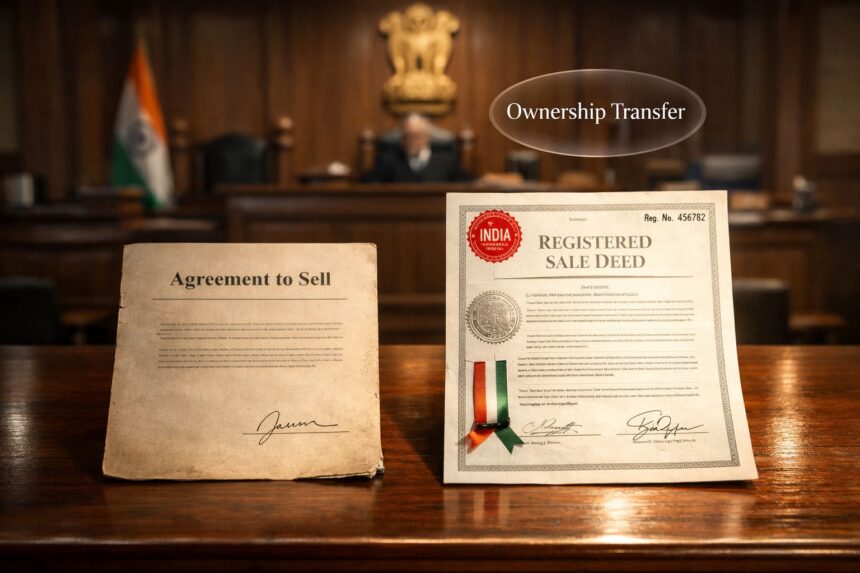
In a significant ruling strengthening clarity in Indian property law, the Supreme Court of India in Vayyaeti Srinivasarao v. Gaineedi Jagajyothi (2026) held that mere possession of immovable property does not amount to ownership without a registered sale deed, even if substantial consideration has been paid.
The Court also ruled that a sale agreement executed between a tenant and landlady could be admitted in evidence, setting aside contrary findings of the Trial Court and the Andhra Pradesh High Court.
This judgment settles important questions concerning:
- Agreement to sell vs registered sale deed
- Stamp duty implications under the Andhra Pradesh Stamp Act
- Whether long possession converts into ownership
- Applicability of deemed conveyance provisions
Case Background: Tenant Paid ₹6.5 Lakh for Property
The dispute arose in Rajahmundry Rural, Andhra Pradesh.
- The appellant, Vayyaeti Srinivasarao, had been a tenant in the property for nearly 50 years.
- On 14 October 2009, he entered into an agreement to purchase the property from the landlady, Gaineedi Jagajyothi, for ₹9 lakh.
- He paid ₹6.5 lakh upfront and agreed to pay ₹2.5 lakh upon execution of the registered sale deed.
- Despite repeated requests, the sale deed was never executed.
- The tenant filed a suit for specific performance.
However, complications arose when the landlady objected to the admissibility of the sale agreement.
Trial Court and High Court View: Stamp Duty and Deemed Conveyance
The Trial Court held that the agreement to sell was insufficiently stamped. It directed payment of stamp duty and penalty, treating the document as a “deemed conveyance” under Article 47-A of Schedule I-A of the Andhra Pradesh Stamp Act.
The Andhra Pradesh High Court upheld this order. It relied heavily on the precedent set in B. Ratnamala v. G. Rudramma (1999), where the High Court had ruled:
- If a sale agreement is followed by delivery of possession, or
- If it evidences delivery of possession,
then it is chargeable with stamp duty as if it were a sale deed.
The Trial Court accepted the objection and ordered the appellant to pay the required stamp duty along with a penalty. The High Court affirmed this decision, which held that delivery of possession can occur at the same time as, or even before, the agreement—so long as it is closely connected to the transaction.
Supreme Court’s Analysis: Key Legal Distinctions
The Supreme Court reversed the High Court’s reasoning and made critical distinctions.
1. Possession Must Flow From the Sale Agreement
The Court clarified that the deeming provision under Article 47-A applies only where possession is delivered pursuant to the agreement itself.
In this case:
- The tenant’s possession predated the agreement.
- Possession arose from tenancy, not from the sale agreement.
- There was no surrender of tenancy nor transformation of the legal relationship into vendor-vendee.
Therefore, the agreement did not amount to a deemed conveyance.
2. Agreement to Sell Does Not Transfer Ownership
Reaffirming Section 54 of the Transfer of Property Act, 1882, the Court held:
- An agreement to sell does not create title.
- It only creates a contractual right to seek specific performance.
- Ownership in immovable property transfers only through a registered sale deed.
Even payment of substantial consideration and long possession do not substitute statutory requirements of registration.
3. Stamp Law Cannot Override Substantive Property Law
The Supreme Court emphasized that:
Stamp duty is only about collecting government tax; it does not decide who owns the property. Since the tenant’s possession did not come from the sale agreement, the document did not automatically need higher stamp duty like a sale deed.
Why the Precedent in B. Ratnamala Did Not Apply
In B. Ratnamala v. G. Rudramma, the agreement itself recited that possession had been delivered as per the agreement.
The case scenario was different.
The Supreme Court explained the difference between express surrender and implied surrender under Section 111 of the Transfer of Property Act.
- Express surrender happens when the tenant and landlord mutually agree that the tenant is giving up the lease.
- Implied surrender happens automatically by law, usually when a new legal relationship replaces the old one or when possession is given up.
- Implied surrender can occur even if the parties did not clearly intend it.
The Court made it clear that simply signing an agreement to sell does not end the tenancy.
An agreement to sell does not give ownership rights in the property.
Ownership transfers only through a properly executed and registered sale deed.
In the present case:
- Possession existed long before the agreement.
- There was no delivery of possession in as part of the agreement
- Hence, Article 47-A’s Explanation could not be invoked.
The Supreme Court effectively distinguished Ratnamala rather than overruling it.
Broader Legal Implications of the Judgment
This ruling is highly relevant for:
Tenants Entering Purchase Agreements
Tenancy possession does not automatically convert into ownership. A registered sale deed is mandatory.
Buyers Relying on Agreements to Sell
Make sure the property is clearly handed over as part of the agreement if you want stamp law protection to apply.
Property Litigation
Courts must examine the source of possession before applying deemed conveyance clauses.
Stamp Duty Disputes
The government cannot automatically treat every agreement where someone has possession as a completed sale.
Core Legal Principles Reaffirmed
- You legally own a property only after a registered sale deed is signed.
- An agreement to sell only gives you the right to demand the sale, not ownership.
- Possession must be directly linked to the sale agreement for deemed conveyance provisions to apply.
- Tax laws cannot change who actually owns the property.
Conclusion
The Supreme Court’s decision reinforces the foundational doctrine of Indian property law:
Possession is not ownership.
Without a registered sale deed, no transfer of title occurs — regardless of payment amount, duration of occupation, or contractual intention.
The judgment provides much-needed clarity in disputes where tenants seek ownership rights based on agreements to sell and longstanding possession.
This ruling will likely influence future cases involving stamp duty objections, specific performance suits, and property transfer litigation across India.
Legal Terms and Sections Explained
Article 47-A of Schedule I-A of the Andhra Pradesh Stamp Act – If a sale agreement also gives the buyer possession of the property, it must be stamped and charged like a full sale deed for stamp duty purposes.
Section 54 of the Transfer of Property Act, 1882 -You do not become the legal owner of a property just by signing an agreement — ownership transfers only when a registered sale deed is executed.
Section 111 of the Transfer of Property Act – It explains the different ways a lease or tenancy can legally come to an end.
Deemed conveyance – A deemed conveyance means the law treats an agreement like a completed sale, even if a formal sale deed has not been signed.
Substantive property law means the actual legal rules that decide who truly owns a property and what rights they have over it.