

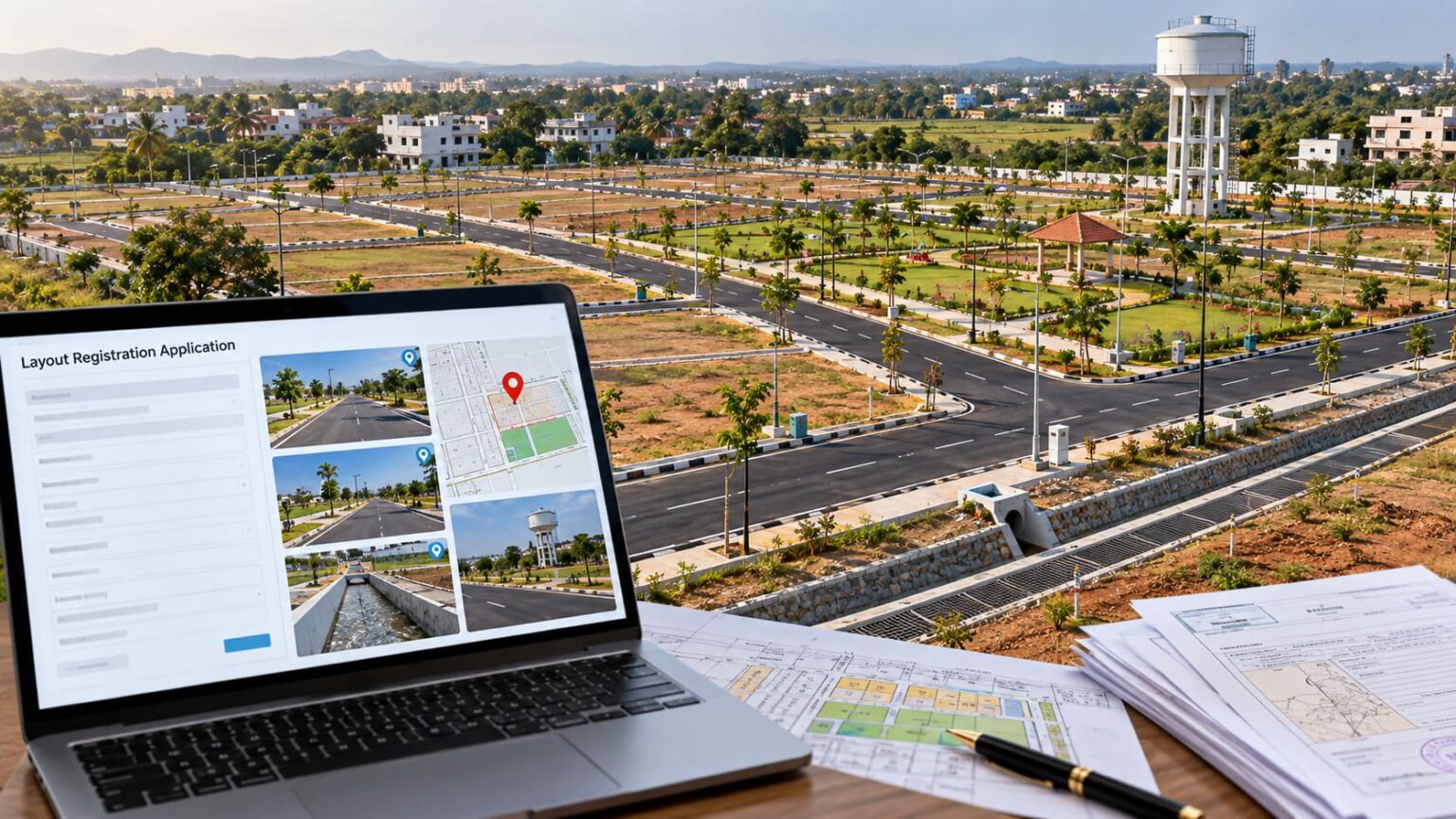
The Tamil Nadu Real Estate Regulatory Authority (TNRERA) is tightening scrutiny of layout-registration applications, with greater emphasis on matching land records, approved plans and actual on-ground infrastructure.
The move is significant for plot buyers because a layout may have planning approval on paper, while questions can still arise over the actual availability of roads, storm-water drains and other infrastructure.
TNRERA has also directed developers to submit geo-tagged photographs of completed infrastructure and ensure that applications contain complete and consistent land and approval documents. Recent data shows that between January 1 and September 15, 2026, TNRERA received 5,423 project-registration applications, of which 3,251 were registered and 1,199 were returned for incomplete documents.
Why is TNRERA tightening the scrutiny?
The focus appears to be on closing the gap between what is approved and what actually exists at the site.
For layout projects, this means greater scrutiny of:
- Land extent and revenue records
- Planning approvals
- Internal roads
- Storm-water drains
- Water and other required infrastructure
- Geo-tagged photographs showing completed works
This approach is also consistent with TNRERA’s recent move towards stronger physical verification and completion monitoring. In June 2026, the Authority introduced specific completion-intimation procedures for building and layout projects, requiring supporting technical records and photographs.
Three cases that underline why the new scrutiny matters
The following developments illustrate the very problems that the new scrutiny is intended to address. Such cases as given here, has led to TNRERA giving out such orders to protect the buyers.
1. Meera Nagar layout – infrastructure on paper versus at site
In July 2026, an RTI-based report raised questions over a 33-plot Meera Nagar layout in Mannivakkam. While one official response stated that roads and storm-water drains had been completed, another complaint response questioned the presence of the required storm-water drains at the site.
This directly underlines why TNRERA is now seeking photographic and geo-tagged evidence of completed infrastructure.
2. Public roads being blocked in approved layouts
In May 2025, TNRERA acted against developers who erected compound walls or gates blocking public roads within layouts. The Authority required such obstructions to be removed and photographic proof of compliance to be submitted.
This showed that even after a layout receives approval, its actual development can affect public access and planned connectivity.
3. Haja Najumudeen case – layouts are covered by RERA
In M.K. Haja Najumudeen v. TNRERA, the Madras High Court held in 2023 that developing land into plots for sale to third parties falls within the definition of a real estate project under RERA. The Court also made it clear that obtaining planning approval does not by itself remove the project from RERA requirements.
This established TNRERA’s regulatory role over plotted developments and provides the legal foundation for closer scrutiny of such projects.
What these developments tell us
Taken together, these cases show why planning approval alone may not be enough to establish that a plotted project is ready for registration and sale.
The regulatory focus is increasingly moving towards:
Approved plan → actual infrastructure → documentary proof → RERA registration
For plot buyers, this provides another reason to check not only whether a layout has planning approval, but also whether its RERA registration, land records and physical infrastructure are consistent.
For developers, it means greater importance must be given to completing the required infrastructure and maintaining accurate documentation before submitting a layout for RERA registration.