
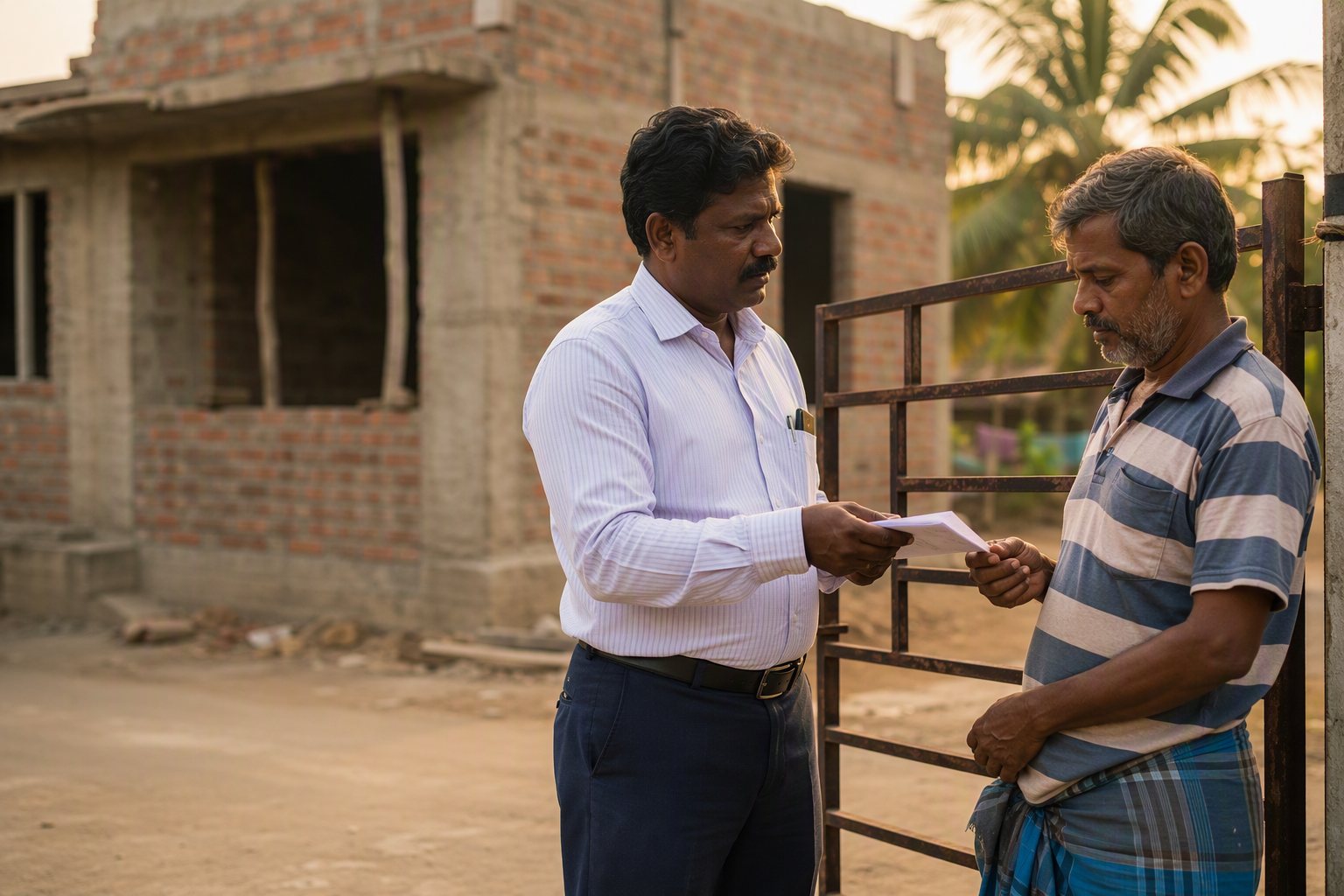

In Tamil Nadu, buying or owning land that carries a B-Memo can be risky. The term appears in revenue department records and often confuses buyers. Understanding what a B-Memo means, why it is issued, and how to resolve it is essential to ensure a safe property transaction.
What is a B-Memo?
A B-Memo (short for “B Memo Notice”) is an official record issued by the Revenue Department indicating that the land is classified as government land under encroachment. It is not a title document, but a warning that the current occupant does not have legal ownership rights over the land.
It functions much like a penalty record, tracking and managing unauthorized occupation of government property. Paying B-Memo charges does not transfer ownership; it simply acknowledges encroachment for that period.
Detailed Explanation
Unauthorized Occupation
A B-Memo is issued when someone is found to be occupying government land without proper authorization.
Penalty Assessment
The memo signifies that the individual is subject to penalties or “B-Memo charges” for occupying the land.
Regulation by Panchayats
In many rural areas, the use of such land is regulated by the Village Panchayat, in coordination with revenue officials.
Legal Implications
In some cases, a B-Memo can become a factor in legal disputes involving land ownership or possession. Even if penalties are paid for years, the government retains the right to evict or reclaim the land.
Importance in Tamil Nadu Real Estate
In Chennai and across Tamil Nadu, some lands under B-Memo classification are ineligible for sale or registration, and transactions involving them can be challenged in court. For homebuyers, a B-Memo entry is a major red flag indicating potential eviction risks.
Why is B-Memo Issued?
Common reasons include:
- Occupying government poramboke land (e.g., water bodies, road margins).
- Unauthorized construction on public property.
- Using reserved land without government approval.
Step-by-Step Process to Check B-Memo Status
- Obtain a Copy of the ‘A’ Register from the VAO/Taluk office.
- Check Land Classification – If listed as “poramboke” or similar, it may have B-Memo status.
- Request B-Memo Details from the Revenue Inspector or VAO.
- Verify via Encumbrance Certificate (EC) to ensure no conflicting entries.
- Use a Patta Analyzer Tool to cross-check property legality.
Regulations & Local Rules (Tamil Nadu-Specific)
- Under the Tamil Nadu Land Encroachment Act, the government can issue a B-Memo and recover the land without compensation.
- Paying B-Memo penalties does not grant ownership; it only acknowledges encroachment for that period.
- Conversion to patta is possible only if the government decides to reclassify and assign the land through official orders.
Common Mistakes & How to Avoid Them
- Mistake: Assuming B-Memo land can be regularized anytime.
Solution: Check with Revenue Department for current policies. - Mistake: Buying land with only possession proof.
Solution: Insist on patta and clear title documents. - Mistake: Believing penalty receipts are ownership proof.
Solution: Get legal verification before purchase.
Practical Tips
- Always conduct a revenue record search before buying.
- Use Verified.RealEstate tools to detect B-Memo issues early.
- Seek legal clearance certificates for disputed lands.
Conclusion
A B-Memo is not just a harmless note — it’s an official record of unauthorized occupation with legal consequences. Whether you are a buyer or seller, always verify land status and resolve any B-Memo issues before proceeding with a deal.