

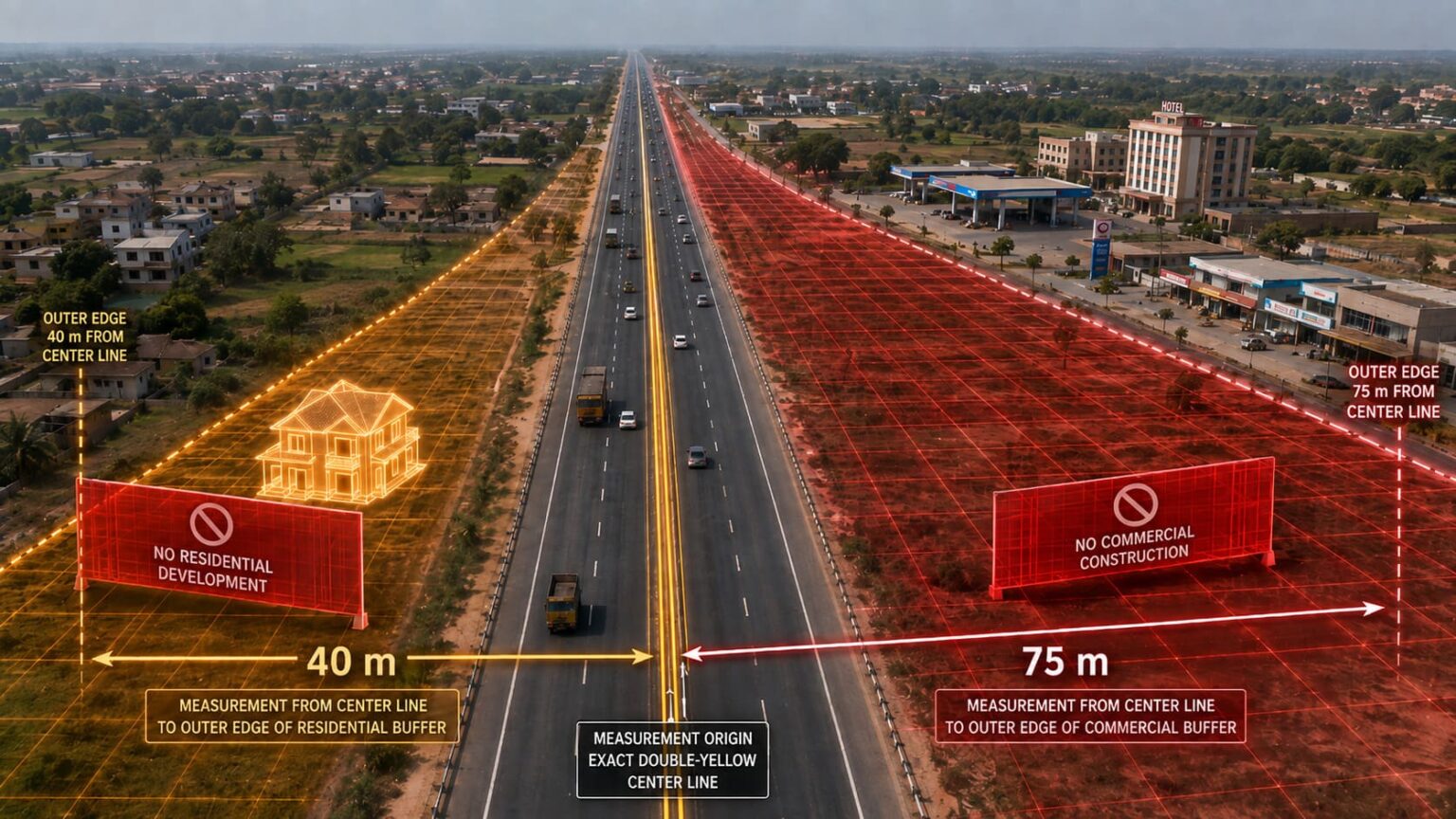
he Supreme Court of India issued a landmark verdict imposing strict nationwide restrictions on Change of Land Use (CLU) and unauthorized construction along National Highways. Aimed at reducing fatal accidents and curbing unplanned commercial growth, the directives mandate strict non-conversion buffer zones along major road corridors across the country.
The directions were issued on April 13, 2026, in In Re: Phalodi Accident v. National Highways Authority of India, Suo Moto Writ Petition (Civil) No. 9 of 2025, reported as 2026 INSC 388. The Bench consisted of Justices J.K. Maheshwari and Atul S. Chandurkar.
Mandatory Highway Distance Restrictions
The order sets strict non-conversion buffer bands measured directly from the centre line (mid-point) of any National Highway:
| Conversion / Land Use Type | Setback Distance Limit | Legal Constraint |
| Residential Housing | 40 metres from centre line | Prohibits residential housing layouts, housing conversions, and building map sanctions. |
| Commercial Construction | 75 metres from centre line | Prohibits commercial structures including shops, hotels, petrol pumps, showrooms, and warehouses. |
| Permanent Concrete Work | Strictly forbidden inside buffer | Unauthorized permanent boundary walls or concrete structures face eviction and demolition. |
Legal & Regulatory Reality
- 100% Rejection of CLU / Building Sanction: Revenue authorities and municipal planners will outright reject any application for Change of Land Use (CLU/DC Conversion) or building map approval.
- Prohibition on Permanent Structures: You cannot legally construct houses, shops, showrooms, hotels like Dhabas, or boundary-walled commercial buildings anywhere on the plot.
- No Unsanctioned Construction: Building without permission will lead to eviction and demolition by NHAI/PWD without any compensation for the demolished structure.
60-Day Removal Deadline
- District Magistrates and local authorities were ordered to clear all unauthorized dhabas, eateries, shops, and commercial encroachments within the Right of Way (RoW) of National Highways within 60 days..
Property Ownership and Land Valuation Impact
Does Land Value Drop to Zero?
No. The order limits new intensive building construction near the road, but it does not cancel land titles, confiscate property, or reduce land value to zero.
- Continued Farming Rights: Landowners retain legal title and can continue agricultural activities, cultivation, and farming without restriction.
- Compensated Government Acquisition: If the government or NHAI ever acquires this buffer land for road-widening, they are legally required under the RFCTLARR Act, 2013 to pay full market value plus a 100% solatium (bonus) and interest.
- Large Land Parcels: For deep plots, the frontage serves as a setback (for green space or parking), while main commercial buildings can be built behind the 75-metre mark.
Challenges for Small Plots Inside the 75m Line
If a small plot sits completely within the restricted buffer band, it has zero buildable depth:
- Automated CLU Rejections: Revenue officers and town planning boards will reject Change of Land Use applications and building plan maps.
- Permitted Open-Air Uses: Plots can still be used for farming, plant nurseries, or open storage where no concrete foundations are laid.
- Legal Remedies: Affected owners can file a Writ Petition in the High Court under Article 226 asking authorities to formally acquire the plot under “regulatory taking” principles or grant site-specific access relief.
Nationwide NHAI Action and Removal Drive (July 2026 Update)
Following the apex court’s ruling, the National Highways Authority of India (NHAI) conducted extensive field operations to clear hazards.
Key Outcomes of the Drive
- Corridor Survey: NHAI surveyed over 693 km of national highways.
- Legal Notices Served: Issued 1,403 formal notices against illegal commercial extensions, unauthorized shops, and unapproved median openings.
- Encroachments Removed: Demolished and cleared 361 illegal access points and roadside obstructions in coordination with local District Magistrates and Superintendents of Police.
- Median Cuts Closed: Permanently sealed 150 unauthorized median gaps used for informal crossings to prevent high-speed collisions.
State-Wise Implementation
- Rajasthan: High Court and revenue task forces issued direct orders to clear commercial structures inside the 75-metre line.
- Karnataka: Updated the Kaveri and Seva Sindhu portals to automatically flag and reject non-compliant DC-conversion applications.
- Haryana, Punjab, Maharashtra, & Uttar Pradesh: Local Town and Country Planning departments froze commercial licenses along major highways unless accompanied by NHAI safety clearance.
Hill-State Conflict: Demands for Exemption in Himachal Pradesh
While the 40m/75m buffer rules are straightforward on flat plains, they have triggered strong resistance in mountainous regions.
Activists, local residents, and organizations like the Bhumi Prabhavit Sangh in Himachal Pradesh (Kullu, Mandi, Bilaspur) are urging the state government to file an urgent review petition in the Supreme Court.
- Geographical Impossibility: Steep cliffs and gorges make 40m/75m setbacks physically impossible on mountain terrain.
- Economic Threat: Enforcing large buffers destroys roadside homestays, dhabas, and local trade.
- Demand for Hill Norms: Stakeholders urge the Supreme Court to allow realistic 3-to-5-metre setbacks in steep valleys.
Tamil Nadu Highway Belts Likely to Face Strict Enforcement
If strict anti-encroachment rules are fully enforced across Tamil Nadu, major transport and industrial belts will face heavy scrutiny:
- Chennai–Bengaluru Highway (NH-48): Sriperumbudur, Kanchipuram, Ranipet, Vellore, and Ambur. High roadside commercialization and encroached service lanes make this a prime demolition target.
- Chennai–Tiruchi–Madurai Highway (NH-45 / GST Road): Tambaram, Vandalur, Guduvanchery, Chengalpattu, Tindivanam, and Villupuram. Suburban fringes with dense commercial setups and residential layouts face significant risk.
- Salem–Coimbatore–Kochi Highway (NH-544): Salem, Sankagiri, Erode, Perundurai, Avinashi, and Coimbatore. A major freight corridor heavily lined with textile units, auto workshops, and dhabas.
- Madurai–Tirunelveli–Kanyakumari Corridor (NH-44): Southern high-speed transit stretch with numerous unapproved access points and illegal median cuts.
- East Coast Road (ECR) & OMR Outskirts: Mahabalipuram to Puducherry. Coastal tourist hubs, resorts, and venues violating buffer lines face access audits.
- Urban Bypasses & Ring Roads: Bypasses around Chennai (ORR), Coimbatore, and Trichy where unapproved developments front direct highway access routes.
Key Due Diligence Steps
The major due diligence steps that Highway Property Owners, Buyers, and Developers must take are
- Conduct Official Land Surveys: Do not rely on sale deeds or online maps. Hire a licensed surveyor to measure the exact setback distance from the centerline (midpoint) of the highway carriageway, not from the edge of the asphalt.
- Check Spatial & Layout Limits: Verify if the survey number falls inside the 40-metre (residential) or 75-metre (commercial) non-conversion buffer line to ensure sufficient buildable depth.
- Verify Right of Way (RoW) & Zoning: Confirm the official RoW, control lines, and latest state notifications to ensure the land permits your proposed development.
- Secure Required Clearances: Obtain an official No Objection Certificate (NOC) from the NHAI or State PWD alongside local town planning approvals before executing land conversions (CLU) or starting construction
Verifying Property Boundaries via Professional Land Survey
To confirm whether a land parcel falls inside or outside the Supreme Court’s mandated 40m (residential) and 75m (commercial) highway buffer limits, property owners can utilize professional land surveying solutions—such as those offered by Verified.RealEstate.
Through these legally valid, government-compliant survey reports the landowners to adjust building layouts. Verified RealEstate also assists in applying for required NHAI Access NOCs, or resolve Change of Land Use (CLU) compliance before investing in unapprovable construction.