

Tamil Nadu Announces Survey-Number-Wise Guideline Value Update
Tamil Nadu is set to assign market guideline values to every land survey number across the State by the end of June 2026, marking an important update in the State’s land registration and property valuation system.
The direction was issued by Tamil Nadu Commercial Taxes and Registration Minister T. Logesh Tamilselvan during the first performance review meeting of senior Registration Department officials.
According to reports, the Minister instructed officials to ensure that guideline values for all land survey numbers in Tamil Nadu are ready by the end of June. He also directed officials to improve public service at registration offices, return registered documents without unnecessary delay, avoid keeping documents pending for avoidable reasons, and complete scrutiny of documents, including building approval-related documents, faster.
This announcement is important because guideline value directly affects property registration, stamp duty, registration charges, land valuation, and the way buyers and sellers calculate the cost of a property transaction.
How Guideline Value Is Currently Assigned
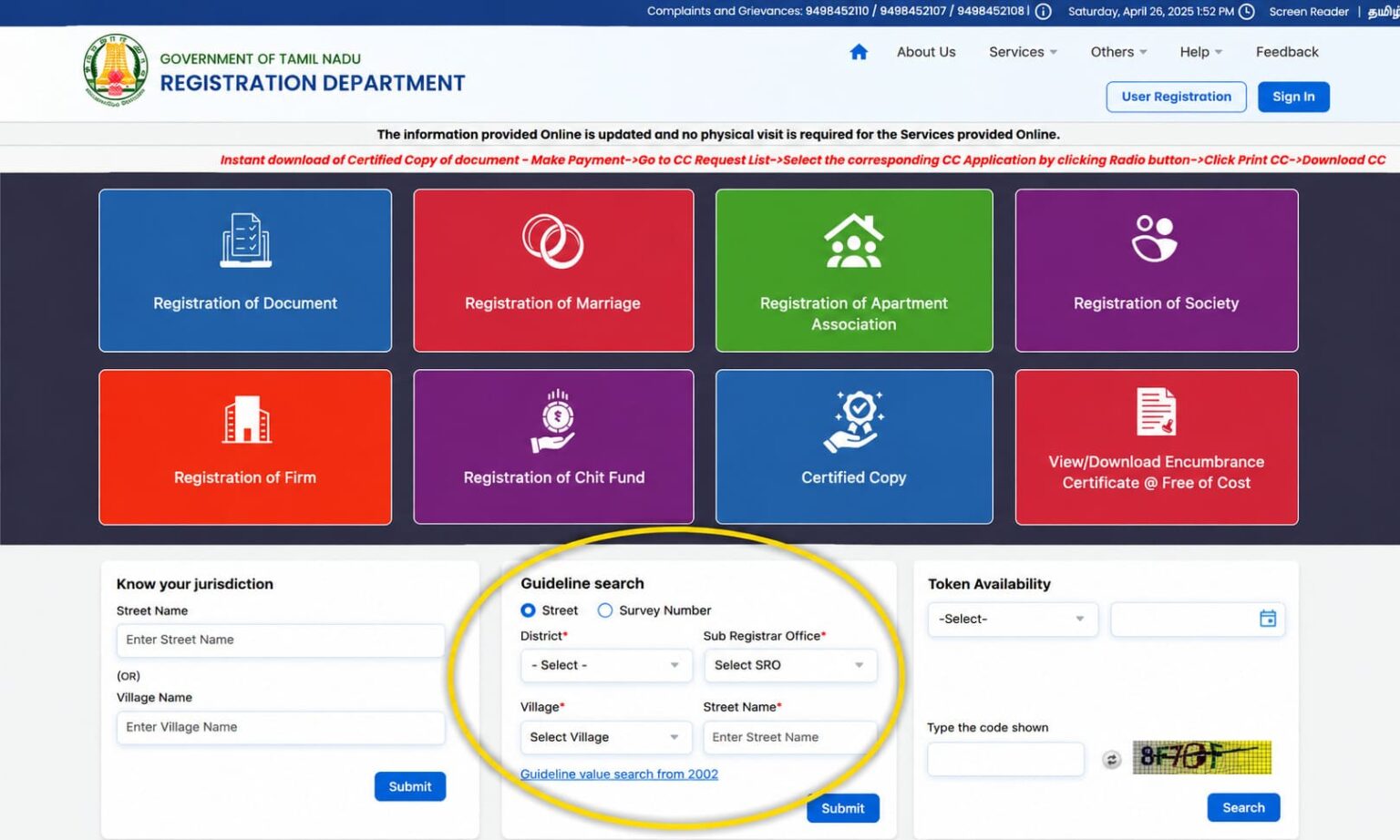
At present, guideline value in Tamil Nadu is largely assigned based on the Sub-Registrar Office jurisdiction, registration village, street name or locality, and property classification such as residential, commercial, agricultural or industrial use. In many urban areas, buyers usually search guideline value by selecting the zone, SRO, village and street name.
Why This Guideline Value Review Is Much Needed Now
1. To Assign Values for Every Survey Number
The main aim of the 2026 review is to ensure that every land survey number in Tamil Nadu has a clear guideline value. This will help buyers, sellers and registration officials identify the correct value for each land parcel without confusion.
2. To Fill Valuation Gaps
For rural lands, agricultural lands and some subdivided properties, survey-number-based values may be available, but they may not be uniformly mapped for every land parcel. This review is expected to fill those gaps and make the registration process smoother.
3. To Bring Uniformity in Property Valuation
The government is also trying to bring more uniformity and transparency in land valuation. When similar properties are valued differently without a clear basis, it can create disputes and delays. A survey-number-wise valuation system can help bring more consistency across different areas and Sub-Registrar Offices.
4. To Reflect Current Market Conditions
Land values have changed in many parts of Tamil Nadu due to urban growth, road projects, infrastructure development and new layouts. When there is a wide gap between the market price and the official guideline value, it can affect stamp duty collection and encourage undervaluation in property documents. So, Updating guideline values can help the official value reflect the current property scenario better.
5. To Include Apartment and Built-Up Property Valuation
The review is also relevant for apartments, villas and row houses, where valuation includes both land share and constructed area. Including composite value for such properties can make valuation more suitable for modern housing projects.
6. To Reduce Registration Confusion
Clearer guideline values can reduce unnecessary doubts during registration. This may help avoid delays, document pendency and repeated follow-up at the Sub-Registrar Office.
Earlier Guideline Value 2023 Revision was Dropped
Tamil Nadu’s earlier guideline value revision in 2023, faced legal scrutiny because the required procedure was not properly followed. The Court noted that the 2023 revision was made without steps such as obtaining reports from a sub-committee or experts, fixing values through the valuation committee, and calling for public objections. The Court therefore directed the State to follow the 2017 guideline values until new guidelines were framed in the manner known to law.
This makes the present review more important. A proper guideline value revision must follow the statutory process, involve the required valuation authorities, and allow the system to be legally sustainable. This is important because guideline value directly affects stamp duty, registration charges and the cost of property transactions for the public.
Conclusion
Tamil Nadu’s move to assign guideline values for every land survey number is an important step towards making property valuation more clear, uniform and transparent. The government is now trying to ensure that every survey number has a clear market guideline value, so that valuation does not depend only on broad locality or street-based references.
For buyers and sellers, it can reduce confusion during registration and give a better idea of the minimum value on which stamp duty and registration charges may be calculated.