

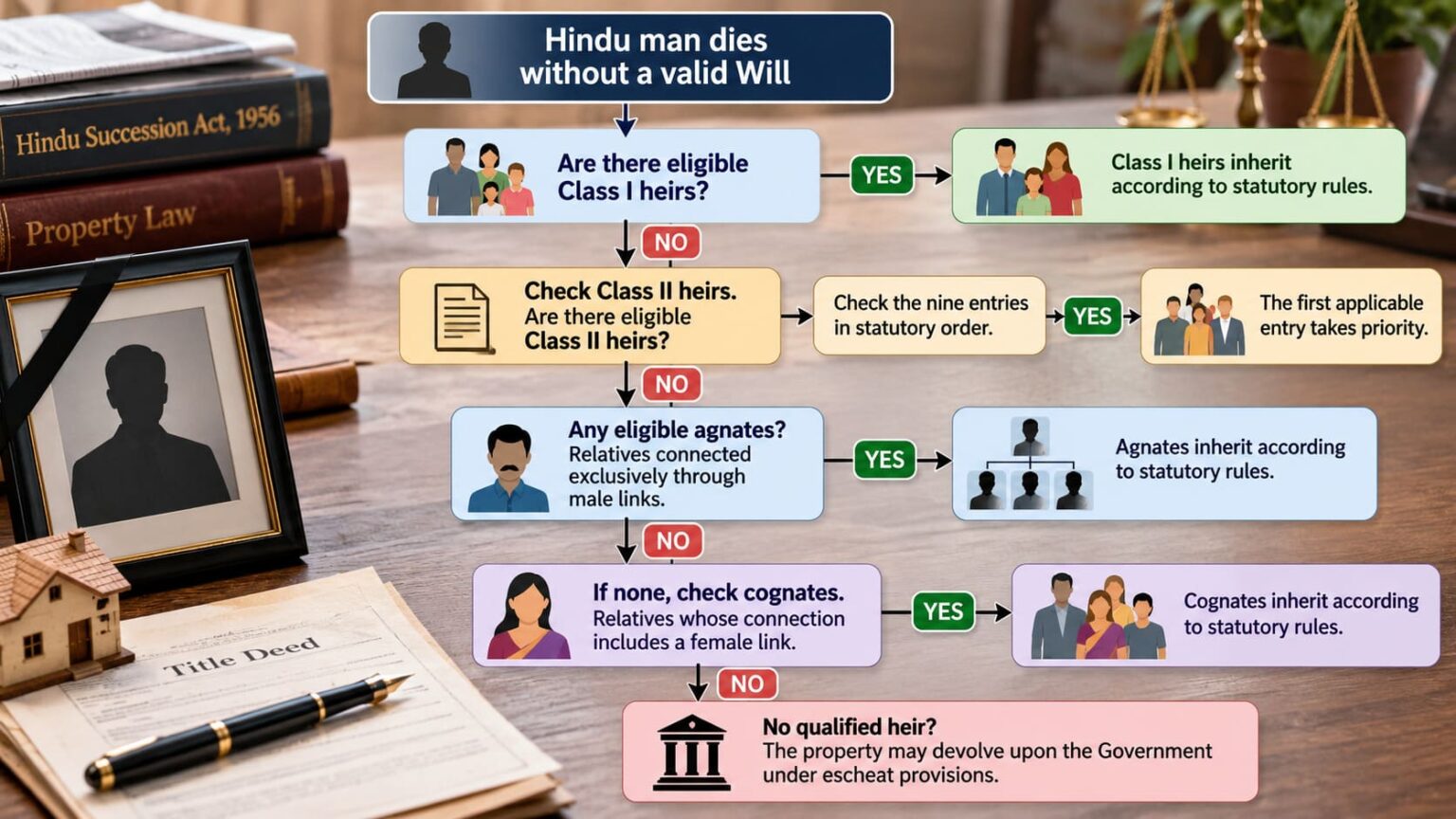
When a Hindu man dies without leaving a valid Will, his property is distributed among his legal heirs according to the Hindu Succession Act, 1956. The Act specifies who inherits the property, the order of priority among relatives, and how the shares are calculated.
The rules depend on whether the deceased has Class I heirs, Class II heirs, agnates or cognates. Understanding these categories is important for families dealing with property inheritance, legal heirship and partition.
What Does Intestate Mean?
Intestate means a person dies without leaving a valid Will that determines how their property should be distributed.
For example, if Arjun dies without leaving a valid Will, the inheritance of his property will generally be determined under the applicable rules of intestate succession.
Order of Succession Under the Hindu Succession Act
Section 8 of the Hindu Succession Act establishes the order in which a Hindu man’s property devolves when he dies intestate.
| Priority | Category of heirs | When they inherit |
|---|---|---|
| 1 | Class I heirs | They inherit first. |
| 2 | Class II heirs | They inherit only if there is no Class I heir. |
| 3 | Agnates | They inherit if there are no heirs in Class I or Class II. |
| 4 | Cognates | They inherit if there are no eligible heirs in the preceding categories. |
| 5 | Government | If no eligible heir exists, the property may pass to the Government under the law of escheat. |
Important: Class I heirs inherit simultaneously according to the statutory rules. Class II heirs inherit according to the order of entries in the Schedule, not simply according to who is closest to the deceased.
Understanding Class I and Class II Heirs Through Examples
Here is the complete, comprehensive list of Class I and Class II heirs under the Hindu Succession Act, 1956.
Disclaimer: All names used in this article are fictional and are provided solely for illustrative purposes to explain the inheritance rules. Any resemblance to actual persons is purely coincidental.
Now let us start to make this clear. Let us assume the deceased person is named Arjun. Arjun has passed away without making a Will (intestate).
📜 CLASS I HEIRS
(All Class I heirs inherit simultaneously. If even one Class I heir is alive, the property never goes to Class II.)
- Widow(s)
- Example: Kavitha (Arjun’s wife).
- Mother
- Example: Saraswathi (Arjun’s biological mother).
- Son(s)
- Example: Vijay (Arjun’s living son).
- Daughter(s)
- Example: Deepa (Arjun’s living daughter).
- Son of a pre-deceased son (Grandson)
- Example: Arjun’s son Rajesh died before Arjun. Rajesh’s son Rahul inherits his father’s portion.
- Daughter of a pre-deceased son (Granddaughter)
- Example: Rajesh’s daughter Neha inherits alongside her brother Rahul.
- Widow of a pre-deceased son (Daughter-in-law)
- Example: Rajesh’s widow Meera inherits alongside her children.
- Son of a pre-deceased daughter (Grandson)
- Example: Arjun’s daughter Anjali died before Arjun. Anjali’s son Amit inherits his mother’s portion.
- Daughter of a pre-deceased daughter (Granddaughter)
- Example: Anjali’s daughter Priya inherits alongside her brother Amit.
- Son of a pre-deceased son of a pre-deceased son (Great-grandson)
- Example: Arjun’s grandson Vikram (from a deceased son) also died before Arjun, leaving behind a son named Aarav.
- Daughter of a pre-deceased son of a pre-deceased son (Great-granddaughter)
- Example: Vikram’s daughter Diya.
- Widow of a pre-deceased son of a pre-deceased son
- Example: Vikram’s widow Sneha.
- Son of a pre-deceased daughter of a pre-deceased daughter
- Example: Arjun’s granddaughter Riya (from a deceased daughter) died before Arjun, leaving behind a son named Karan.
- Daughter of a pre-deceased daughter of a pre-deceased daughter
- Example: Riya’s daughter Isha.
- Daughter of a pre-deceased son of a pre-deceased daughter
- Example: A great-granddaughter from a deceased daughter’s branch named Maya.
- Daughter of a pre-deceased daughter of a pre-deceased son
- Example: A great-granddaughter from a deceased son’s branch named Ananya.
Class I heirs inherit in preference
Example 1: Wife, One Son and One Daughter
Suppose Arjun dies intestate, leaving his wife Kavitha, his son Vijay and his daughter Deepa. Assume there are no other relevant Class I heirs and that the entire estate belongs to Arjun.
| Heir | Relationship to Arjun | Share |
|---|---|---|
| Kavitha | Wife | 33⅓% |
| Vijay | Son | 33⅓% |
| Deepa | Daughter | 33⅓% |
| Total | 100% |
Each heir receives one-third of Arjun’s estate.
What if Arjun’s Mother, Saraswathi, Is Also Alive?
Saraswathi, Arjun’s mother, is also a Class I heir. She receives an equal share alongside Kavitha and the two children.
| Heir | Relationship to Arjun | Share |
|---|---|---|
| Kavitha | Wife | 25% |
| Vijay | Son | 25% |
| Deepa | Daughter | 25% |
| Saraswathi | Mother | 25% |
| Total | 100% |
Each of the four heirs receives one-fourth of Arjun’s estate, assuming these are the only relevant Class I heirs and no predeceased child’s branch affects the calculation.
What if Arjun Has Two Wives?
Under the statutory rules, if Arjun leaves more than one widow, all the widows collectively receive one share of the estate. They do not each receive a separate full share. That collective share is then divided between the widows according to the applicable rules.
📜 CLASS II HEIRS
⭕These heirs only inherit if no one from Class I is alive.
They are divided into nine entries in the Schedule to the Hindu Succession Act. The first entry has priority over the second, the second over the third, and so on. If there is an eligible heir in an earlier entry, heirs in later entries do not inherit.
Entry I
- Father
- Example: Ramesh (Arjun’s father). If Ramesh is alive, Entry II through IX get nothing.
Entry II (All 4 share equally if Entry I or the deceased’s father is not alive)
- Son’s daughter’s son
- Example: Varun (Arjun’s great-grandson via a son).
- Son’s daughter’s daughter
- Example: Kriti (Arjun’s great-granddaughter via a son).
- Brother
- Example: Suresh (Arjun’s full brother).
- Sister
- Example: Gita (Arjun’s full sister).
Entry III (Grandchildren via a daughter)
- Daughter’s son’s son
- Example: Rohan (Arjun’s great-grandson).
- Daughter’s son’s daughter
- Example: Aditi (Arjun’s great-granddaughter).
- Daughter’s daughter’s son
- Example: Arnav (Arjun’s great-great-grandson).
- Daughter’s daughter’s daughter
- Example: Sanya (Arjun’s great-great-granddaughter).
Entry IV (Nephews and Nieces)
- Brother’s son
- Example: Manish (Suresh’s son).
- Sister’s son
- Example: Alok (Gita’s son).
- Brother’s daughter
- Example: Pooja (Suresh’s daughter).
- Sister’s daughter
- Example: Divya (Gita’s daughter).
Entry V (Paternal Grandparents)
- Father’s father (Example: Jagdish, Arjun’s grandfather).
- Father’s mother (Example: Devi, Arjun’s grandmother).
Entry VI (Widows of Father and Brother)
- Father’s widow
- Example: Sharda (Arjun’s stepmother).
- Brother’s widow
- Example: Nisha (Arjun’s late brother Suresh’s wife).
Entry VII (Paternal Uncles and Aunts)
- Father’s brother (Example: Prakash — Arjun’s paternal uncle).
- Father’s sister (Example: Lalitha — Arjun’s paternal aunt).
Entry VIII (Maternal Grandparents)
- Mother’s father (Example: Hari, Arjun’s maternal grandfather).
- Mother’s mother (Example: Radha, Arjun’s maternal grandmother).
Entry IX (Maternal Uncles and Aunts)
- Mother’s brother (Example: Vinod — Arjun’s maternal uncle).
- Mother’s sister (Example: Sunita — Arjun’s maternal aunt).
Note: The names are illustrative. The precise relationship must match the relevant entry in the statutory Schedule. In particular, “father’s widow” means the widow of the deceased’s father, and therefore may refer to the deceased’s stepmother.
Example: Why Entry I Has Priority
Suppose Arjun dies without a valid Will and has no Class I heir. His father Ramesh is alive, and Arjun also has a brother, Suresh, and a sister, Gita.
- Ramesh falls under Class II Entry I.
- Suresh and Gita fall under Class II Entry II.
- Since Entry I takes priority over Entry II, Ramesh inherits (100%) to the exclusion of Suresh and Gita under these circumstances.
If Ramesh is not alive and Suresh (50%) and Gita(50%) are the only eligible heirs in the first applicable entry, they generally share the estate equally.
This example shows why the order of entries matters. A relative does not inherit merely because they are close to the deceased; the statutory priority must be followed.
3. Agnates: Relatives Connected Through Male Links
If the deceased has no eligible heir in Class I or Class II, succession passes to agnates.
An agnate is a relative whose relationship to the deceased can be traced entirely through male links. The connection may extend across several generations.
For example, Prakash is Arjun’s father’s brother, making him Arjun’s paternal uncle. Prakash’s son is Arjun’s paternal cousin. Their relationship to Arjun is traced through the male line.
| Person | Relationship to Arjun | Explanation |
|---|---|---|
| Prakash | Arjun’s father’s brother | Paternal uncle, connected through Arjun’s father |
| Prakash’s son | Arjun’s paternal cousin | Connected through the male line |
| Prakash’s grandson | Arjun’s paternal cousin’s son | A further relative in the same male line |
These examples illustrate male-line connections. Agnates are considered only when there is no eligible Class I or Class II heir.
How Is Priority Determined Among Agnates?
Sections 12 and 13 provide rules for the order of succession and the calculation of degrees of relationship.
The law considers degrees of ascent and descent:
- Degrees of ascent: The number of generations traced upward from the deceased to the common ancestor.
- Degrees of descent: The number of generations traced downward from that common ancestor to the relative claiming inheritance.
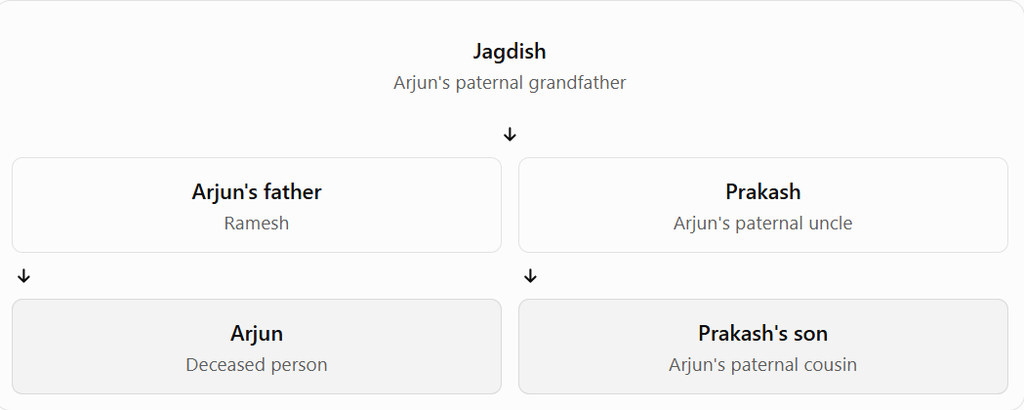
For example, Arjun and his father’s brother Prakash share a common ancestor: Arjun’s paternal grandfather.
- Arjun’s father and Prakash are sons of the common grandfather (Jagdish).
- Prakash’s son is Arjun’s paternal cousin.
- The relationship is assessed by counting the relevant generations under the statutory rules.
4. Cognates: Relatives Connected Through a Female Link
If no eligible agnate exists, the property may pass to cognates.
A cognate is a relative whose relationship to the deceased is traced through at least one female link, provided the relationship is not exclusively through male links.
Examples may include relatives connected through Arjun’s mother or through his sister.
| Person | Relationship to Arjun | Explanation |
|---|---|---|
| Vinod | Arjun’s mother’s brother | Maternal uncle, connected through Arjun’s mother |
| Sunita | Arjun’s mother’s sister | Maternal aunt, connected through Arjun’s mother |
| Alok | Gita’s son | Nephew connected through Arjun’s sister |
These relationships are examples of connections involving a female link. Whether a particular relative qualifies and takes priority depends on the statutory rules for cognates and the full family relationship.
5. When Does the Government Inherit the Property?
The Government may inherit property under the legal principle known as escheat.
Escheat applies when a person dies intestate without leaving a qualified heir entitled to succeed under the applicable law.
The Government does not automatically inherit simply because the deceased has no spouse, children, parents or siblings. More distant eligible relatives must also be considered.
The general sequence for a Hindu male dying intestate is:
If there is no qualified heir entitled to inherit, the property may devolve upon the Government under the applicable rules.
✅ Check for eligible Class I heirs.
✅ If none exist, examine Class II heirs, entry by entry.
✅ If neither category provides an eligible heir, consider agnates.
✅ If there are no eligible agnates, consider cognates.
6. Does the Same Rule Apply to Every Type of Property?
Not necessarily. Before calculating inheritance, it is important to identify the type of property and the deceased’s legal interest in it.
Self-Acquired or Separate Property
If Arjun owns property in his own name as his separate property and dies intestate, the applicable succession rules determine which heirs inherit it and in what shares.
Ancestral or Coparcenary Property
If the property is coparcenary property, Arjun’s own interest may first need to be determined under the applicable law, including Section 6 of the Hindu Succession Act where relevant. The succession rules then apply to the interest that devolves on death.
Therefore, it is important not to assume that every property described as “ancestral” is divided in the same way as a person’s separate property.
7. Other Important Rules Under the Hindu Succession Act
Several other provisions can affect inheritance:
| Legal provision | Simple explanation |
|---|---|
| Section 18 — Full blood and half blood | A preference for full-blood relationships may apply over half-blood relationships when the statutory conditions are met. |
| Section 20 — Child in the womb | A child who was in the womb when the deceased died may inherit if the statutory conditions are satisfied. |
| Section 21 — Simultaneous deaths | Special rules apply where it is uncertain who survived whom. |
| Section 22 — Preferential right to acquire property | In specified circumstances, heirs may have a preferential right when another heir proposes to transfer an inherited interest. |
| Section 25 — Murder | A person who commits or abets the murder of the person whose property is inherited is disqualified under the Act. |
| Section 26 — Descendants of converts | Specific disqualification rules apply to certain descendants of converts in the circumstances stated in the Act. |
| Sections 27 and 28 — Disqualification | These provisions address the consequences of disqualification and circumstances that do not by themselves disqualify a person from inheritance. |
These provisions must be considered when relevant to the facts of a particular case.
The precise application of these provisions depends on the facts of the case.
8. What If a Hindu Woman Dies Without a Will?
The rules explained above primarily concern the intestate succession of a Hindu man under Sections 8 to 13.
When a Hindu woman dies without a valid Will, the general rules under Sections 15 and 16 apply, subject to the Act’s specific provisions.
Sections 15 and 16 of the Hindu Succession Act, 1956, specify how a Hindu woman’s property is inherited if she dies without a Will. The property generally passes first to her husband, children and eligible descendants of predeceased children, followed by other relatives in the order prescribed by law.
In certain circumstances, her husband’s heirs may inherit before her own parents. Making a valid Will allows a woman to specify how her self-acquired wealth should be distributed, helping protect her wishes and reduce potential family disputes.
Special rules apply to certain property inherited by the woman from her parents or her husband’s family, so the source of the property can affect who inherits it.
Why Is Understanding Legal Heir Priority Important?
Understanding the order of succession helps families determine who may be entitled to inherit property.
The main principles are:
- Class I heirs have the first priority.
- Class II heirs inherit according to the order of entries in the Schedule.
- Agnates are considered before cognates.
- The Government may inherit only when the legal conditions for escheat are satisfied.
- Descendants of predeceased children may inherit through their respective branches.
- The deceased’s actual interest in the property must be identified before calculating inheritance shares.
- Separate provisions apply to the intestate property of a Hindu woman.
The mere existence of a family relationship does not automatically establish an immediate right to inherit. The statutory category, priority and distribution rules must all be considered.
Identify the Heirs Before Dividing the Property
Using Arjun’s family as an example makes these relationships easier to understand. However, where the family tree includes predeceased relatives, descendants in different branches, multiple widows or coparcenary property, the statutory rules must be applied carefully before deciding the final shares.
Verified Real Estate provides legal expert assistance throughout the legal heirship and property succession process, from identifying eligible legal heirs and guiding families through the procedures for obtaining a Legal Heir Certificate to verifying property documents. Where no Class I heirs exist, Verified Real Estate helps trace the applicable Class II heirs and understand the relevant order of succession. With support from its expert legal team, Verified Real Estate also assists in assessing the rightful property shares under the applicable succession laws, helping families navigate inheritance procedures with greater clarity and confidence.
This article provides general information and is not a substitute for legal advice on a specific inheritance or property dispute.