

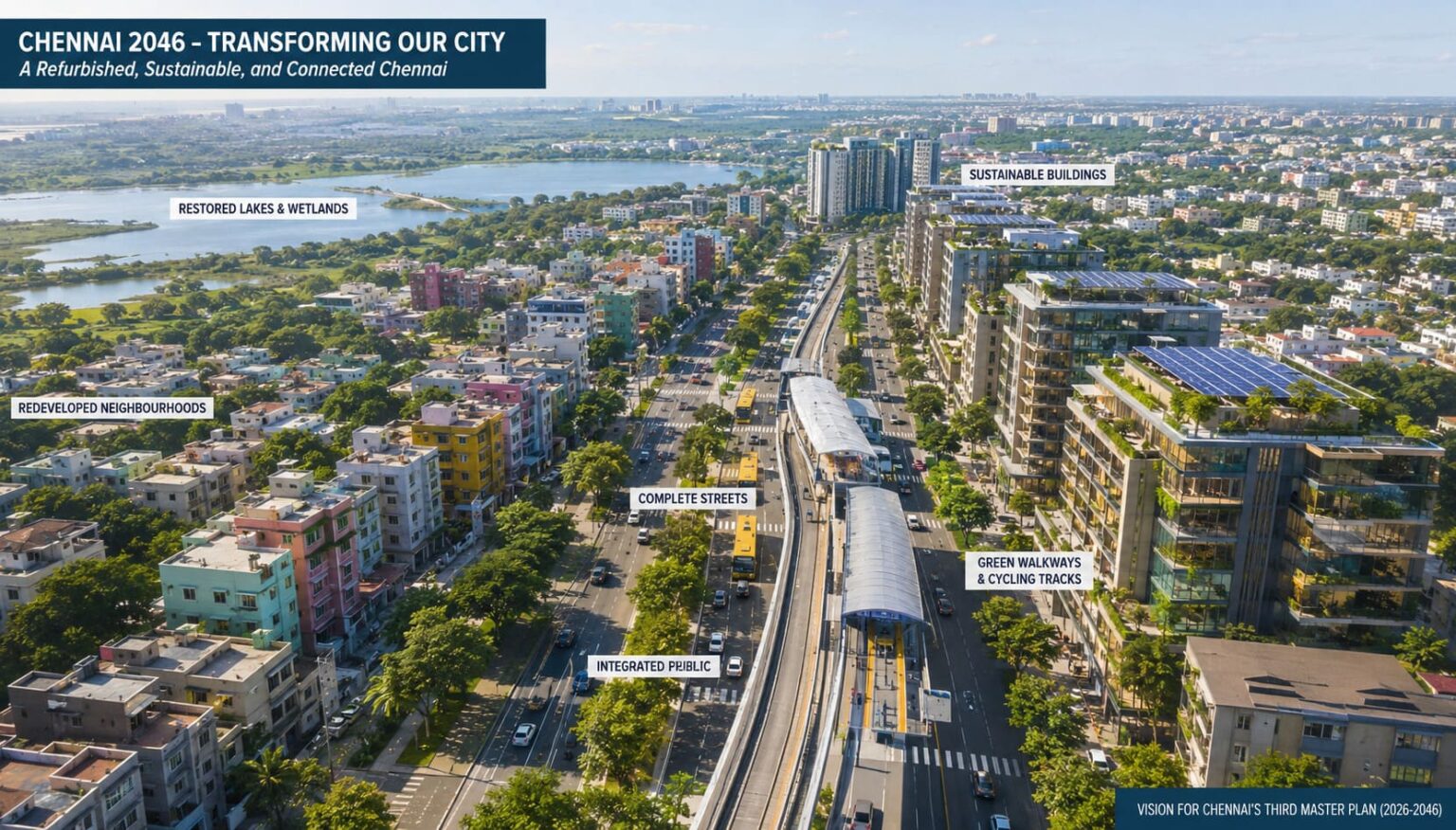
The Chennai Metropolitan Development Authority (CMDA) has officially launched its comprehensive stakeholder consultation process to formulate Chennai’s highly anticipated Third Master Plan (TMP). This key policy document will act as a strategic, future-ready roadmap guiding the city’s urban growth, major infrastructure investments, and overall regional development over the coming decades.
What is the Third Master Plan About?
The Third Master Plan (TMP) is a data-driven development framework designed to navigate the challenges of Chennai’s rapidly expanding urban footprint. Moving forward from the previous Second Master Plan, the TMP focuses on upgrading Chennai into a world-class, highly efficient metropolis. Its primary goal is to seamlessly balance the region’s long-term economic competitiveness with high environmental sustainability, climate resilience, and everyday liveability.
Core Concepts of the Third Master Plan
During these early interactive sessions, stakeholders and urban local bodies emphasized several foundational planning concepts that will define the upcoming master plan:
1. Infrastructure, Mobility, and Transit-Oriented Development (TOD)
A central pillar of the plan is the integration of land-use planning with the city’s transport networks. The CMDA aims to build a highly efficient multimodal transport network. By prioritizing Transit-Oriented Development, the plan will cluster high-density residential and commercial spaces around major metro, rail, and bus corridors to maximize public utility use and systematically curb traffic congestion.
2. Growth Management and Urban Density
To address rapid population expansion, the plan focuses heavily on smart density management. Instead of allowing unchecked horizontal sprawl into suburban areas, the framework emphasizes optimizing land utilization within the existing planning limits to support balanced, organized regional growth.
3. Climate Resilience and Environmental Sustainability
Adapting to increasing climate risks is a major priority for the new framework. The plan outlines strategies to strengthen disaster preparedness across the Chennai Metropolitan Area. This includes mapping out strict protections for the city’s vital ecological assets, green spaces, wetlands, and water bodies to protect them from unauthorized development.
4. Housing and Everyday Liveability
The TMP aims to elevate the baseline quality of life for Chennai’s residents by expanding accessible public green spaces, promoting mixed land-use zones (placing workplaces, commercial centers, and homes closer together), and significantly expanding access to affordable housing.
The Consultation Process and Implementation Timeline
The CMDA is actively gathering a highly diverse range of data and perspectives by involving a broad spectrum of participants in these sessions, including:
- Government & Civil Authorities: Urban local bodies, infrastructure providers, and regional transport authorities.
- Industry & Technical Experts: Real estate professionals, academic institutions, and professional urban planning organizations.
- Community Representatives: Civil society organizations and non-governmental bodies.
International Experts Roped In to Review Draft Plan
To ensure the framework aligns with global standards and avoids execution bottlenecks, the Tamil Nadu Housing and Urban Development Department has decided to rope in international town planning experts to thoroughly review the draft of the Third Master Plan. The CMDA has been working on this plan for the last five years, investing nearly ₹2.5 crore, with a target to release the draft before the Second Master Plan lapses in September. Because internal sources have flagged certain practical difficulties and shortcomings in the current draft, these global experts will help tweak and refine the framework. The goal is to deliver a highly accurate and legally sound final blueprint that will successfully dictate Chennai’s metropolitan growth through its horizon period of 2047.
When Will It Be Introduced?
While an exact calendar launch date for the final document is not specified, the process is actively moving through its mandatory drafting stages. CMDA officials noted that this current exercise marks the beginning phase; the authority is scheduled to conduct additional rounds of consultations to evaluate all feedback before finalizing and officially releasing the draft plan to the public.
The consultations are intentionally structured to be inclusive, bringing together a wide array of perspectives from government agencies, transport authorities, industry representatives, infrastructure providers, academic institutions, planning professionals, and civil society organizations.