

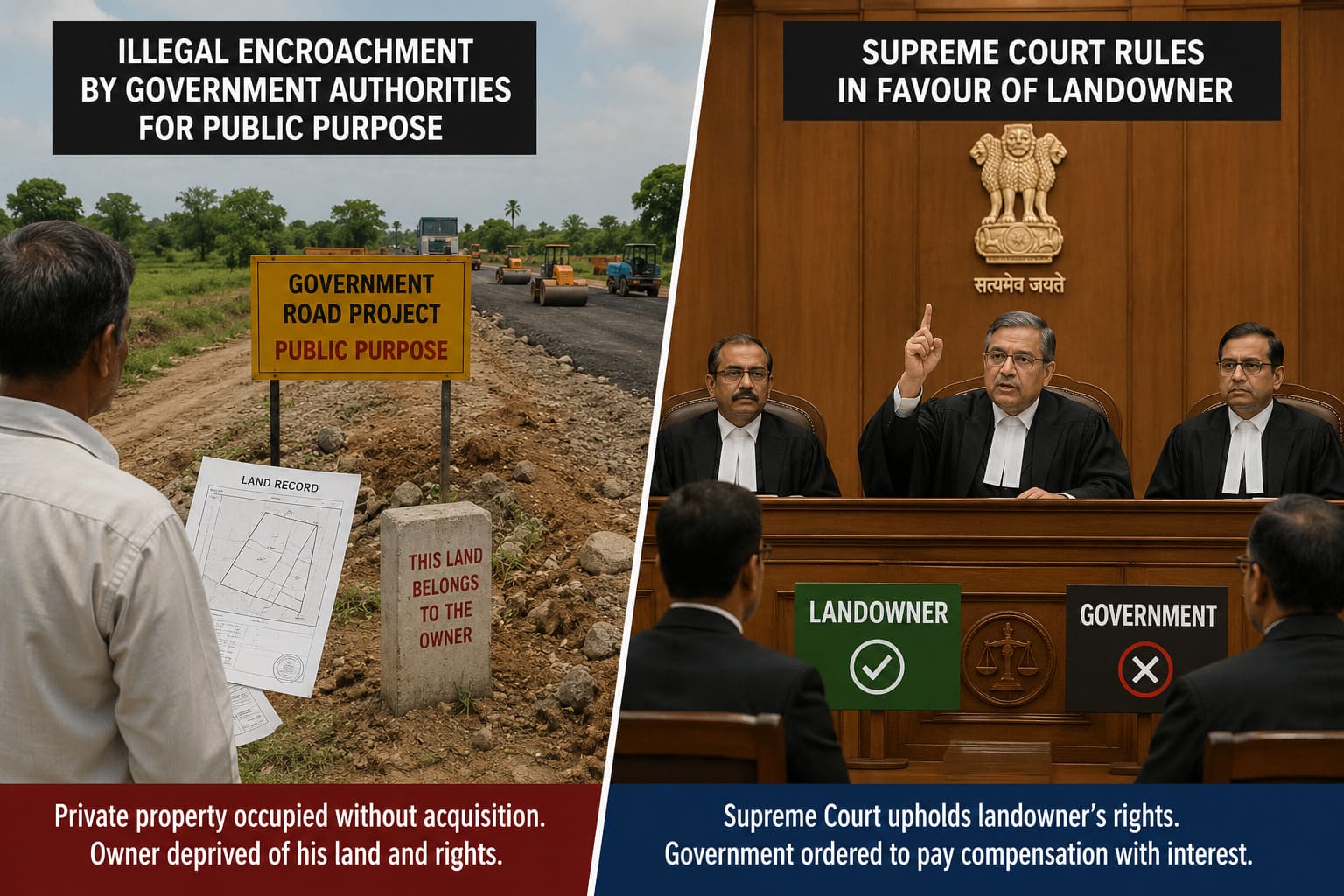
Government Used Private Land for 25 Years Without Acquisition
In a significant ruling protecting property rights, the Supreme Court has dismissed an appeal filed by the State of Chhattisgarh after it occupied private land for nearly 25 years without acquiring it or paying compensation to the landowners.
Calling the State’s challenge “absolutely baseless”, the apex court not only upheld the enhanced compensation and interest awarded to the landowners but also imposed costs of ₹2 lakh on the State.
The judgment reiterates that the government cannot deprive a person of their property without following due process of law and paying fair compensation.
How Did the Dispute Begin?
The dispute dates back to 1986, when the Chhattisgarh Public Works Department (PWD) took possession of privately owned land in Durg district and used it for a road project.
However, the State neither initiated land acquisition proceedings nor paid any compensation to the landowners.
For years, the landowners remained unaware of the illegal occupation.
Encroachment Discovered During Demarcation Proceedings
The encroachment came to light during 1demarcation proceedings.
After discovering that the PWD had occupied their land, the owners filed a suit in 2006, seeking eviction of the department from their property.
State Initiated Acquisition After 24 Years
Only after the litigation commenced did the State begin the acquisition process.
On 13 August 2010, nearly 24 years after taking possession of the land, the government issued a notification under Section 4 of the Land Acquisition Act, 1894, formally initiating acquisition proceedings.
Compensation Fixed by Land Acquisition Officer
In June 2011, the Land Acquisition Officer passed the final award and determined the compensation at:
₹4,308 per square metre
The valuation was based on the 2009-10 guideline value.
Landowners Challenged Compensation
The landowners argued that the compensation was inadequate because the 2010-11 guideline values had already come into effect before the final award was passed.
The Reference Court accepted their contention and enhanced the compensation to:
₹5,380 per square metre
by applying the updated 2010-11 guideline rates.
High Court Upholds Enhanced Compensation and Awards Interest
Both the State and the landowners approached the Chhattisgarh High Court.
The High Court upheld the enhanced compensation and further directed the State to pay interest from the date the landowners first approached the court in 2006.
The Court ordered:
- 9% interest for the first year, and
- 15% interest per annum thereafter until the entire compensation amount is paid.
The High Court recognised that the landowners had been deprived of both their land and compensation for several decades.
State Challenges Interest Before Supreme Court
Unhappy with the interest awarded, the State approached the Supreme Court.
The government argued against the High Court’s direction to pay interest on the compensation amount.
However, the Supreme Court refused to interfere.
Supreme Court’s Verdict
A Bench comprising Justice Sandeep Mehta and Justice Vijay Bishnoi strongly criticised the State’s conduct.
The Court observed that:
- The State had occupied private land for decades without authority of law.
- The landowners were forced to approach the courts because of the government’s inaction.
- The State could not take advantage of its own wrongdoing.
- The award of interest by the High Court was fully justified.
The Supreme Court noted that after illegally occupying private property for decades, the State should have complied with the compensation order instead of continuing litigation.
What Was the State Ordered to Pay?
✅ Pay compensation at the enhanced rate of ₹5,380 per square metre instead of ₹4,308 per square metre.
✅ Pay 9% interest for the first year, calculated from 2006, the year the landowners first approached the court.
✅ Pay 15% interest per annum thereafter until the entire compensation amount is fully paid.
✅ Pay an additional ₹2 lakh as costs for filing what the Supreme Court termed an “absolutely frivolous” appeal.
Article 300A: Right to Property Still Protected
The judgment is an important reminder that although the Right to Property is no longer a fundamental right, it remains a constitutional right under Article 300A of the Constitution of India, which states:
No person shall be deprived of his property save by authority of law.
The ruling makes it clear that governments cannot occupy private property first and think about compensation later.
Why This Judgment Matters for Property Owners
The judgment sends a strong message to government authorities across the country:
✔ Illegal occupation of private land cannot be justified on the ground of public purpose.
✔ Delays in initiating acquisition proceedings do not extinguish the rights of landowners.
✔ Courts can award enhanced compensation and substantial interest where owners have been deprived of their property for years.
✔ Governments can also be penalised with costs for pursuing frivolous litigation.
The Bottom Line
The Supreme Court’s decision reinforces a simple but powerful principle:
If the government uses your land, it must acquire it legally and pay fair compensation. Decades of delay cannot deprive landowners of their constitutional rights.
Property Owners Must Stay Vigilant
This case also highlights the importance of property owners regularly monitoring their land records and physical property boundaries. Conducting survey and demarcation checks can help identify encroachments, boundary disputes, or unauthorised changes at an early stage.
For owners who hold multiple properties or live abroad, keeping track of every asset can be challenging. Tools such as Verified Real Estate’s Property tracker can provide instant alerts whenever there is a change in land records, helping owners stay informed and take timely action.
Similarly, Verified Real Estate’s Property Management services can assist owners with multiple properties and NRIs by monitoring, managing, and safeguarding their real estate assets even when they are not physically present.
- Demarcation is the process of identifying and physically marking the exact boundaries of a property based on land records and survey documents. ↩︎