

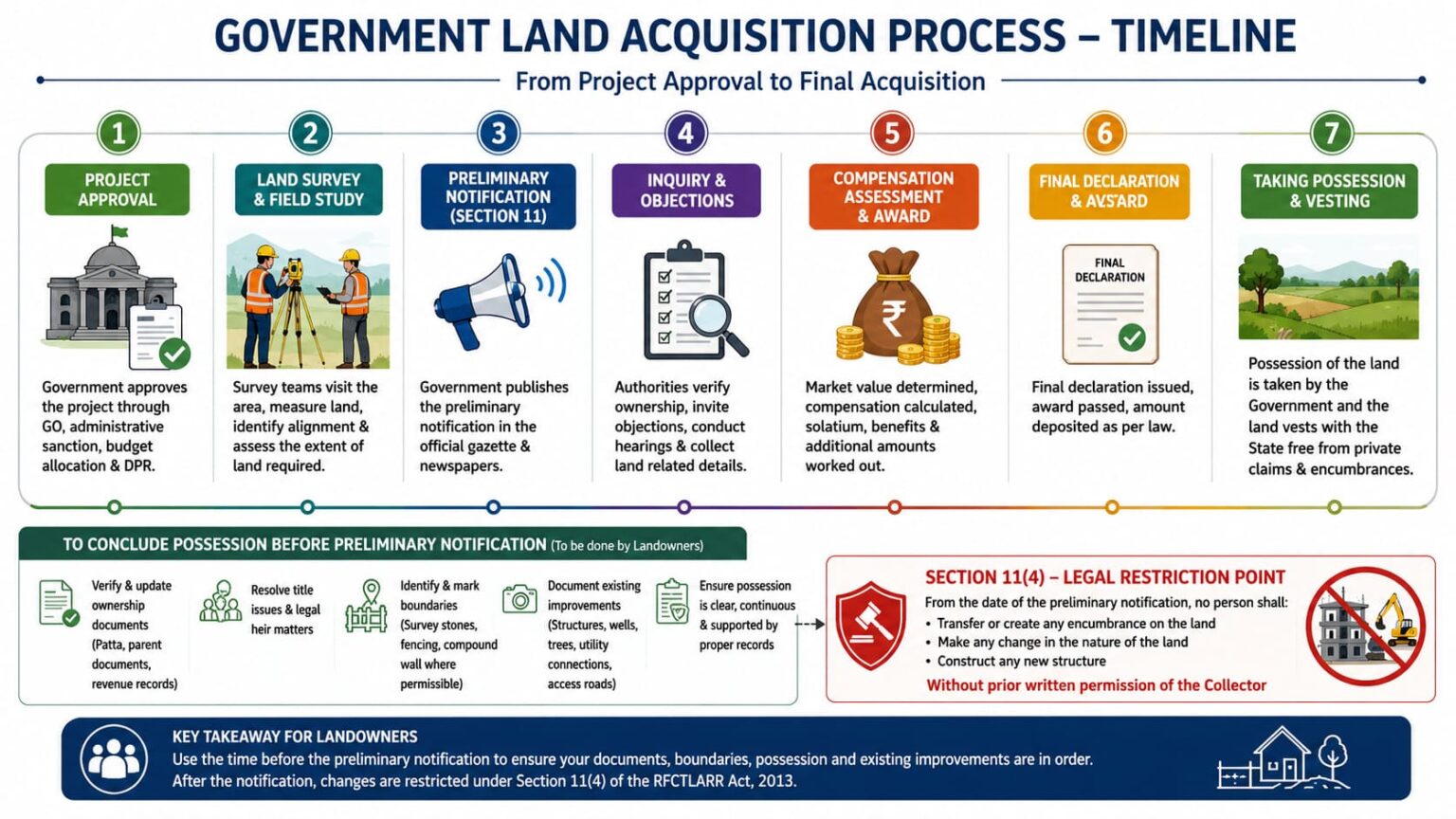
How Does the Government Acquire Land for Public Projects?
Large public projects such as highways, river restoration works, canals, metro rail corridors, flood mitigation schemes, and infrastructure developments often require the acquisition of private land.
India’s land acquisition process is governed by the RFCTLARR Act, 2013, which lays down the framework for notifications, compensation, rehabilitation, and the acquisition of private land for public purposes.
While most people focus on the compensation stage, the acquisition process usually begins much earlier with planning and surveys. In many cases, landowners become aware of a proposed acquisition long before the government publishes an official notification.
Understanding this timeline is important because the period before the notification is often the last opportunity for landowners to clearly establish and document their possession of the property.
Project Approval by the Government
Before any acquisition begins, the government typically approves the project through:
- Government Orders (GO)
- Administrative sanctions
- Budget allocations
- Detailed Project Reports (DPR)
- Departmental approvals
At this stage, no acquisition notification may have been issued yet, but the project has already entered the planning phase.
Preliminary Surveys and Field Measurements
After project approval, government officials and survey teams often enter the field to:
- Identify the required alignment
- Measure affected lands
- Assess ground conditions
- Determine the extent of acquisition required
For projects such as river restoration, canal expansion, road widening, or railway corridors, these surveys help authorities identify exactly which properties may be affected.
It is often during this phase that local residents first become aware that their land could be acquired.
Information Spreads Before Official Notification
In many areas, news of an upcoming acquisition spreads through:
- Survey activities
- Village Administrative Officers (VAOs)
- Local revenue officials
- Contractors
- Neighbouring landowners
As a result, landowners frequently learn about a potential acquisition before any official newspaper publication or government notice is issued.
Although no formal acquisition proceedings may have begun, many owners use this period to verify their documents and establish their possession over the property.
Publishing the Preliminary Notification and Inquiring
Once the government publishes the statutory acquisition notification, the process enters a formal legal stage.
Authorities then proceed with:
- Ownership verification
- Objection hearings
- Land inquiries
- Compensation assessments
- Final acquisition proceedings
At this stage, the government examines both ownership records and the physical condition of the property.
Final Declaration and Acquisition
After the inquiry and compensation assessment are completed, the government issues the final notification in the newpaper and passes the compensation award. Once the compensation is paid or deposited as required by law, possession of the land is taken by the government, and the property officially becomes part of the public project.
Concluding Possession Matters Before Preliminary Stage
When compensation is eventually assessed, authorities do not merely examine ownership records.
Officials may also record:
- Existing structures
- Compound walls
- Boundary fencing
- Wells
- Trees
- Utility connections
- Physical possession of the land
For this reason, many landowners choose to ensure that their property’s boundaries and possession are clearly identifiable before acquisition proceedings formally begin.
This does not necessarily mean constructing expensive structures. The objective is to ensure that possession and existing improvements are visible, lawful, and properly documented.
How Landowners Often Conclude Possession Before Notification
Before the acquisition notification is published, landowners may take steps such as:
Verifying Ownership Documents
Owners often ensure that:
- Patta records are updated
- Parent documents are available
- Revenue records reflect current ownership
- Legal heir issues are resolved
Marking Property Boundaries
Many owners identify and demarcate boundaries through:
- Survey stones
- Fencing
- Boundary markers
- Compound walls where legally permissible
Recording Existing Improvements
Owners may document:
- Existing trees
- Wells
- Buildings
- Utility connections
- Access roads
This helps establish the property’s actual condition before acquisition proceedings commence.
Understanding Section 11(4) of the RFCTLARR Act, 2013
One of the most important provisions affecting landowners after notification is Section 11(4) of the Right to Fair Compensation and Transparency in Land Acquisition, Rehabilitation and Resettlement Act, 2013.
No person shall make any transaction or cause any transaction of land specified in
the preliminary notification or create any encumbrances on such land from the date of
publication of such notification till such time as the proceedings under this Chapter are
completed:
Provided that the Collector may, on the application made by the owner of the land so
notified, exempt in special circumstances to be recorded in writing, such owner from the
operation of this sub-section:
Provided further that any loss or injury suffered by any person due to his wilful
violation of this provision shall not be made up by the Collector.
The provision seeks to prevent changes to the property after acquisition proceedings have formally begun.
Once the preliminary notification is published, landowners generally cannot create new encumbrances, transfer interests, or significantly alter the property without the approval of the Collector.
The purpose of the provision is to ensure that compensation reflects the genuine condition of the land and not changes made after acquisition becomes imminent.
The Noida Airport Example
The importance of Section 11(4) became evident during land acquisition proceedings connected to the Noida International Airport project.
Authorities reportedly registered cases against individuals who allegedly constructed buildings after acquisition notifications had already been issued. Officials claimed that the construction was carried out despite restrictions imposed during the acquisition process and was intended to influence compensation claims.
According to officials, the unauthorized constructions came to light through ground-level inspections and satellite imagery that tracked changes on the affected properties, despite several warnings from the district administration.
The case highlighted an important principle: once acquisition proceedings have formally begun, authorities may refuse to recognize newly created structures and may even initiate legal action where violations are suspected.
The case illustrates why authorities closely scrutinize structures created after acquisition notifications are published.
Remember : The Period Before Notification Is Important
For many landowners, the most important phase is not the compensation inquiry but the period before the acquisition notification itself. This is why land acquisition consultants and legal practitioners often advise landowners to complete legitimate possession-related activities before the notification stage
Once survey activities begin and acquisition becomes likely, owners often focus on:
- Updating ownership records
- Resolving title issues
- Establishing possession
- Identifying boundaries
- Documenting existing improvements
Services such as Verified.RealEstate’s document verification and due diligence assistance can help landowners review ownership records, identify potential title concerns, verify possession-related documentation, and ensure that key property records are in order before the acquisition process progresses further.
After the notification stage, opportunities to make changes become significantly more limited due to statutory restrictions such as Section 11(4).
The rationale is not necessarily to increase compensation but to ensure that the existing condition of the property is properly recognized during surveys and valuation exercises.