

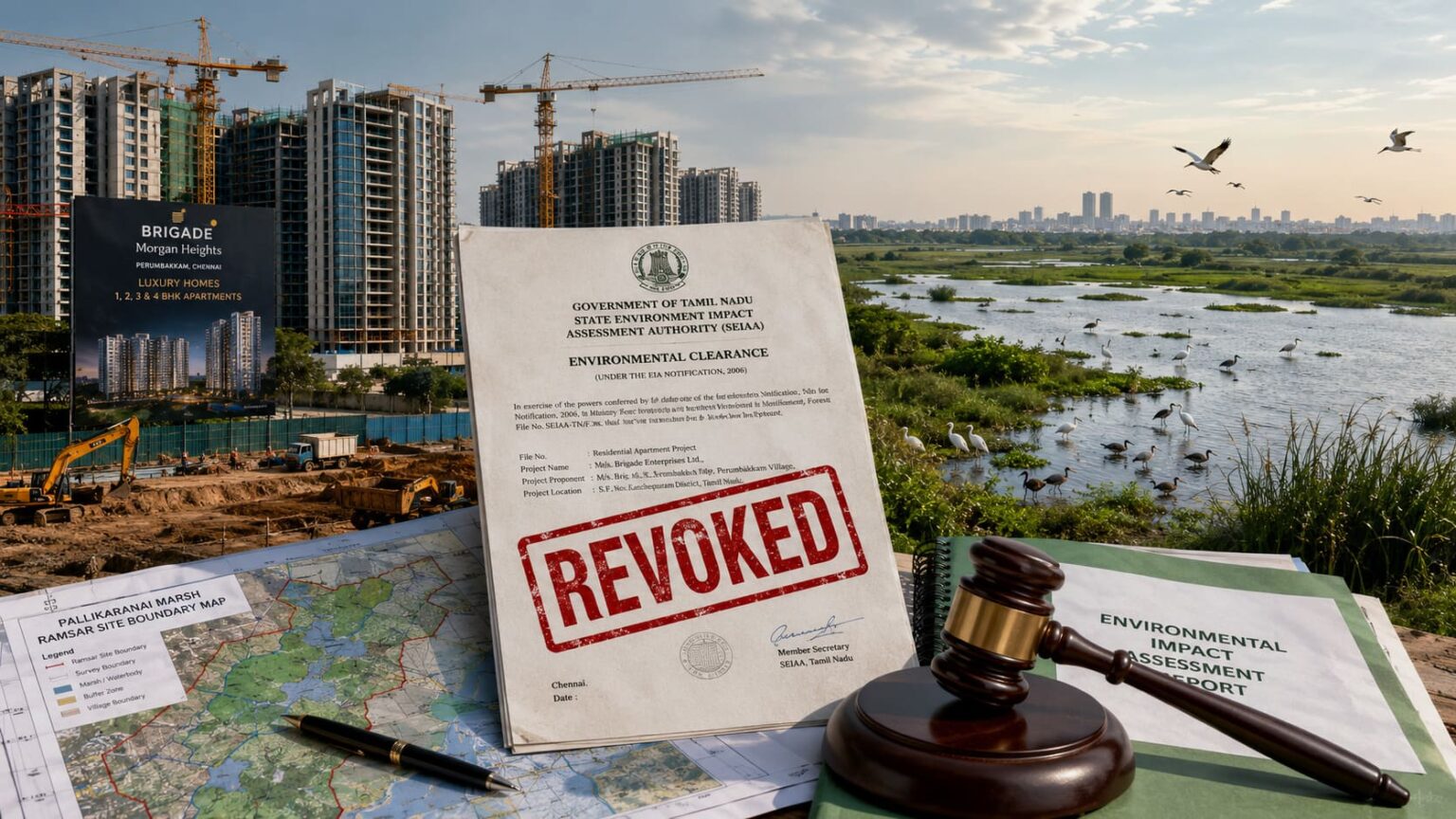
Major Setback for Brigade’s Pallikaranai Housing Project
In a significant development for Chennai’s real estate and environmental sectors, the State Environment Impact Assessment Authority (SEIAA), Tamil Nadu, has revoked the environmental clearance (EC) granted to Brigade Enterprises’ large-scale residential project at Perumbakkam near the Pallikaranai Marsh.
The decision comes amid continuing allegations that the project site falls within the boundaries of the internationally protected Pallikaranai Ramsar Site, one of Chennai’s most ecologically sensitive wetlands.
The revocation removes a critical approval required for the project’s development and could have far-reaching implications for future construction activities around the Pallikaranai Marsh.
The Mega Project
The project, widely known as Brigade Morgan Heights, was proposed on approximately 14.7 acres of land in Perumbakkam. The development was planned as a large residential complex comprising around 1,250 housing units.
The project received:
- Environmental Clearance (EC) from SEIAA on January 20, 2025
- Planning Permission from CMDA on January 23, 2025
However, environmental activists alleged that the approvals were granted despite the project site falling within the Pallikaranai Ramsar wetland boundary.
Why Was the Environmental Clearance Revoked?
The controversy revolves around whether the project site is located within the notified Pallikaranai Ramsar Site.
Environmental activists, particularly Arappor Iyakkam, argued that several survey numbers forming part of the project are located inside the Ramsar-designated wetland area.
According to the organisation:
- The Pallikaranai Marsh was designated as a Ramsar Site in April 2022.
- Construction activities are prohibited within protected wetland areas under the Wetlands (Conservation and Management) Rules, 2017.
- The project site allegedly falls within survey numbers identified as part of the wetland ecosystem.
Following months of scrutiny, complaints, legal challenges and environmental concerns, SEIAA delivered the permanent blow during its 1,005th meeting on May 8, 2026.
The revocation became public this week, bringing renewed attention to the project and the approvals granted to it.
How the Dispute Began
The issue first gained prominence when Arappor Iyakkam released documents alleging that environmental and planning approvals had been issued for a project located within the Pallikaranai Ramsar Site.
The NGO claimed:
- The project is valued at nearly ₹2,000 crore.
- The site falls within the Ramsar wetland boundary.
- The project application allegedly stated that the marshland was located about 1.28 km away, while activists claimed the site directly adjoins the wetland.
The organisation subsequently submitted detailed complaints to the Tamil Nadu government and various authorities seeking cancellation of the approvals.
The Tamil Nadu government had earlier stated that, the project was proposed on private patta land and not within the officially notified reserve forest area.
The state also informed courts that wetland boundary delineation and survey identification exercises were being carried out by the National Centre for Sustainable Coastal Management (NCSCM). However, environmental groups continued to argue that portions of the project site fell within the Pallikaranai Ramsar wetland boundary.
Court Cases and Legal Challenges
The project has faced multiple legal hurdles over the past year.
Key Developments
October 2025
- Public Interest Litigations (PILs) were filed challenging the environmental clearance and planning permission.
- Petitioners argued that construction within a Ramsar site violates the Wetlands Rules, 2017.
October-November 2025
- The Madras High Court issued interim directions restraining further construction activity while examining the matter.
December 2025
- The state informed the court that boundary delineation and ground-truthing exercises were underway to determine the exact limits of the Ramsar site.
February 2026
- The Madras High Court declined to continue parallel proceedings, observing that the Supreme Court was already dealing with broader wetland-related issues across the country.
- Petitioners were advised to approach the Supreme Court for further relief.
Why Pallikaranai Marsh Matters
The Pallikaranai Marsh is one of Chennai’s most important natural ecosystems.
The wetland:
- Drains a large portion of South Chennai.
- Acts as a flood buffer during heavy rainfall.
- Supports diverse flora and fauna.
- Plays a critical role in groundwater recharge and ecological balance.
In April 2022, approximately 1,247 hectares of the marshland ecosystem received Ramsar Site status, giving it international recognition as a wetland of global importance.
Because of this status, any development proposal in or around the marsh attracts intense environmental scrutiny.
What Happens Next?
The revocation of the environmental clearance does not automatically cancel the planning permission issued by CMDA.
Arappor Iyakkam (Led by Coordinator Jayaram Venkatesan), hails the revocation as a monumental victory, the NGO revealed it has submitted exhaustive dossiers tracking these violations to the Directorate of Vigilance and Anti-Corruption (DVAC) and the Union Ministry of Environment, Forest and Climate Change (MoEFCC).
The group is now demanding that the CMDA immediately step in to revoke the project’s planning permission and initiate criminal/disciplinary action against the officials who original expedited the files.
Poovulagin Nanbargal, the prominent environmental advocacy group has urged the State Environment Department to permanently bar Brigade Enterprises from submitting any fresh or revised EC applications for this specific patch of land. They have also called upon the Tamil Nadu government to fast-track the comprehensive identification and strict legal notification of all remaining wetlands across the state.
A Landmark Decision for Wetland Protection
The revocation of the environmental clearance marks one of the most significant regulatory actions involving a major real estate project near the Pallikaranai Marsh.
Beyond the Brigade project itself, the decision could influence how authorities evaluate future developments around ecologically sensitive zones in Chennai.
As the debate between urban expansion and environmental conservation continues, the Pallikaranai case is emerging as a defining test of how India’s Ramsar wetlands will be protected in rapidly growing metropolitan regions.
Prospective buyers and investors planning to purchase property near the Pallikaranai Marsh should be wary of the traps in the ecologically sensitive environment and carefully verify whether the land falls within any notified wetland or protected zone. This can help protect their investment from future litigation, regulatory action, or restrictions on development and construction.