

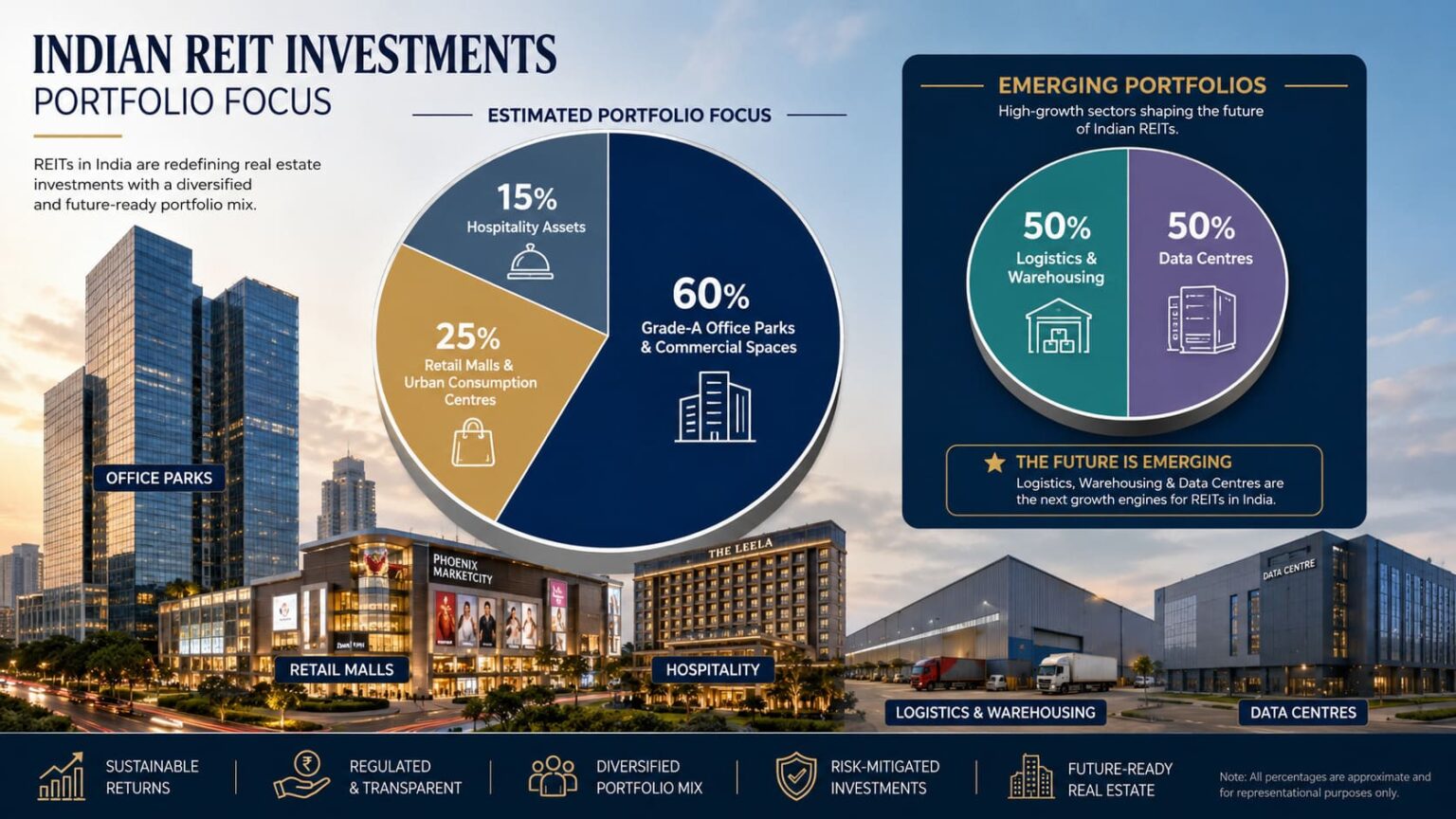
Indian REITs Are Entering a New Phase
Indian Real Estate Investment Trusts, commonly known as REITs, started mainly as a way for investors to invest in large office parks and commercial buildings without directly buying property.
For many years, Indian REITs focused mostly on Grade-A commercial real estate, such as IT parks, business parks and corporate campuses. These assets were preferred because they offered stable rental income from large companies.
But now, the Indian REIT market is slowly changing. Like global REIT markets, India is beginning to look beyond office buildings and explore new asset classes such as retail malls, hotels, logistics parks, data centres, healthcare facilities and industrial spaces.
What Are REITs in Simple Words?
A REIT is an investment structure that owns income-generating real estate. Instead of buying a full commercial building, investors can buy units of a REIT and earn returns from the rental income generated by the properties owned by that REIT.
This makes real estate investment more accessible for smaller investors. It also gives them exposure to professionally managed commercial properties.
In India, REITs are regulated by SEBI to protect investors and ensure that most of the money is invested in completed, income-generating assets.
Office Space Still Dominates Indian REITs
Office space remains the strongest asset class for Indian REITs.
Major listed REITs such as Embassy Office Parks REIT, Mindspace Business Parks REIT and Brookfield India Real Estate Trust are largely built around office portfolios. These include IT parks, business parks and corporate campuses leased to large companies.
These properties are attractive because they usually have:
Stable tenants, long lease agreements, regular rental income, high-quality infrastructure and strong demand from corporate occupiers.
This is why office REITs became the starting point for India’s listed REIT market.
Retail REITs Are Bringing Urban Consumption Into Focus
India has also entered the retail REIT space through Nexus Select Trust, which focuses on shopping malls and urban consumption centres.
Retail REITs are important because they are linked to consumer spending. As people spend more on shopping, dining, entertainment and lifestyle services, well-located malls can generate steady rental income.
Nexus Select Trust owns a portfolio of major shopping centres across several Indian cities. It also includes complementary hotel and office assets, giving investors exposure to more than one type of real estate income.
This shows that Indian REITs are no longer limited only to office parks.
Hospitality Assets Add Another Layer of Diversification
Some REIT portfolios also include premium hotel assets. Hotels can help diversify income because their performance depends on travel, tourism, business events and urban demand.
For example, Nexus Select Trust includes hotel assets along with its retail properties. This gives the REIT a broader income base instead of depending only on mall rentals.
Hospitality may become more relevant in the future as India’s travel, tourism, business conference and urban leisure sectors continue to grow.
Data Centres Could Become a Major REIT Opportunity
One of the biggest emerging opportunities for Indian REITs is the data centre sector.
Data centres are becoming critical because of the rapid growth of:
Artificial intelligence, cloud computing, 5G networks, digital payments, e-commerce, online entertainment and data localisation requirements.
India is producing and storing more digital data than ever before. This creates strong demand for large, secure and power-backed data centre facilities.
For REITs, data centres can become an attractive asset class because they are income-generating properties with long-term tenants. Globally, data centre REITs are already a major investment category. India may gradually move in the same direction.
Logistics and Warehousing Are Also Gaining Importance
Logistics parks and Grade-A warehouses are another strong future opportunity for Indian REITs.
Earlier, India’s warehousing sector was mostly fragmented and dominated by small godowns. But now, the sector is becoming more organised due to:
E-commerce growth, quick commerce, manufacturing expansion, supply-chain modernisation and the National Logistics Policy.
Modern warehouses and industrial parks are now being built with better road access, larger storage capacity, automation, safety systems and professional leasing models.
This makes logistics real estate suitable for institutional investment and future REIT structures.
Why Diversification Matters for Investors
Diversification is important because every real estate sector depends on different economic drivers.
For example:
- Office space depends heavily on corporate hiring and business expansion.
- Retail malls depend on consumer spending.
- Warehousing depends on supply chains and e-commerce.
- Data centres depend on digital growth and cloud infrastructure.
- Hotels depend on travel and tourism.
When a REIT owns only one type of asset, it may face higher risk if that sector slows down.
But when a REIT owns different types of income-generating properties, the risk becomes more balanced. If one sector performs slowly, another sector may still support the income flow.
This is why diversified REITs are important for the future of Indian real estate investment.
SEBI Rules Keep Indian REITs Investor-Friendly
Indian REITs are regulated by SEBI. These rules are designed to ensure that REITs remain stable and income-focused.
One of the most important rules is that at least 80% of a REIT’s asset value must be invested in completed and income-generating properties. This means most of the portfolio must already be capable of generating rental income.
REITs can invest only up to 20% of their asset value in under-construction properties and other permitted assets. This reduces the risk of investors being exposed too heavily to unfinished projects.
REITs can hold properties directly or through SPVs. These structures help organise ownership and management of large real estate assets.
Indian REITs are also subject to borrowing limits, which helps prevent excessive debt risk.
Indian REITs Cannot Freely Invest Like Global REITs Yet
In mature global markets, REITs invest in many types of assets, including hospitals, cell towers, student housing, warehouses, hotels, data centres and even specialised infrastructure.
Indian REITs are still at an early stage compared to these markets. The current focus remains mainly on domestic commercial real estate, retail assets and limited hospitality exposure.
However, as the Indian market matures, more specialised REIT structures may emerge. Data centres, logistics parks, healthcare real estate and industrial facilities could become important future categories.
Why This Matters for India’s Real Estate Market
The growth of diversified REITs can make India’s real estate market more transparent and professionally managed.
It can also help developers unlock value from completed assets and use that capital for new projects. Investors, on the other hand, get access to large commercial properties without directly buying, managing or maintaining them.
For ordinary investors, REITs provide a way to participate in premium real estate with smaller investment amounts.
For the real estate industry, REITs can bring more discipline, better reporting, stronger governance and improved asset management.
The Future of Indian REITs
The future of Indian REITs will not be limited to office parks alone.
Office assets will continue to remain important, but future growth may come from:
Data centres, logistics parks, shopping malls, hotels, healthcare facilities, industrial parks and mixed-use urban assets.
This shift will make Indian REITs broader, stronger and more aligned with global real estate investment trends.
As India’s economy becomes more digital, urban and consumption-driven, REITs may become one of the most important investment routes in the real estate sector.
For investors, the message is simple: Indian REITs are moving from a narrow office-space model to a wider income-generating real estate model.