

For a long time, trying to find old family land in rural India was a nightmare. You had to deal with confusing government websites, ancient legal words, and maps that did not work with regular GPS. But recently, a tech executive used an Artificial Intelligence (AI) program to find his family’s lost land records. His story went viral and showed everyone how technology is changing real estate forever.
The internet went crazy when a senior technology leader from Bengaluru shared his story. He used an AI program called Claude to find 25 different pieces of land that belonged to his ancestors in a small village in Uttar Pradesh.
He faced a big problem: the land had been passed down through four generations, the government records were written in a very old, complicated style of Hindi that read like ancient scripture, and the maps didn’t work on normal phones. Instead of hiring an expensive local agent, he let the AI do the hard work.
How the AI Found the Land (The Tech Trick)
To find the land, the AI acted like a digital assistant. The executive used a new feature that lets the AI control a computer screen. The AI typed his grandfather’s and father’s names into the government website using an on-screen Hindi keyboard. It searched through the files and found every single piece of land where his family owned a share. This gave him the exact Gata Sankhya ( legal term for a unique plot or survey number) for all 25 pieces of land.
The hardest part was figuring out exactly where the land was on a real map. The government website did not use normal GPS numbers (latitude and longitude). Instead, it used a confusing grid system called UTM (Universal Transverse Mercator) coordinates.
The AI solved this by writing a quick computer script. This tool let it click on the corners of the land shapes on the screen, collect the hidden map data, and convert it into a standard KML file (a file format used to save map locations). It then loaded those locations perfectly onto normal Google Maps.
The Problem with Doing This Yourself: While this was an amazing achievement, there is a catch. To do what this tech boss did, you need to know how to give AI highly technical instructions, write code, and spend hours fixing errors. Normal homebuyers or landowners do not have the time or technical skills to do this just to find a plot of land.
A Simpler Way: LandLens -Automated Property Checks
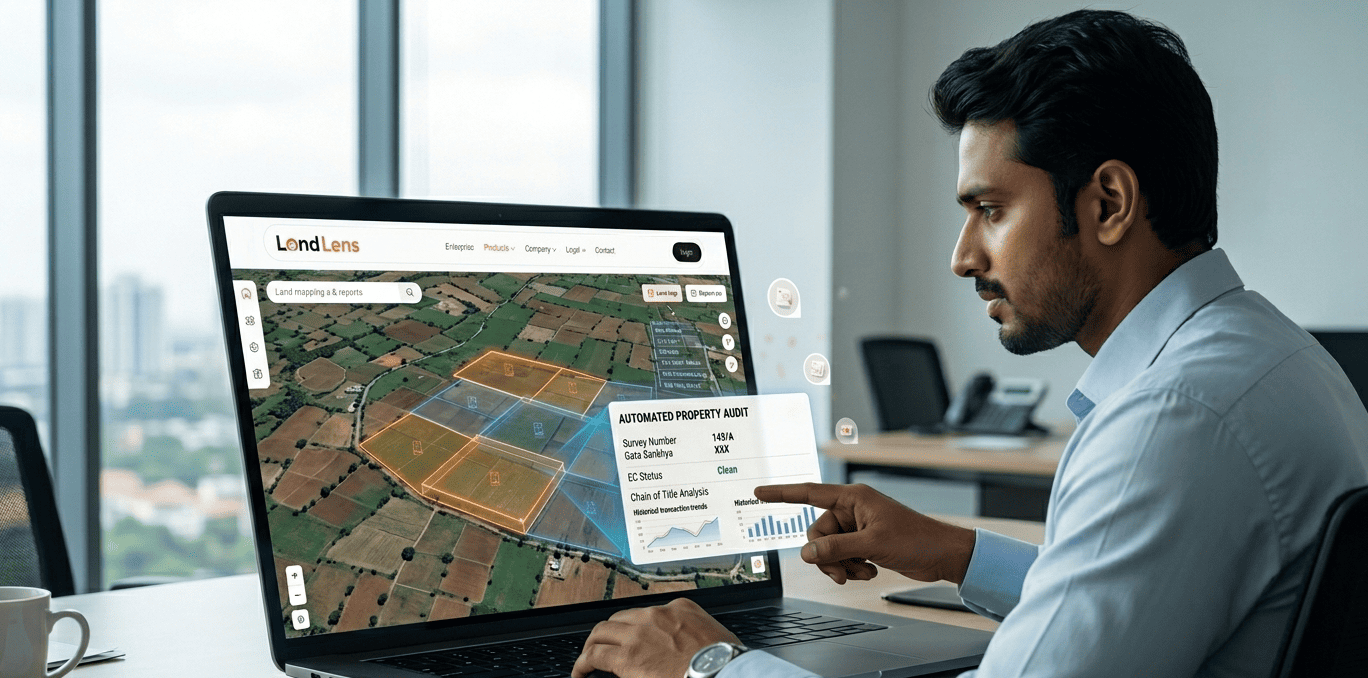
This is exactly why specialized real estate technology has evolved. Instead of forcing you to spend hours teaching a general AI how to read a map or a legal document, automated platforms like LandLens by Verified.RealEstate do all of this for you in a single click.
While general AI models have to be guided step-by-step, LandLens is already custom-built and trained by real estate lawyers to understand local property laws, regional land codes, and government paperwork. It allows everyday people to identify a piece of land, pull the official government documents, and check for legal risks instantly.
How LandLens Automatically Scans a Property
The moment you click on the interactive map provided in the verify your land option in LandLens, the system runs an automatic, 30-point background check across official government databases:
- Instant Map & Location Spotting: The system takes your map pin or survey number and instantly figures out the exact local government boundaries. It automatically identifies the District, Taluk, Village, and the local Sub-Registrar Office (SRO) where the property is registered.
- Automatic Document Gathering: LandLens connects directly to official state portals (like TNReginet) to download your core property documents. It grabs the Encumbrance Certificate (EC), Patta (the official land ownership document), and Adangal (the government record showing land type and use). It then uses smart text-reading technology to pull out the important data.
- Building the Ownership Chain: The AI automatically reads through 30 years of history in the Encumbrance Certificate (EC). It builds a clear timeline of who sold the land to whom and flags any “broken links”—meaning years where land transfers were missing or unrecorded, which is a massive legal warning sign.
- Smart Name-Checking: The AI automatically checks the spelling of names across 30 years of old handwritten or typed records. It flags typos, name variations, or hidden co-owners that normal database searches completely miss, protecting you from future family court battles.
Checking for Hidden Risks Beyond the Map
Finding land on a map is only half the battle. The real value of real estate safety checks is finding hidden problems that don’t show up on a standard map or a basic government search. legal opinion in LandLens runs a deep security scan to catch these major red flags:
- Hidden Bank Loans: It directly checks a central national registry called CERSAI. This reveals if the seller has secretly taken out a bank loan or mortgage using the property as collateral—something that often completely disappears from regular state government EC records. PDF+ 3
- Unsellable Public/Religious Land: It automatically checks special government lists to ensure the plot doesn’t belong to the Waqf Board or Temple Trusts (HR&CE). These types of land are legally protected and cannot be bought or sold by private individuals.
- Environmental & Government Rules: It overlays your land’s map coordinates with strict government boundary maps. It calculates if your plot illegally overlaps with Coastal Regulation Zones (CRZ) near the ocean, active water bodies, protected wetlands, or future government road-widening projects.
- Building Rules: It uses built-in smart calculators to look at local city rules. It tells you your exact Floor Space Index (FSI)—which is the legal limit on how tall or wide you can build your structure—and how far back from the property line your walls must be.
The Digital Guard: Automated Property Tracking & Fraud Protection
For distant property owners, investors, and especially Non-Resident Indians (NRIs), keeping an eye on physical land from hundreds of miles away is a constant source of stress. A major worry is waking up to find that encroachers have occupied the land, or that fraudsters have used forged signatures to illegally transfer the property.
To solve this, the platform goes beyond one-time lookups by offering a continuous Property Tracker module that acts like a 24/7 digital security guard over your specific survey number.
How the Digital Watchdog Works:
- Real-Time Registry Alerts: Once you link your plot’s survey numbers to the tracker, the engine sits on top of live government registry portals.
- Instant WhatsApp Notifications: If anyone tries to secretly register a new transaction deed, change the ownership name on the Patta, or file a lawsuit against that specific piece of land, the system detects it instantly. It fires an automated alert directly to your WhatsApp so you can freeze fraudulent activity before it escalates.
- Anti-Encroachment Security: By monitoring official revenue records (like the Adangal) for unexpected changes in land use or tenancy listings, it helps long-distance owners maintain strict legal control over their assets without needing to fly down for constant physical inspections.
Complete Hands-Free Property Management
For NRIs and busy owners who cannot be physically present to manage their investments, this technology completely eliminates the burden of property upkeep. Instead of worrying about unauthorized construction, land grabbers, or unpaid utility bills, owners can leave their land under automated digital surveillance.
The system handles the background monitoring, tracks property tax deadlines, and ensures the asset remains securely under your name and control—giving you total peace of mind without the hassle of traditional property maintenance.
Making Property Buying Safe for Everyone
The viral story of the tech boss proved that land data is out there in the digital cloud, but it is too hard for the average person to extract and read.
By combining easy digital maps with automated legal document reading, platforms like LandLens by Verified.RealEstate make property checking simple. Buyers no longer have to cross their fingers, hire shady middlemen, or try to write complicated AI code. Instead, they can use an automated, lawyer-approved assistant to verify their investment and catch serious legal traps before any money changes hands.