

Understanding the Legal Framework for Entrance Arches
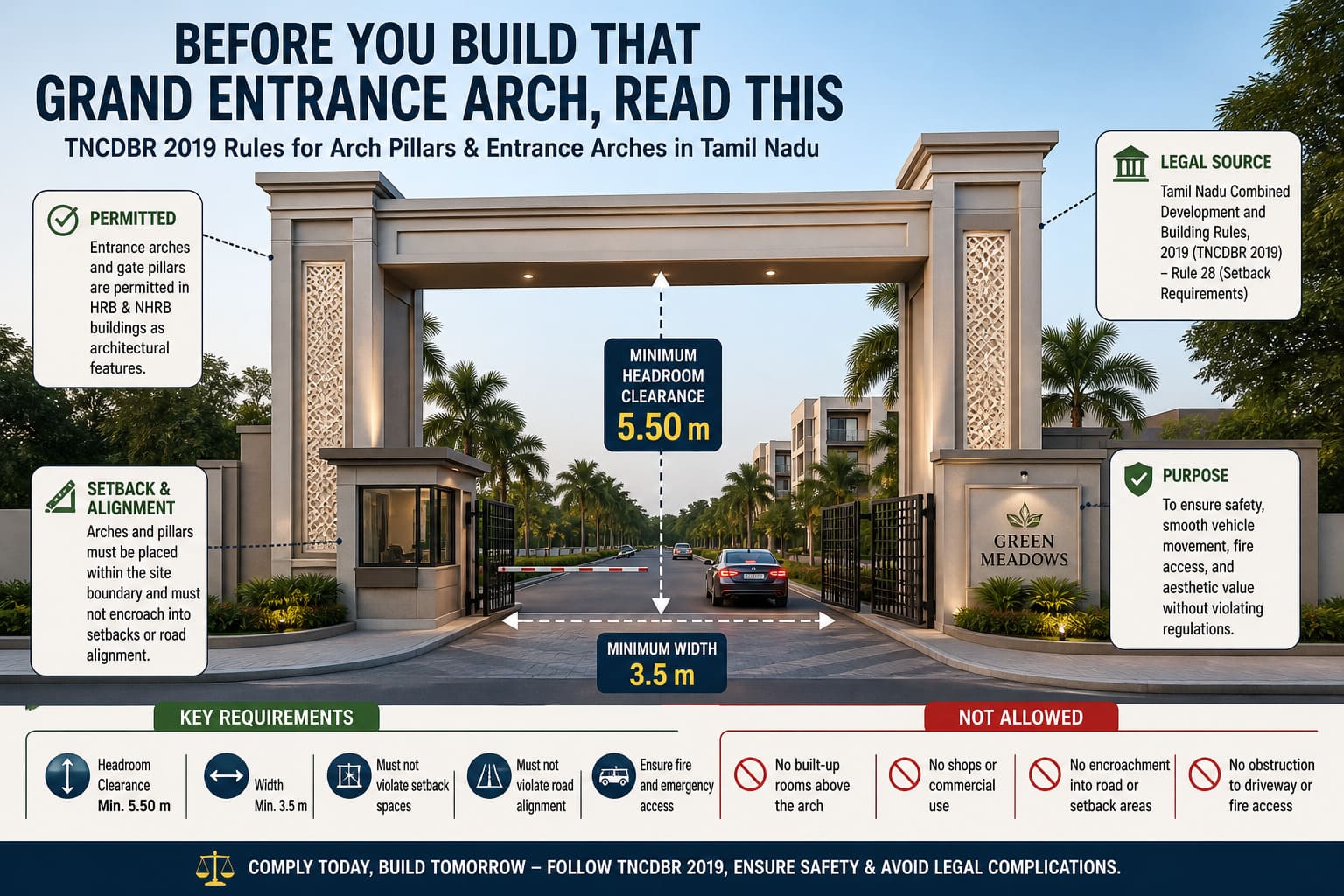
Entrance arches and gate pillars are commonly used in residential layouts, apartments, and commercial developments for identity and access control. However, their construction is not purely aesthetic—they are governed by the Tamil Nadu Combined Development and Building Rules, 2019 (TNCDBR, 2019).
Under these rules, entrance arches are classified as ancillary architectural features, meaning they are permitted—but only within strict regulatory limits.
Are Entrance Arches Allowed in Tamil Nadu?
Yes. TNCDBR explicitly permits:
- Gate pillars
- Entrance arches (with or without beams)
These are allowed in both:
- High-Rise Buildings (HRB)
- Non-High-Rise Buildings (NHRB)
However, they must not function as independent structures or usable built-up spaces.
Minimum Dimensions You Must Follow
The rules clearly define minimum requirements, which are mandatory:
- Headroom clearance: Minimum: 5.50 metres
- This is not just a guideline—it is a safety mandate as it ensures
- Fire engines access that usually requires ~4.5–5.0 m clearance
- Ambulance and service vehicle movement
- Disaster response readiness
- This is not just a guideline—it is a safety mandate as it ensures
- Width: Minimum 3.5 metres
- Must align with driveway width approved in plan
- Should allow:
- Two-way movement (if designed)
- Turning radius for emergency vehicles
- Practically, developers keep 6 m – 9 m clear width in large projects
These dimensions ensure:
- Smooth movement of vehicles
- No obstruction to public infrastructure
Ignoring these requirements can delay or lead to rejection of
- Completion Certificate (CC)
- Fire NOC approvals
Is There a Maximum Height Limit for Arch Pillars?
This is where many misunderstand the law.
- ❌ No explicit maximum height is specified in TNCDBR
- ✅ However, height is indirectly controlled
Practical constraints include:
- The structure must remain non-habitable
- It should not resemble a building or enclosed space
- It must not obstruct:
- Fire access
- Driveways
- Visibility
Height, massing & structural considerations
If building oversized arches, they must be engineered for safety and regulatory compliance.
- Must comply with:
- Wind load (important for tall arches)
- No loose cladding / falling hazard
- Must avoid:
- Using a large concrete arch beam without proper engineering design and load calculations
- Unsupported decorative beams
👉 In real-world approvals, most arches are kept between 6 m to 9 m, though larger landmark entrances may be permitted with scrutiny.
📐 Practical interpretation used by authorities (CMDA / DTCP)
In real approvals
| Element | Typical Accepted Range |
|---|---|
| Headroom (mandatory) | ≥ 5.5 m |
| Practical arch height | 6 m – 9 m |
| Very large landmark gates | 10–15 m (with scrutiny) |
| Extreme cases | Needs special justification |
Setback Rules: The Most Critical Compliance Factor
Even if your dimensions are correct, violations often happen here.
Entrance arches must:
- Be placed within your site boundary
- Not encroach into setback areas
- Not interfere with road alignment or future road widening
Practical Tip:
Developers often set the arch slightly inside the boundary line to avoid compliance issues during approval.
What Is Strictly Not Allowed
To remain compliant, avoid the following:
- ❌ Shops or commercial use within gate pillars
- ❌ Security rooms integrated into the arch structure
- ❌ Enclosed rooms above the arch
- ❌ Any projection into road or setback space
If misused, the structure will be treated as a building, triggering full regulatory scrutiny.
Approval Requirements for Developers
When submitting plans:
- The arch must be shown in:
- Site plan
- Elevation drawings
- Clearly specify:
- Height
- Width
- Distance from boundary
Authorities evaluate whether the structure is:
- Non-obstructive
- Structurally safe
- Within legal limits
Key Takeaway for Builders and Buyers
Entrance arches are permitted—but only when designed as non-intrusive architectural elements.
They must enhance the project visually without compromising safety, access, or regulatory compliance.