

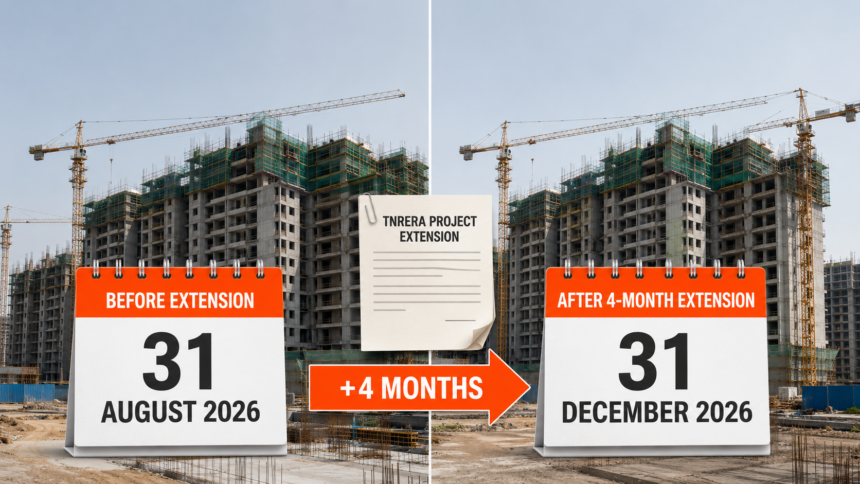
The Tamil Nadu Real Estate Regulatory Authority has granted a four-month automatic extension to eligible real estate projects affected by the West Asia conflict.
According to the TNRERA circular dated August 10, 2026, the relief applies to registered projects whose original, revised or previously extended completion date falls on or after February 28, 2026.
Eligible developers do not have to submit a separate extension application or pay an extension fee.
Why has TNRERA granted this extension?
The Union Ministry of Housing and Urban Affairs issued an advisory on July 31, 2026, asking State RERA authorities to consider four months of relief for affected projects.
This followed an Office Memorandum issued by the Union Finance Ministry on April 29, 2026. It treated the prevailing West Asia situation as a “war” for invoking force majeure where related disruptions affected contractual work.
Section 6 of the RERA Act allows a project’s registration to be extended when events such as war affect its regular development.
Which projects are eligible?
All registered projects with an official completion date on or after February 28, 2026, receive an automatic four-month extension. This extra time applies whether the project is on its original deadline, a revised timeline, or an already extended schedule. The relief is granted universally to eligible projects without developers needing to submit individual applications or pay extra fees.
For example, if a project’s recognised completion date was August 31, 2026, it may now move to December 31, 2026.
Projects with a completion date before February 28, 2026, do not appear to qualify under the stated condition.
S. Ramprabhu, chairman of the DTCP Committee at the Builders Association of India, urged the Tamil Nadu government to reduce delays in TNRERA project registrations and introduce a faster, more efficient approval process.
Does your possession date also change automatically?
Not necessarily.
A homebuyer must check two different dates:
- The possession date written in the Agreement for Sale
- The revised completion date recorded by TNRERA
The circular clearly gives the project four more months under TNRERA. But it should not automatically be treated as changing every possession promise made to buyers.
If the sale agreement contains a valid force-majeure clause covering war, the developer may rely on it. However, the extension should not be used to hide delays caused by poor planning, lack of funds, slow construction or problems that existed before the West Asia conflict.
Buyers may still have rights to seek interest, compensation or refund under Section 18 of RERA, depending on their agreement and the actual cause of delay.
Homebuyers question the blanket relief
The Forum for People’s Collective Efforts(FPCE) has strongly criticised the national advisory.
FPCE president Abhay Upadhyay questioned why a conflict outside India was being used to give a blanket extension when no project-by-project proof of material shortages had been demanded.
The organisation fears that this could create a precedent under which builders cite future international conflicts to seek repeated extensions.
FPCE also pointed out that developers normally choose their own completion timelines, often allowing several years to finish a project. It argued that these timelines should already include a reasonable cushion for temporary supply problems and commercial risks.
Builders get relief—but what about buyers?
This is the most serious concern.
A buyer may have planned to leave a rented house, conduct a housewarming or arrange school admissions based on the promised possession date. A four-month delay could mean four more months of:
- House rent
- Home-loan EMI or pre-EMI
- Storage and moving expenses
- Financial and personal uncertainty
However, the circular does not provide automatic financial relief to affected buyers. Those seeking delay interest, compensation or refund may still have to approach TNRERA or another appropriate legal forum individually.
Check Project Details Using the Verified.RealEstate
Homebuyers can use the Verified.RealEstate RERA Search Tool to quickly find the available registration details of a project. Keep the project’s exact RERA registration number ready and follow these steps:
- Open the Verified.RealEstate RERA Search Tool.
- Scroll down and below the Quick RERA Search, enter the complete RERA registration number without changing its format in the search bar.
- Click the search or submit button.
- Select the correct project and click on the RERA number from the displayed result.
- You can now view the details, including
- the project name,
- promoter,
- registered address,
- registration date,
- project documents
- completion deadline and
- current status.
- Compare the displayed completion date with the date in the original RERA certificate and the possession date promised in the Agreement for Sale.
- If the builder claims an extension, check whether a revised completion date or extension record is available.
Always confirm that the project name and promoter match your documents, as entering an incorrect or incomplete RERA number may produce the wrong result or no result.
Buyers who need further support can contact Verified.RealEstate for offline assistance. The team can communicate with the promoter and relevant authorities to collect available project details, verify the revised completion timeline and help buyers understand how the extension affects their booking.
The bottom line
TNRERA’s circular gives eligible projects four additional months of regulatory time. But it does not automatically erase every earlier delay or cancel all homebuyer rights.
Buyers should not rely only on a builder’s announcement. They must compare the revised TNRERA deadline with the possession date promised in their Agreement for Sale before accepting that the delay is legally protected.