

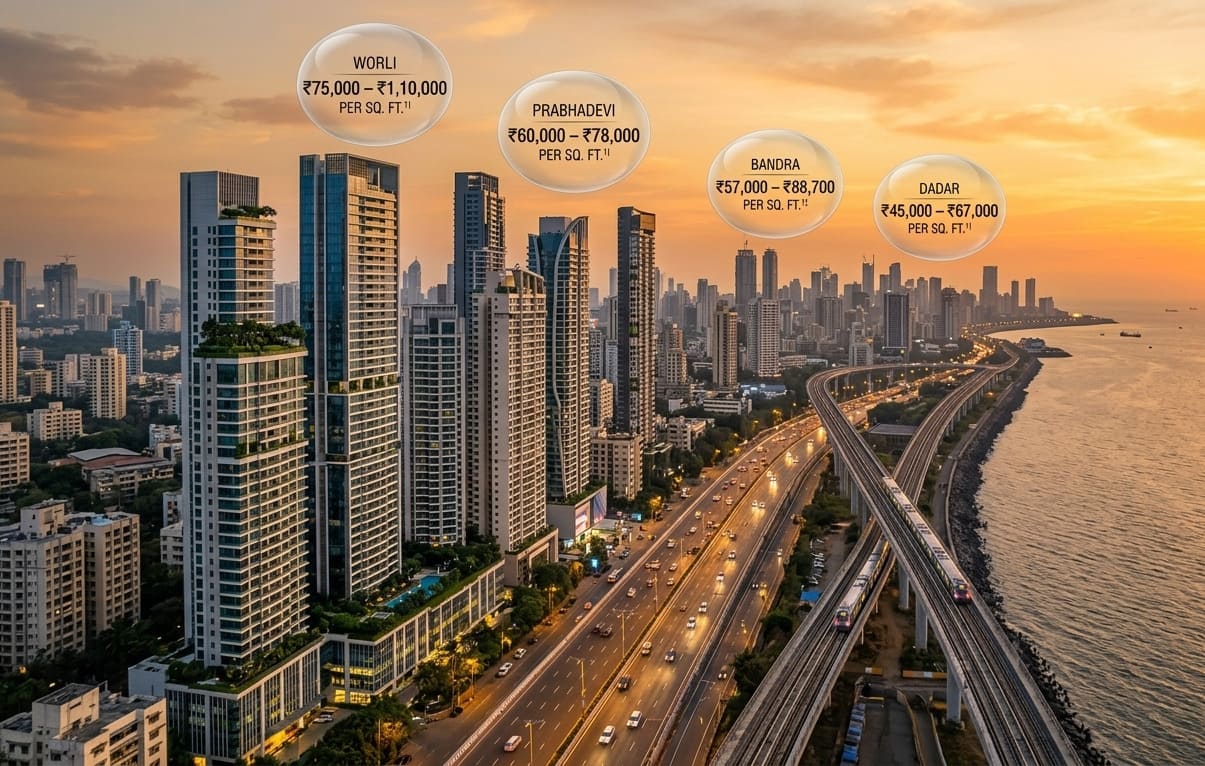
Property prices for homes in Mumbai have hit an all-time high in 2026. In the most expensive neighborhoods like Worli, prices have gone past ₹1,10,000 for just one square foot of space. Homebuyers, builders, and market experts are all trying to figure out why prices are going up so fast. Even though houses are very expensive right now, people are still buying them in record numbers, and Mumbai is seeing the highest number of property registrations in years.
To help you understand what is happening, this guide breaks down the property rates across different areas, the new transport projects driving up prices, and a new government rule that is changing everything.
1. Area-Wise Breakdown: Mumbai Per Sq. Ft. Rates (2026)
Property prices in Mumbai change a lot depending on where you look. Newer areas further away from the main city are cheaper, while old, established neighborhoods are incredibly expensive. Here is a list of the average prices per square foot across Mumbai in 2026:
| Area / Neighborhood | Estimated Price Range Per Sq. Ft. (INR) |
| Mira Road | ₹13,000 – ₹18,500 |
| Thane | ₹16,500 – ₹25,000 |
| Vikhroli | ₹20,000 – ₹30,000 |
| Malad | ₹22,000 – ₹34,000 |
| Mulund | ₹22,000 – ₹34,000 |
| Borivali | ₹25,000 – ₹38,000 |
| Goregaon | ₹25,000 – ₹40,000 |
| Ghatkopar | ₹26,000 – ₹40,000 |
| Chembur | ₹26,000 – ₹42,000 |
| Andheri | ₹32,000 – ₹48,000 |
| Powai | ₹32,000 – ₹50,000 |
| Sion | ₹34,000 – ₹46,000 |
| Wadala | ₹36,000 – ₹50,000 |
| Parel | ₹40,000 – ₹56,000 |
| Matunga | ₹43,000 – ₹57,000 |
| Vile Parle | ₹44,000 – ₹57,000 |
| Byculla | ₹44,000 – ₹65,000 |
| Dadar | ₹45,000 – ₹67,000 |
| Colaba | ₹47,000 – ₹69,000 |
| Santacruz | ₹48,000 – ₹68,000 |
| Khar | ₹51,000 – ₹74,000 |
| Bandra | ₹57,000 – ₹88,700 |
| Prabhadevi | ₹60,000 – ₹78,000 |
| Worli | ₹75,000 – ₹1,10,000 |
2. Main Reasons Why Mumbai Property Prices Are Rising
The huge jump in property prices across Mumbai is happening because of three main reasons:
A. Major New Transport and Infrastructure Projects
The government is opening several massive transport projects that make traveling around the city much faster. Whenever travel times go down, property prices in those areas go up:
- The Coastal Road: Now that the Mumbai Coastal Road is fully open, people can travel from the Western Suburbs to South Mumbai in just a few minutes. This has caused a huge jump in property prices in places like Worli and Bandra.
- The Expanding Metro Network: New metro lines are opening up across the city, making daily commutes much easier. Because of this, prices have jumped in central suburbs like Goregaon, Andheri, and Ghatkopar.
- Atal Setu (MTHL) & New Roads: India’s longest sea bridge has connected the main city to the surrounding regions much better, causing property prices to rise across the whole Mumbai Metropolitan Region.
B. No Open Land Left and the Focus on Redevelopment
Mumbai is surrounded by water on three sides, meaning the city has completely run out of empty land to build on. Because there is no new land, builders have to tear down old housing societies and build new, tall towers in their place. These new buildings come with modern features like multi-level parking, better security, and parks, which naturally makes them much more expensive to buy.
C. Buyers Want Better Lifestyles
After the pandemic, people’s habits changed. Rich individuals, company executives, and Indians living abroad want bigger and better homes. They are selling their old, basic apartments to buy flats in large, secure gated communities that offer luxury facilities like gyms, pools, and big gardens.
3. The Hidden Cost: The Mandatory 40% Dharavi TDR Rule
Apart from normal supply and demand, there is a big government policy change that is quietly pushing up construction costs. This is called the Mandatory Dharavi TDR (Transferable Development Rights) Policy.
What is this rule? In Mumbai, if a builder wants to build extra floors on their building, they have to buy “development rights” (called TDR), which is like buying permission to build higher into the air. Under this new government rule, every single builder in Mumbai must buy at least 40% of these rights directly from the Dharavi Redevelopment Project.
This mandatory rule has made building a house much more expensive because of three reasons:
🎲Elimination of Indexation: Traditionally, TDR had an “indexation” rule. If a developer generated 1,000 sq. ft. of TDR in a cheaper area (like a distant suburb), they couldn’t use all 1,000 sq. ft. in an expensive area like Bandra or South Mumbai—it would be scaled down (e.g., to 100 sq. ft.) to reflect the value difference. The government removed indexation for Dharavi TDR, meaning 1 sq. ft. generated in Dharavi can be loaded as 1 sq. ft. in premium markets like Juhu or Colaba
🎲The 90% Ready Reckoner Cap: The government allows the Dharavi project to sell these rights at up to 90% of the official government land rate (Ready Reckoner rate) of the area where the building is being made. In the past, builders could buy these rights from the open market for just 30% to 60% of the land rate. Forcing them to pay up to 90% has made these permissions the most expensive in Mumbai’s history.
Example : Receiving plot in Bandra
Suppose:
RR rate of Bandra land = ₹5 lakh per sq.m.
Then:
90% × ₹5 lakh = ₹4.5 lakh per sq.m.
This means Dharavi TDR can be sold for up to:₹4.5 lakh per sq.m.
🎲No Choice for Builders: Because builders are legally forced to buy from the Dharavi project, they cannot look around for cheaper options. This takes away open-market competition, and builders have to pay whatever high price is set.
4. How This Affects the Homebuyer
When builders have to pay so much extra money just to get permissions and certificates to construct their buildings, they do not pay it out of their own pockets.
Instead, they add all these extra expenses straight to the final price of the flats. This means the high property rates you see across Mumbai are being kept high because of these unavoidable government charges. Until these rules change or cheaper options become available, the price of buying a flat in Mumbai will stay tied to these heavy extra costs.