

Engineering Sovereign AI Infrastructure at Unprecedented Scale
India has taken a decisive step toward building sovereign artificial intelligence capacity with Larsen & Toubro (L&T) announcing a strategic collaboration with NVIDIA to develop gigawatt-scale AI data centre infrastructure under the IndiaAI Mission.
The partnership merges L&T’s execution strength in large-scale engineering, procurement and construction (EPC) with NVIDIA’s advanced GPU computing platforms to create production-grade AI infrastructure capable of serving enterprises, policymakers and global clients from India.
This is not a pilot program. It is an industrial-scale computing initiative designed to anchor India’s next phase of digital growth.
What Gigawatt-Scale AI Infrastructure Really Means
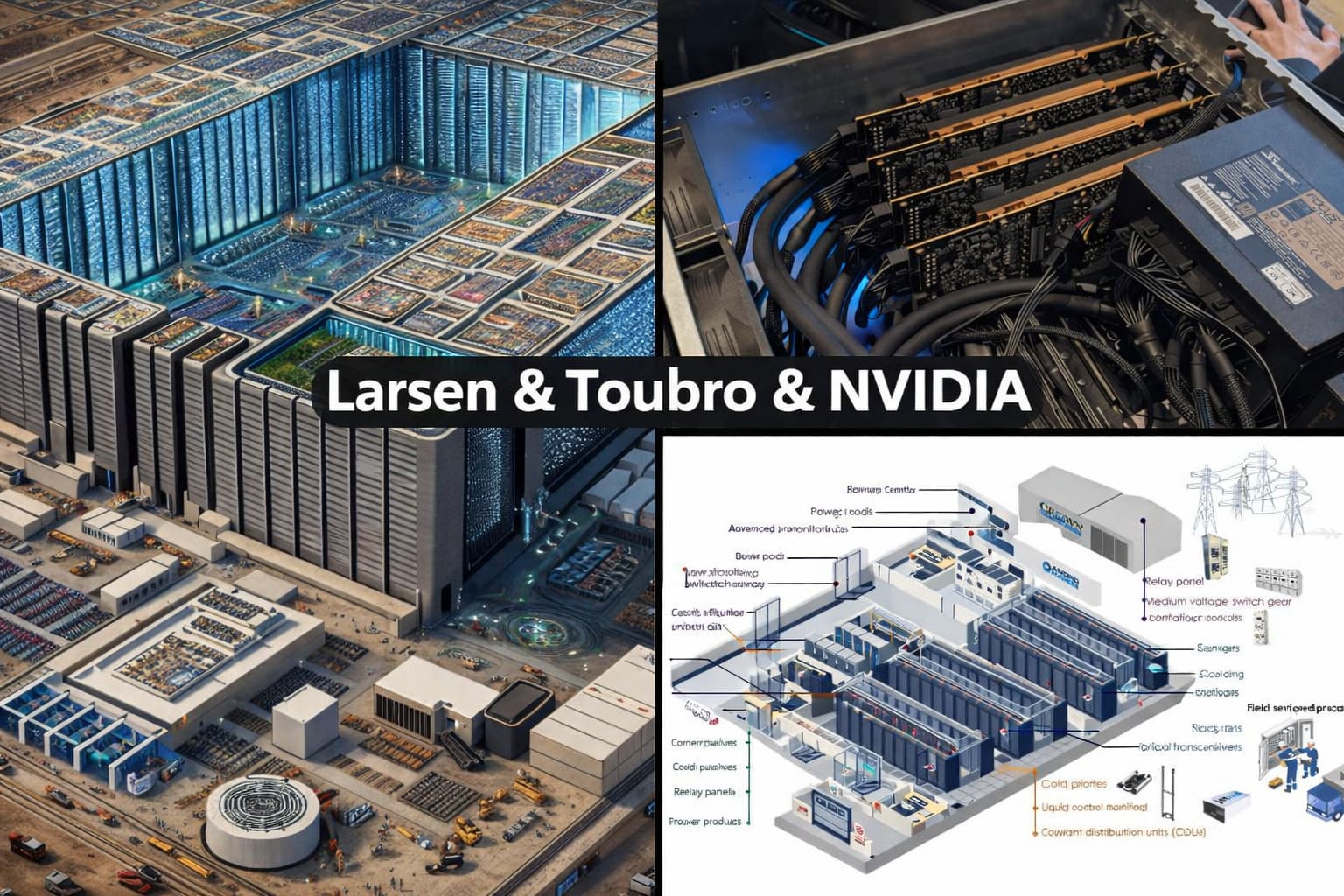
Unlike conventional data centres operating in the tens or hundreds of megawatts, AI-driven hyperscale facilities demand:
- Ultra-high-density 1GPU clusters
- Advanced cooling systems (including liquid cooling)
- Dedicated substations and power redundancy
- Low-latency networking fabrics
- AI-optimised storage and compute orchestration
Such infrastructure is essential to train and deploy large language models, industrial automation systems, financial risk engines, healthcare analytics platforms and national digital governance tools.
Gigawatt-scale deployment signals long-term commitment, not experimental adoption.
Strategic Expansion:
L&T already runs AI-ready data centres powered by green energy in Mumbai and Chennai.
Now, it plans to build three more data centres in:
- Bengaluru
- Panvel (near Navi Mumbai)
- Mahape (in Navi Mumbai)
This means L&T is expanding its AI and data infrastructure across major tech and financial hubs in India.
Why These Cities Matter
Chennai
NVIDIA’s powerful AI GPU systems at L&T’s Chennai data centre will be expanded to handle 30 megawatts (MW) of computing power.
The campus is spread across 300 acres and is designed in a way that it can grow much larger in the future — potentially reaching gigawatt-scale capacity, which is massive and meant for very large AI workloads.
L&T’s Chennai data centre has
- Strong power grid stability
- Industrial ecosystem depth
- Growing AI and technology workforce
Mumbai
- India’s financial nerve centre
- Enterprise-grade demand concentration
- Global connectivity advantages
Together, these locations position India as a regional AI compute hub serving domestic and international markets.
Moving Beyond AI Experimentation
The collaboration aims to shift India from fragmented AI experimentation to full-scale deployment across critical sectors, including:
- Manufacturing (predictive maintenance, robotics integration)
- Energy (grid optimisation and load forecasting)
- Financial services (fraud detection and algorithmic risk modelling)
- Healthcare (AI diagnostics and research analytics)
- Public administration (data-driven governance platforms)
When powerful AI computers (GPUs) are built and operated inside India, companies can use them safely and reliably without sending data outside the country.
This helps businesses:
- Follow Indian data laws
- Keep sensitive information secure
- Get steady and reliable performance
- Avoid delays or dependency on foreign systems
In short, it means Indian companies get strong AI computing power within India, under Indian rules.
Building a National GPU Backbone
The IndiaAI Mission envisions democratised access to high-performance computing. This initiative supports that objective by:
- Reducing dependence on foreign compute ecosystems
- Encouraging indigenous AI model development
- Enabling startups and research institutions
- Supporting enterprise-scale digital transformation
Sovereign AI infrastructure strengthens national resilience while accelerating innovation velocity.
A Foundational Investment in India’s Digital Economy
Recently, Sarvam AI conducted major AI-related initiatives in Tamil Nadu focused on building Indian large language models and AI applications tailored to local languages and governance needs. That effort is centered on AI software and model development.
In contrast, the announcement involving Larsen & Toubro and NVIDIA, revealed at the India AI Impact Summit 2026 under the IndiaAI Mission, focuses on building gigawatt-scale AI data centre infrastructure — the physical compute backbone required to train and run advanced AI systems.
The difference is clear:
- Sarvam AI builds the intelligence (software and language models).
- L&T–NVIDIA builds the AI factory (data centres and GPU infrastructure).
However, both will significantly impact the workforce.
- The L&T–NVIDIA infrastructure push will create demand for data centre engineers, electrical and mechanical specialists, cooling system experts, power infrastructure professionals, semiconductor technicians, and cloud operations teams.
- The Sarvam AI model development ecosystem will generate opportunities for AI researchers, data scientists, prompt engineers, language specialists, AI trainers, and software developers — especially in regional language AI.
In simple terms, one strengthens physical infrastructure jobs, while the other accelerates digital and knowledge-based AI jobs. Together, they expand India’s AI employment ecosystem across both engineering and software domains intelligence.
India is definitively moving toward the creation of a strong, nationally anchored AI network.
- Graphics Processing Unit.
It is a specialized electronic processor designed to handle large amounts of data and complex calculations simultaneously — originally for graphics, but now widely used for AI training and high-performance computing. ↩︎