


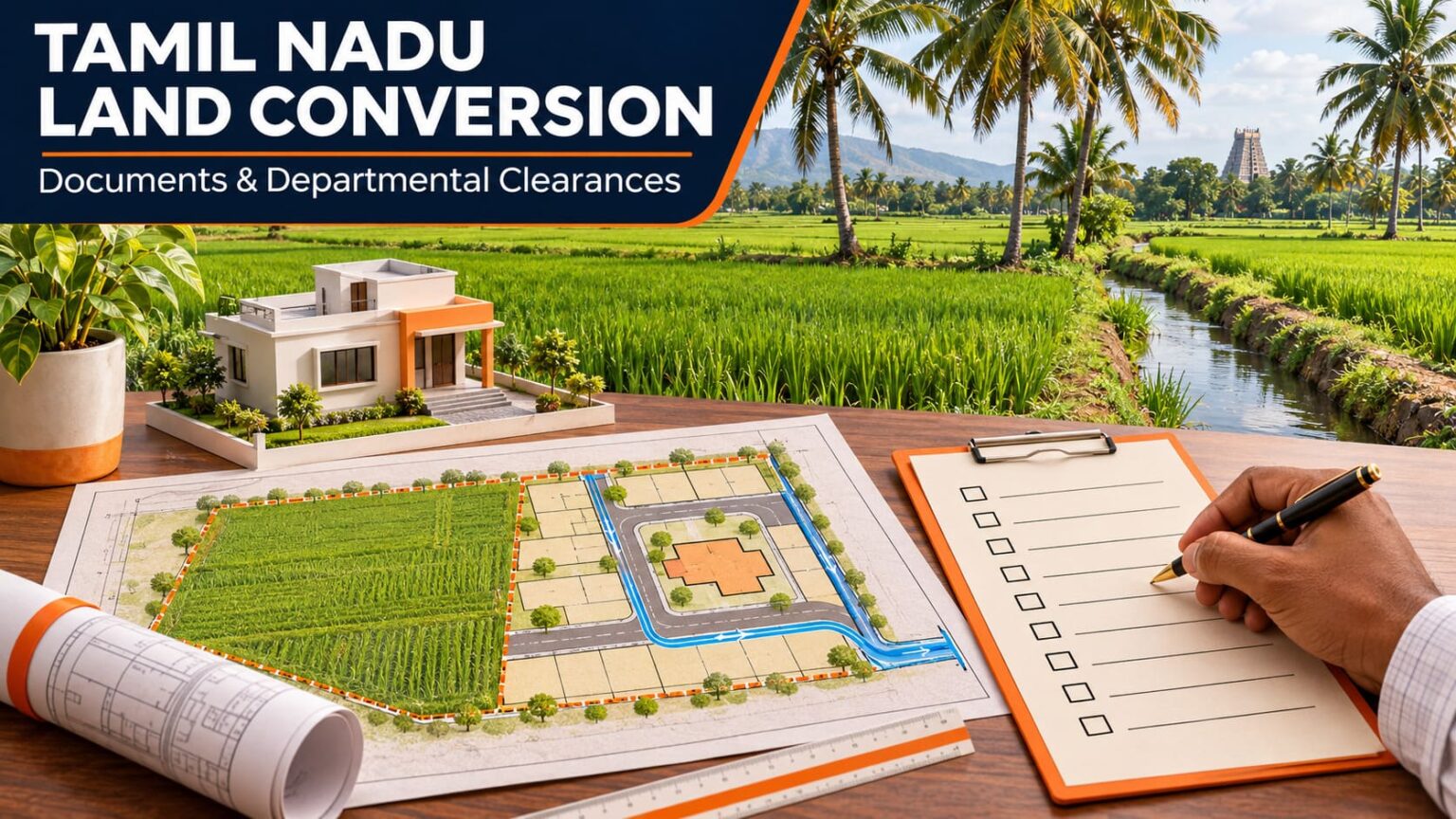
Converting agricultural land for non-agricultural use—such as building a house, shop, or factory—has undergone major updates in Tamil Nadu. The government has introduced fresh rules under the Housing and Urban Development Department to curb illegal construction and streamline land classification across the state.
If you plan to buy or convert dry agricultural land (Punjai) for development, here is everything you need to know.
Why Were these Rules Introduced?
In the past, many developers and individuals constructed buildings on farm land or near waterbodies using incomplete documents. To prevent illegal encroachments, protect natural drainage paths, and speed up genuine approvals, the Tamil Nadu government updated the Change of Land Use Rules.
Under the new system, manual applications are no longer accepted. Everything is handled digitally through a single online portal, requiring strict document checks before construction can start.
Required Documents for Wetland Development
Applicants must provide 9 categories of documents, which include
- Title and Ownership Proof: Self-attested copies of the sale deed, lease deed, or power of attorney.
- Land Records: Patta, Chitta, and Adangal records for the preceding three Fasli years (the years used in Tamil Nadu’s land revenue records, each running from 1 July to 30 June.) , including the current year.
- Plans and Layouts:
- Site drainage plan
- Site plan drawn to scales of 1:400, 1:800, or 1:1,600
- Proposed layout, subdivision plan, or building plan (where applicable)
- Topographical Plan: Must show all existing developments within a 500-meter radius of the proposed development site, aligning with the village map, and drafted at a minimum scale of 1:2,000.
- Online Affidavit: A legal declaration confirming that the proposed development area completely excludes any third-party properties, government lands, or poramboke (waste/common) land.
How the Approval Process Works
Earlier, the process required the District Collector’s concurrence, meaning official agreement or approval. The recent amendment replaces that route with a procedure in which the Director coordinates clearances from the three departmental officials.
The government has completely digitized the approval workflow to eliminate manual delays:
- Online Application: Submit your documents on the Tamil Nadu Single Window Portal (
onlineppa.tn.gov.in).
Mandatory NOCs: Under the reported amendment to Rule 4, the Director must obtain clearance for the submitted application, from the following three officials before processing applications for wet agricultural land:
- The Revenue Divisional Officer (RDO): Checks property title, ownership, and local boundary disputes..
- The concerned Joint Director of Agriculture: Evaluates soil condition and loss of arable land.
- The Executive Engineer of the Water Resources Department: Ensures construction will not block natural water flow, lakes, or irrigation channels.
Fees and Charges
- Application Scrutiny Fee: A flat online processing fee of ₹1,000 per application.
- Conversion Charge: Once approved, you must pay a conversion charge equal to 3% of the land’s official Guideline Value before the final land classification order is issued.
District Collector’s Concurrence is no longer required for conversion of wet agricultural lands in non -plannng areas.
The requirement for the District Collector’s prior concurrence(approval) for converting wet agricultural land (Nanjai) to non-agricultural use in Tamil Nadu’s non-planning areas has been removed. Prior concurrence will now be granted by the Director of Town and Country Planning (DTCP), subject to the required departmental NOCs and applicable safeguards. This does not make land conversion automatic or remove the need for other applicable permissions.
Summary Checklist for Landowners
Before submitting your application online, make sure:
- Your Patta and Chitta reflect your current legal ownership.
- You have collected Adangal extracts for 3 full years.
- Your land does not block natural water drains or encroach on public land.
- All 9 categories of documents are clearly scanned and ready for upload.
Before planning construction, check the land’s applicable classification. For properties within the Chennai Metropolitan Area, Verified.RealEstate’s Land Use Zone Finder helps you explore CMDA maps and identify the mapped land-use zone. This is a useful starting point; land conversion and building permissions still require approval from the relevant authorities.