



The Tamil Nadu Government has introduced a Bill to change how development applications involving wet agricultural land are handled in non-planning areas.
The Tamil Nadu Town and Country Planning (Amendment) Bill, 2026 was introduced in the Assembly on September 1, 2026. It proposes removing the requirement to obtain the District Collector’s prior concurrence for developing wet agricultural land in non-planning areas.
The Government says this additional approval has been causing delays. However, the Bill does not give automatic permission to build on wet land.
What is wet agricultural land?
In this Bill, “wet land” mainly refers to agricultural land classified as wet in Tamil Nadu’s revenue records. It is commonly known as nanjai land and is generally connected to irrigation or wet-crop cultivation.
This is different from an environmentally protected wetland such as:
- A lake, tank, river or canal
- A marsh or natural water-storage area
- Government waterbody poramboke
- A wetland notified under environmental laws
- Land protected under CRZ, forest or wildlife rules
Therefore, the Bill is mainly about revenue-classified wet agricultural land. It does not permit construction over lakes, canals or protected wetlands.
What is a non-planning area?
A non-planning area is an area that is not covered by an approved master plan or another notified planning area.
It may include certain rural and peripheral areas under Directorate of Town and Country Planning (DTCP) jurisdiction. However, being located in a village panchayat does not automatically mean that the property is in a non-planning area.
Some village panchayats already fall within:
- CMDA limits
- Local Planning Areas
- New Town Development Areas
- Urban Development Authority limits
- Other notified DTCP planning areas
The planning jurisdiction must be confirmed using the exact village and survey number.
What happens under the present process?
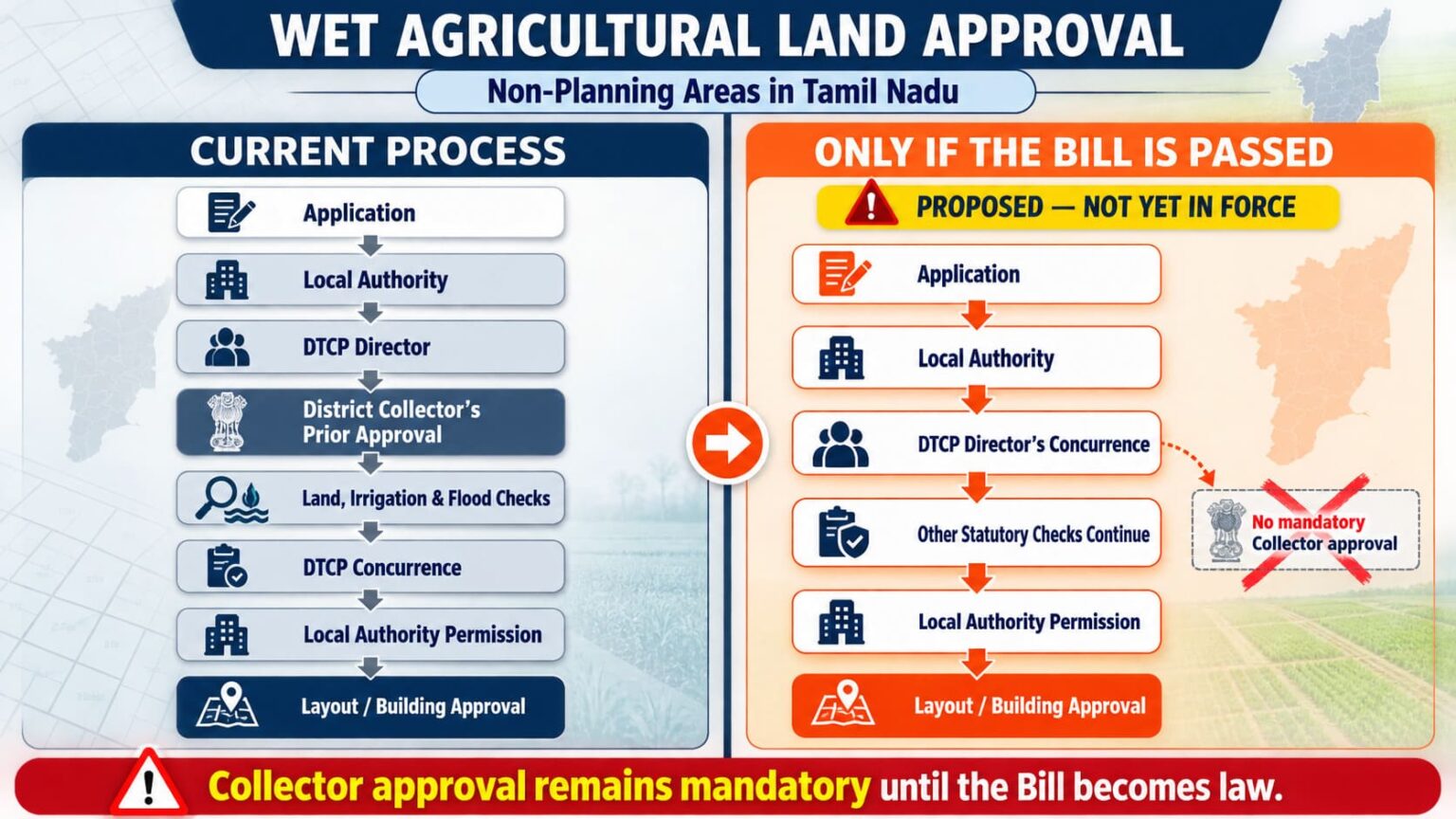
At present, a person seeking to develop wet agricultural land in a non-planning area must apply through the concerned local authority.
Before granting permission, the local authority must obtain the prior concurrence of the Director of Town and Country Planning.
For wet agricultural land, the District Collector’s prior approval is also required. The Collector presently examines matters such as the land’s cultivation status and records, irrigation and ayacut details, nearby water channels and drainage, flooding or waterlogging risks, impacts on groundwater and neighbouring properties, revenue classification and ownership, high-tension lines, and any encroachment on government land or waterbodies.
Only after these checks can the application proceed to the remaining planning and local-body approvals.
What will change if the Bill becomes law?
The Government says the amendment will simplify the approval process and reduce unnecessary delays by removing the District Collector’s mandatory prior approval.
The Director of Town and Country Planning will remain responsible for giving concurrence to the local authority.
In simple terms:
Present system: Local authority + DTCP Director + District Collector concurrence for wet land.
Proposed system: Local authority + DTCP Director concurrence, without the mandatory Collector concurrence.
The same checks continues
The DTCP Director is still expected to examine:
- Whether the land forms part of a waterbody
- Ownership and revenue records
- Encroachments and legal access
- Road and railway proposals
- High-tension electricity corridors
- Drainage and stormwater flow
- Risk of waterlogging
- Compliance with planning and building rules
Separate layout approval, planning permission or building approval will also continue to be necessary, depending on the proposed development.
Environmental restrictions, court orders, CRZ rules and protections relating to lakes, tanks, canals and other public waterbodies will continue to apply.
Why has the Bill faced opposition?
The opposition parties, AIADMK, CPI and CPI(M), opposed the proposal when it was introduced. Their concern is that removing the Collector’s scrutiny could weaken protection for cultivable land and water-sensitive areas. DMK and PMK reportedly sought a detailed discussion and clarification.
The main unanswered question: is whether the DTCP Director will carry out the agricultural, irrigation, drainage and flood-related checks currently undertaken by the Collector.
Is the change already in force?
No. The Bill was introduced in the Assembly on September 1, 2026, but has not yet become law.
The Collector NOC requirement remains in force until the Bill is passed, receives the Governor’s assent, is published in the Tamil Nadu Government Gazette, comes into force, and leads to changes in land-use rules and online approvals.
Until then, property owners and buyers should follow the existing approval requirements.
Disclaimer: This article explains a Bill introduced in the Tamil Nadu Assembly. It is not yet an operative change in law. The final provisions may change during passage or through later rules and notifications.