

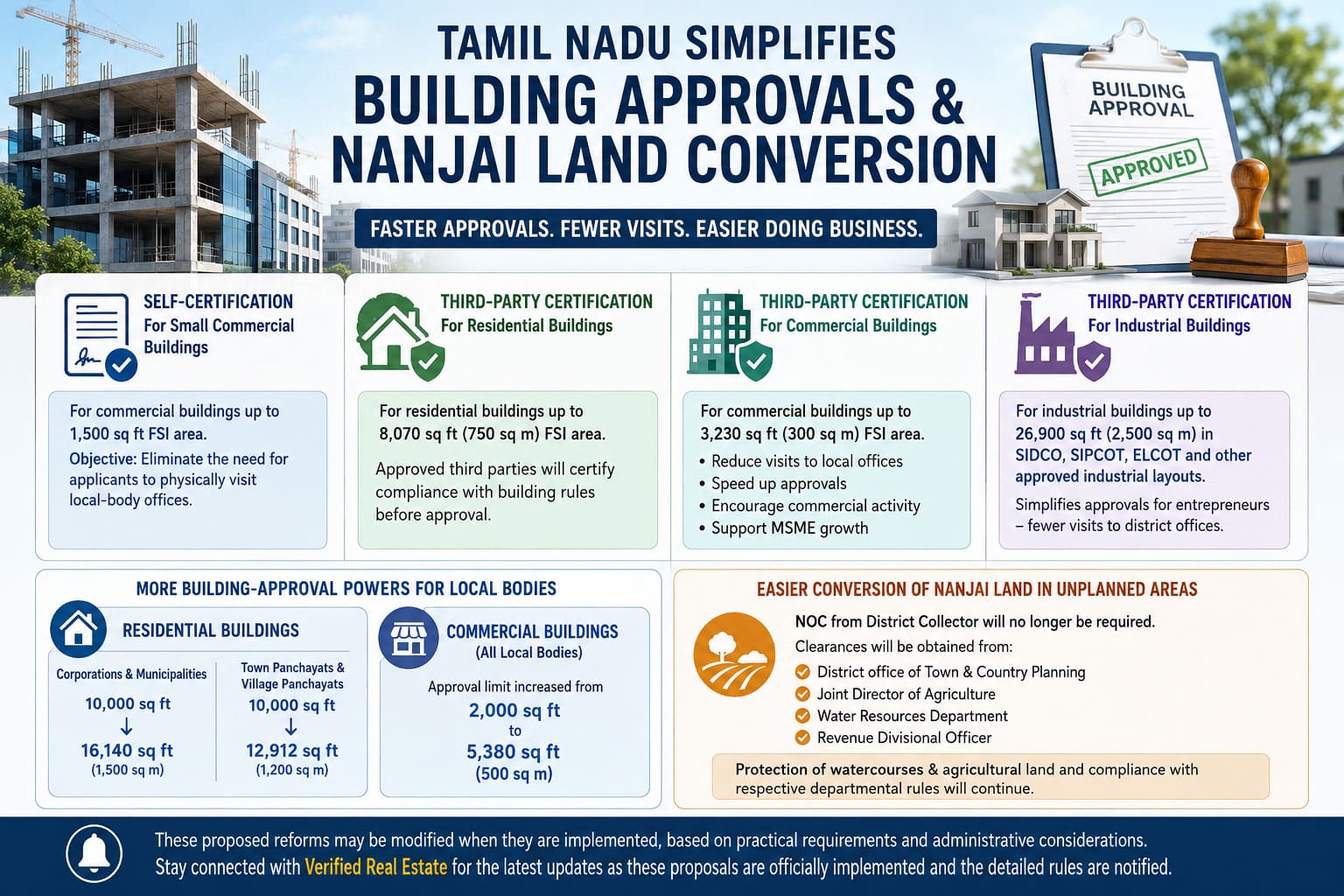
Tamil Nadu is set to simplify several building approval and land-use procedures, with a focus on reducing physical visits to government offices, speeding up approvals and giving greater powers to local bodies.
The proposed measures introduce
- self-certification for certain small buildings,
- third-party certification for specified projects,
- higher approval limits for local authorities and
- a simplified process for converting nanjai land in unplanned areas.
These changes could make the approval process more convenient for homeowners, small businesses, industrial entrepreneurs and property developers.
Simplified Certification and Approval for Small Buildings
Self-Certification for Small Commercial Buildings
For the first time, self-certification-based building approval will be introduced for small commercial buildings with an FSI area of up to 1,500 sq ft.
Under this system, eligible applicants can certify that their proposed buildings comply with the applicable building regulations and obtain approval without making repeated physical visits to local-body offices.
Third-Party Certification for Residential Buildings
Third-party certification means an approved professional or agency verifies that a building complies with the required rules before the government issues the approval.
For residential buildings with an FSI area of up to 8,070 sq ft (750 sq m), compliance with building rules can be certified by an approved third party.
Third-party certification means that an approved professional or agency verifies whether the proposed building complies with the required regulations before the government issues approval. Once the certification is completed, building approval can be issued.
Third-Party Certification for Small Commercial Buildings
Third-party certification will also be introduced for commercial buildings with an FSI area of up to 3,230 sq ft (300 sq m).
Approved third parties will verify whether the proposed building complies with the applicable regulations before approval is granted. For small commercial projects, this could significantly reduce the administrative burden associated with obtaining building approval.
Why the New Certification System Is Being Introduced
The common objective of these measures is to simplify and speed up the building-approval process by reducing dependence on repeated visits to local government offices. By allowing eligible applicants to use self-certification or approved third-party verification, the system is intended to:
- Reduce visits to local offices
- Speed up building approvals
- Reduce administrative delays
- Make the approval process more convenient and transparent
- Encourage small-scale commercial activity
- Make it easier to start and operate businesses
- Support MSMEs and small traders
Overall, the new system is designed to shift routine compliance verification away from lengthy government procedures while retaining regulatory oversight.
Faster Approvals for Industrial Buildings
Industrial entrepreneurs will also get a simplified approval mechanism through third-party certification.
The system will apply to industrial buildings located in:
- SIDCO layouts
- SIPCOT layouts
- ELCOT layouts
- Other approved industrial layouts
The proposed limit is 26,900 sq ft (2,500 sq m).
An approved third party will verify compliance with building regulations before the approval is issued. The measure is aimed at reducing the need for entrepreneurs to repeatedly approach district-level offices and facilitating faster establishment or expansion of industrial facilities.
Local Bodies Get Greater Powers for Residential Approvals
Another significant change is the proposed increase in the building-approval powers of local bodies.
Corporations and Municipalities
The approval limit for residential buildings will increase from 10,000 sq ft to 16,140 sq ft (1,500 sq m).
Town Panchayats and Village Panchayats
The limit will increase from 10,000 sq ft to 12,912 sq ft (1,200 sq m).
This means a larger number of smaller residential building applications can potentially be processed directly at the local-body level instead of being referred to higher authorities.
Commercial Building Approval Limits Increased
The approval powers of all local bodies for commercial buildings will also be expanded.
The existing limit of 2,000 sq ft will increase to 5,380 sq ft (500 sq m).
This is particularly significant for small traders and businesses, as more commercial building applications can be handled at the local-body level.
Nanjai Land Conversion Procedure to Be Simplified
The proposed changes also address the conversion of nanjai (wet agricultural) land in unplanned areas.
At present, converting nanjai land for non-agricultural purposes such as residential, commercial or industrial development requires a No Objection Certificate (NOC) from the District Collector.
Under the proposed simplified procedure, the required clearances will instead be obtained from the relevant departments, including:
- District office of Town and Country Planning
- Joint Director of Agriculture
- Water Resources Department
- Revenue Divisional Officer
This is intended to streamline the process by obtaining clearances directly from the departments responsible for the relevant aspects of land use.
Does This Mean Nanjai Land Can Now Be Automatically Converted? NO
The proposed change does not automatically permit development on agricultural or nanjai land. Watercourses, agricultural protections, departmental rules, land classification, planning status and required approvals must still be verified before development.
What These Changes Mean for Property Owners, Businesses and Buyers
Tamil Nadu’s proposed reforms aim to make building approvals faster, more decentralised and less dependent on physical visits to government offices.
Higher local-body limits, self-certification and third-party certification could reduce delays for eligible residential, commercial and industrial projects.
However, simplified approvals do not remove regulatory requirements. Projects must still comply with planning, building, environmental, land-use and departmental rules.
The reforms may ease approval procedures, but due diligence remains essential, especially for agricultural land and environmentally sensitive areas.
❌ These proposed reforms may be modified when they are implemented, based on practical requirements and administrative considerations. Stay connected with Verified Real Estate for the latest updates as these proposals are officially implemented and the detailed rules are notified.
Official announcement:
https://cms.tn.gov.in/cms_migrated/document/announcements/hud_t_ann_2026_27.pdf
TNHB website:
https://tnhb.tn.gov.in/
Disclaimer: This article is based on the Tamil Nadu Government’s 2026–27 Assembly announcement. Project prices, sizes, eligibility, timelines and booking conditions have not yet been released and may change when TNHB publishes the detailed project notifications.