

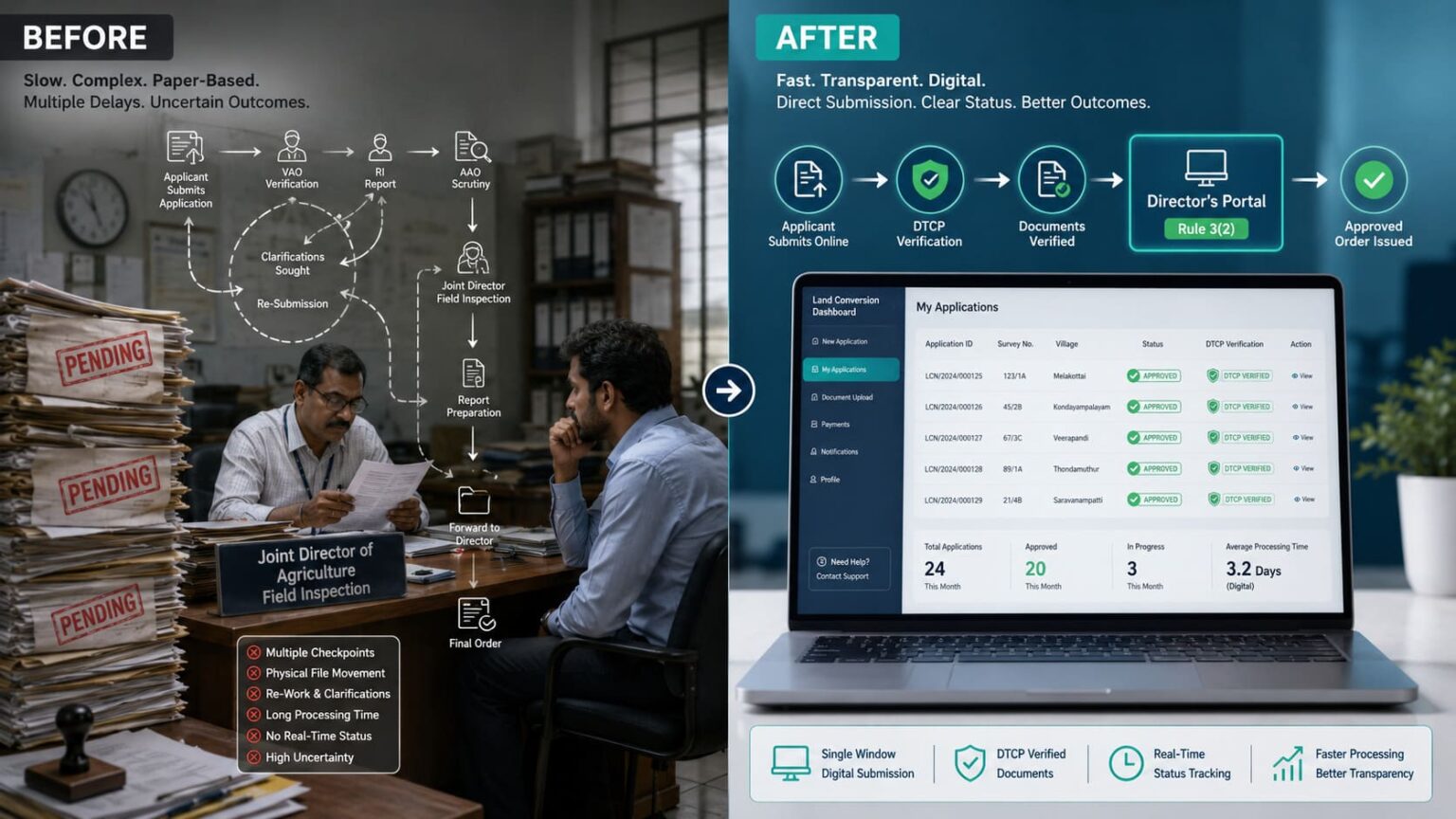
The Housing and Urban Development Department of Tamil Nadu issued G.O. (Ms) No. 149 on July 31, 2026, introducing significant amendments to land conversion rules across the state. Published in the Tamil Nadu Government Gazette Extraordinary on August 3, 2026, this notification updates the Tamil Nadu Change of Land Use (From Agriculture to Non-agriculture Purposes in Non-planning Areas) Rules, 2017.
This reform streamlines the approval process for converting agricultural dry land to non-agricultural uses—such as residential layouts, commercial developments, or industrial projects—in non-planning areas.
What is G.O. (Ms) No. 149 About?
G.O. (Ms) No. 149 simplifies the Change of Land Use (CLU) approval process for dry agricultural lands in non-planning areas.
Exercising powers under Section 122(1) read with Section 47-A of the Tamil Nadu Town and Country Planning Act, 1971, the Government has eliminated extra administrative dependencies to speed up property developments.
- Section 122(1) – gives the Government the legal authority to draft and amend rule.
- Section 47-A – is the specific provision governing land conversion in non-planning areas.
Key Legal Sections & Rule Changes Breakdown
The notification directly modifies two specific rules within the 2017 framework:
1. Amendment to Rule 4, Clause (b): Direct Authority for Dry Lands
- The New Provision: “(b) In case of dry lands, the Director shall take a decision himself to issue prior concurrence, after satisfying with the documents uploaded by the applicant under sub-rule (2) of rule 3.”
- Previous Process: Applicants previously had to wait for a mandatory field verification and recommendation report from the Joint Director of Agriculture before the Town and Country Planning Directorate could consider the request.
- What Changes Now: The Director of Town and Country Planning (DTCP) can now directly assess uploaded documents and issue prior concurrence without waiting for an external departmental report.
2. Omission of Rule 7, Sub-rule (2): Removal of Redundant Reports
- The New Provision: “(2) in rule 7, sub-rule (2) shall be omitted.”
- Previous Process: Rule 7(2) legally mandated that the Director base their final decision on the Joint Director of Agriculture’s report for dry lands.
- What Changes Now: Deleting this sub-rule removes the legal dependency on the Agricultural Department’s report for dry land conversions.
How This Impacts Landowners and Real Estate Developers
- Faster Turnaround Times: Cutting out the requirement for secondary agricultural reports reduces processing delays for CLU applications.
- Simplified Online Verification: Approvals are now primarily document-driven based on files uploaded under Rule 3(2).
- Wet Land Regulations Remain Unchanged: This streamlined process applies exclusively to dry lands. Wet land conversions still require strict scrutiny, including Collector concurrence, to protect active farming ecosystems.
Documents Required Under Rule 3(2)
To apply for Change of Land Use (CLU) under Rule 3(2), applicants must submit Form-I and a non-refundable scrutiny fee of ₹1,000 per plot. The documents that should be submitted along with the form are:
- Ownership Proof: Self-attested copy of the Sale Deed, Lease Deed, or Power of Attorney.
- Local Authority Certificate: Ownership certificate from the BDO (rural) or Municipal Commissioner/Executive Officer (urban).
- Revenue Records: Latest Patta, TSLR, Encumbrance Certificate (EC), and self-attested Chitta & Adangal.
- Site Sketches: Field Measurement Book (FMB) sketch and a detailed Site Plan showing boundaries, access roads, and nearby water bodies.
- Self-Declaration Affidavit: Declaration confirming no encroachment on government land, water bodies, or public roads.
Important: Supreme Court Restrictions on Highway Land Conversion
Despite Tamil Nadu’s streamlined approval process under G.O. (Ms) No. 149, landowners must remain aware of the recent Supreme Court directive issued to all states.
Under the April 2026 mandate, strict buffer zones now prohibit any Change of Land Use (CLU) or new construction within 40 metres (for residential) and 75 metres (for commercial) from the centreline of any National Highway.
Consequently, while the state has removed agricultural department hurdles for dry land conversions, applications will still be outright rejected if the property falls within these federally enforced highway setback limits.
Land Survey Services Overview
Verified Real Estate offers professional land surveying services to accurately establish property boundaries, prevent legal disputes, and assist with land development, construction, and registration requirements.