

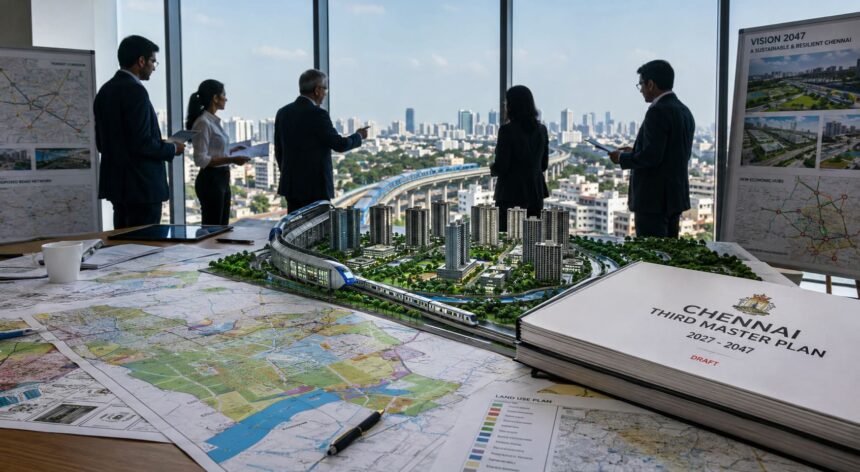
The Tamil Nadu government has decided to have Chennai’s draft Third Master Plan (TMP) reviewed by international urban planning experts before its final notification, marking a significant step in shaping the city’s future growth trajectory. The Chennai Metropolitan Development Authority (CMDA) has been preparing the plan for nearly five years at an estimated cost of ₹2.5 crore, with the new blueprint expected to guide Chennai’s development until 2047.
What Has Been Done So Far?
TThe preparation of the Third Master Plan commenced in December 2020. Since then, CMDA has:
- Conducted public consultations across Chennai and suburban areas.
- Held stakeholder meetings covering housing, transport, infrastructure, environment, economy, and technology.
- Undertaken more than 15 studies on land use, blue-green infrastructure, income patterns, gender-inclusive planning, temporal growth, and climate resilience.
- Prepared a vision document that forms the foundation of the master plan.
The plan also proposes major urban reforms such as transit-oriented development, vertical growth through higher FSI, mixed-use development, climate-resilient infrastructure, and the creation of new economic hubs.
Why Is an International Review Being Considered?
According to reports, the government intends to have the draft reviewed because certain aspects of the plan require further refinement to ensure practical implementation and alignment with global urban planning standards. International experts are expected to examine the plan’s proposals, identify any shortcomings, and provide recommendations that could help create a more robust and future-ready framework for Chennai’s growth.
If significant modifications are suggested, the government may revise portions of the draft before placing it in the public domain.
Chennai Metropolitan Area Expansion
One of the most significant developments during the preparation of the Third Master Plan was the expansion of the Chennai Metropolitan Area (CMA) in 2022. The planning area increased from approximately 1,189 sq km to about 5,904 sq km, bringing several additional urban and peri-urban regions under the metropolitan planning framework.
The integration of these newly added areas into the future planning framework is still under consideration, with separate regional plans expected to address the development needs of the expanded regions.
Why the Third Master Plan Matters for Real Estate
The Third Master Plan could have far-reaching implications for the real estate sector, particularly in:
- Metro corridors
- Transit-oriented development zones
- Mixed-use development areas
- Industrial clusters
- Commercial hubs and growth corridors
Potential impacts could include:
- Increase in land values.
- Higher development potential.
- Greater redevelopment opportunities.
- New infrastructure investments and economic activity.
However, since the draft has not yet been officially notified, landowners, developers, and investors should closely monitor these aspects and exercise caution before making any investment or project planning decisions until the final plan is released.
Grid of Roads Proposal: A Key Aspect to Watch
Another important aspect that stakeholders may need to closely monitor is the proposed Grid of Roads (GoR) network, which has already generated concerns within the real estate sector.
The proposal seeks to establish a planned road hierarchy and improve connectivity across the Chennai Metropolitan Area. However, developers and landowners have raised concerns that some proposed road alignments pass through approved layouts and private developments, potentially affecting project planning, land utilisation, and future approvals.
As the Grid of Roads proposal is expected to form part of the future planning framework, stakeholders may need to carefully examine whether their properties are impacted by any proposed road reservations before initiating development projects or making investment decisions.
How Could the Third Master Plan Impact Stakeholders?
Landowners
Properties located within future growth corridors, transit-oriented zones, and areas identified for higher development potential could witness appreciation in land values and increased redevelopment opportunities.
Developers and Builders
A well-defined master plan can provide planning certainty, unlock new development corridors, and create opportunities for high-density, mixed-use, and transit-oriented projects.
Commercial Property Owners
Commercial assets situated near transport nodes, economic hubs, and major infrastructure corridors could benefit from increased demand, improved connectivity, and higher rental and capital values.
What Could the Final Third Master Plan Include?
Based on the various studies undertaken by CMDA and the themes discussed in public consultations and previous reports, the Third Master Plan is expected to address areas such as land use, housing, transportation, economic development, environmental management, climate resilience, infrastructure planning, and implementation mechanisms. However, the final structure and contents of the plan will become clear only after the draft is officially released.
What Happens Next?
The next stages in the process are expected to include:
- Review of the draft by international experts.
- Release of the draft Third Master Plan.
- Public comments and objections.
- Any major recommendations could lead to revisions before the draft is released.
- Government approval.
- Final notification before the existing Second Master Plan expires.
As Chennai prepares for its next phase of urban growth, the Third Master Plan could become one of the most influential policy documents for the city’s real estate, infrastructure, and economic development over the coming decades.