

In the case of Vadiyala Prabhakar Rao & Ors. v. The Government of Andhra Pradesh & Ors., the Supreme Court dealt with a major dispute involving nearly 600 acres of land situated in Survey No. 81 of Kalvalanagaram Village, Telangana.
The land formed part of a larger area proposed to be declared as reserve forest under the Hyderabad Forest Act through a 1950 Gazette Notification.
The appellants claimed ownership over the land based on:
- Pattas allegedly granted during the Nizam era in 1931–32
- Revenue records including:
- Faisal Patti
- Pahanies
- Vasool Baqi entries
The dispute began after the authorities treated the land as forest land and rejected the appellants’ ownership claims.
Proceedings Before Authorities and Courts
Joint Collector’s Decision (2003)
In 2003, the Joint Collector rejected the appellants’ claim on the following grounds:
- No original patta or primary title document was produced
- Revenue entries alone could not establish ownership
- The land continued to remain classified as forest land
The authority held that mutation and revenue records were insufficient to prove legal title.
Andhra Pradesh High Court – Single Judge
The appellants later approached the Andhra Pradesh High Court.
A Single Judge accepted their claim and quashed the forest proceedings, effectively recognizing their entitlement over the land.
Division Bench Reversal
However, the Division Bench of the High Court reversed the Single Judge’s decision.
The Division Bench held that:
- Ownership cannot be proved merely through revenue records
- Primary title documents were essential
- Serious disputes relating to title must be decided by civil courts
Aggrieved by this, the appellants approached the Supreme Court.
Supreme Court Judgment
The Supreme Court dismissed the appeal and upheld the Division Bench judgment.
The judgment emphasized that the appellants failed to establish ownership because they could not produce the original title documents through which title was allegedly derived.
The Court observed:
“Appellants failed to prove the primary document through which title to the property is claimed by them.”
The Court further clarified that writ proceedings under Article 226 of the Constitution are not the proper forum for deciding complicated title disputes involving disputed facts.
Supreme Court Reiterates: Revenue Records Do Not Confer Title
While deciding the case, the Supreme Court once again summarized settled legal principles relating to:
- Mutation entries
- Revenue records
- Jamabandi
- Pattas
- Possession versus ownership
The Court reiterated that:
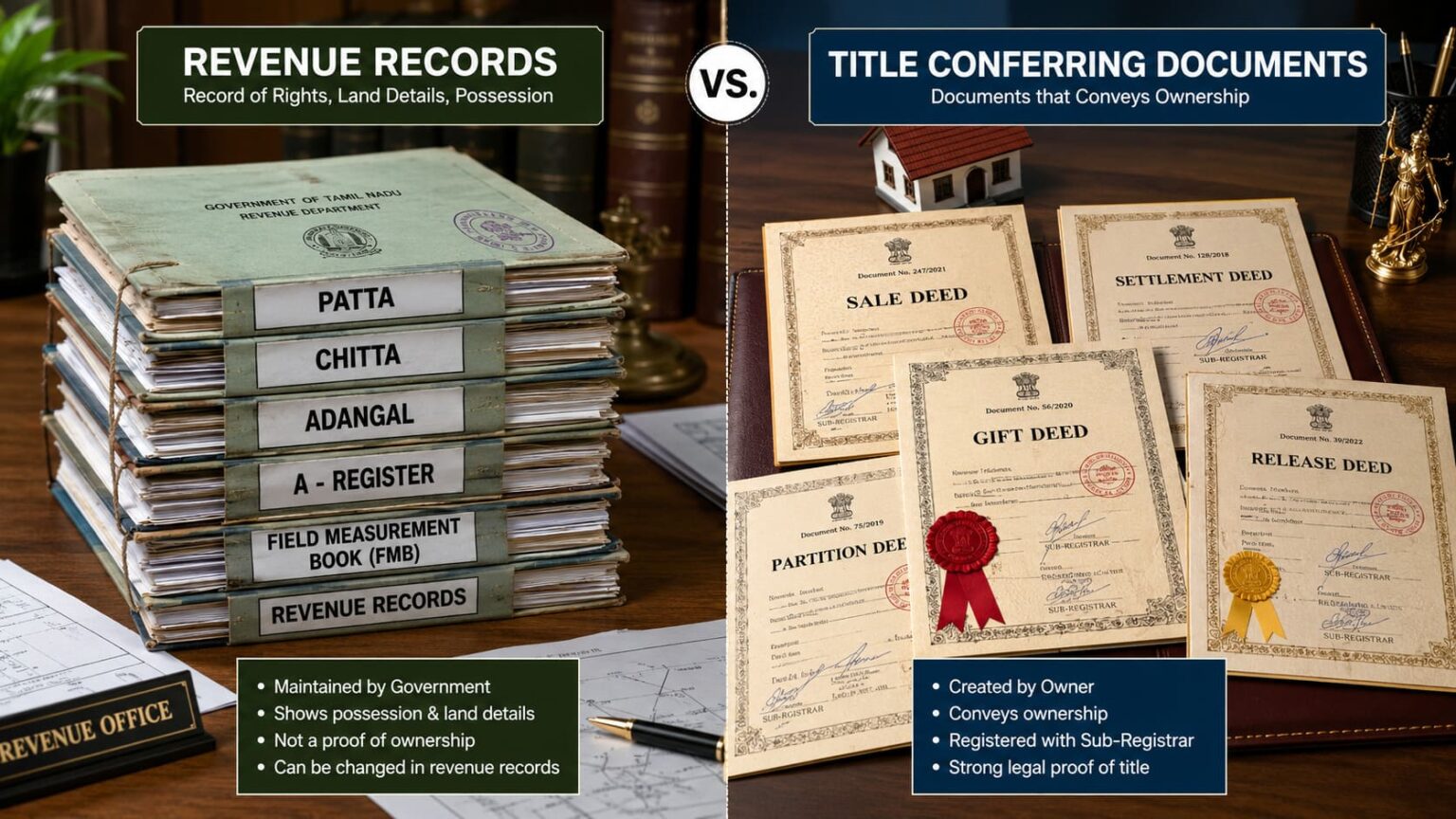
- No Title Conferred: Revenue records or Jamabandi do not serve as proof of title or ownership and cannot be used to establish property ownership.
Fiscal Purpose: Their primary function is to track who is responsible for paying land revenue to the government.
Possession vs. Title: While revenue records cannot prove ownership, they may sometimes indicate who is in possession or occupation of the land.
Patwari Responsibility: The maintenance and custody of these records fall to the Patwari, and it is noted that these records can be manipulated to suit various situations.
No Title Conferred Through Revenue Records
The Supreme Court categorically held that:
Revenue records or Jamabandi entries are not proof of ownership and cannot establish legal title over property.
Explanation
Even if a person’s name appears in:
- Patta, Mutation records, Pahani, Jamabandi, Revenue registers.
it does not automatically make that person the legal owner of the land.
Ownership must be established through valid legal documents such as:
- Registered Sale Deed
- Gift Deed
- Partition Deed
- Settlement Deed
- Court Decree
- Succession documents
Final Thoughts
The Supreme Court’s judgment serves as a major reminder that property ownership in India cannot be established merely through revenue entries or mutation records.
Legal title flows from:
- Valid registered documents
- Lawful transfer of rights
- Proper succession
- Judicial determination where necessary
For property buyers and investors, this judgment strongly reinforces the importance of proper legal due diligence before purchasing any land or property.