

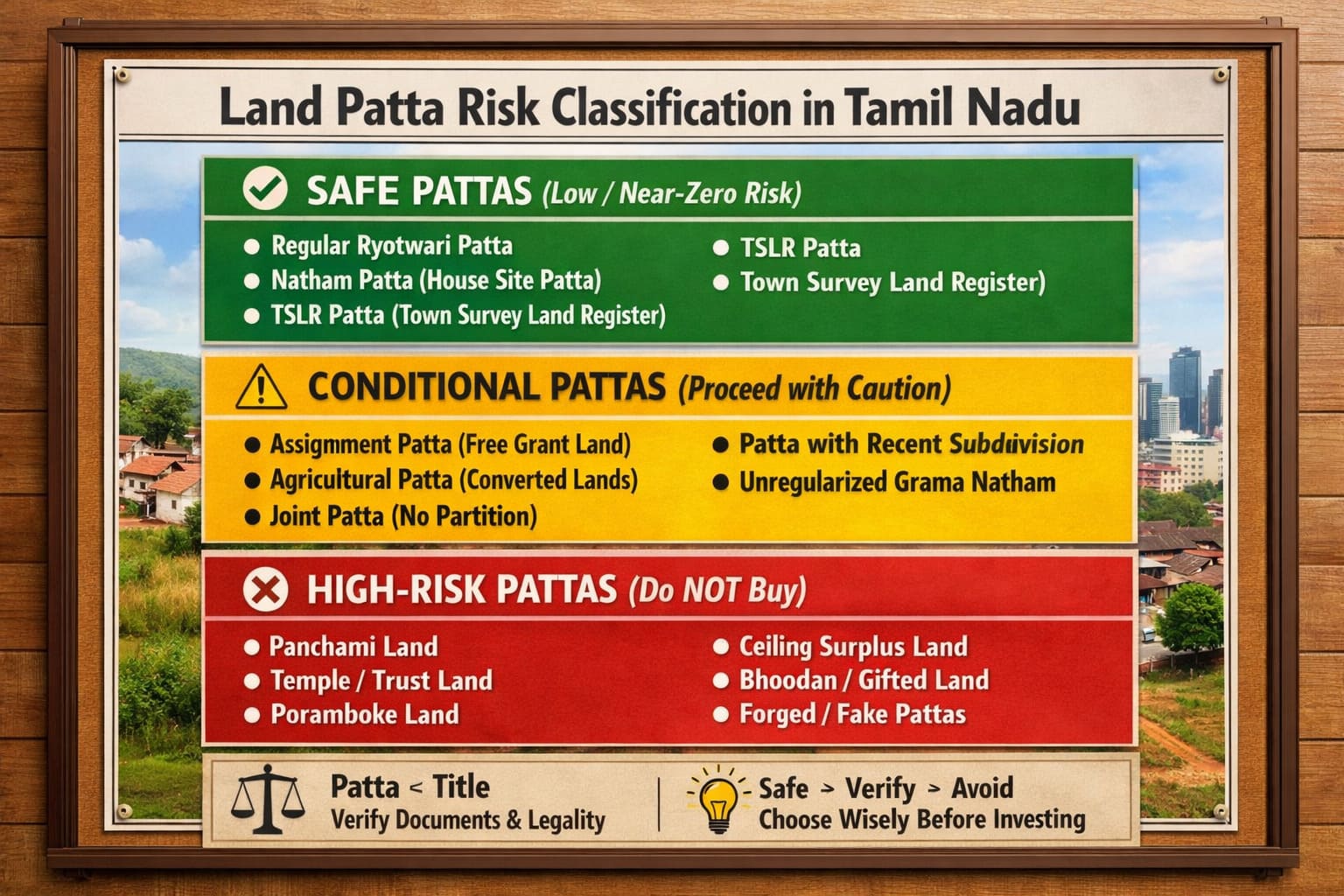
In Tamil Nadu real estate, the patta is one of the most critical land records, serving as the primary government-recognized proof of lawful possession and revenue classification. It plays a central role in transactions, bank financing, and ownership verification.
However, not all pattas carry the same legal strength. The type of patta, its origin, and attached conditions can significantly impact the safety of a property purchase.
👉 That’s why understanding which pattas are safe, conditional, or high-risk is essential before making any investment decision.
This guide provides a clear, practitioner-level classification to help you assess land risk with confidence.
1. SAFE PATTAS (Low / Near-Zero Risk)
These pattas generally indicate clear ownership and strong legal standing, provided standard due diligence is completed.
Regular Ryotwari Patta
- Issued under the Ryotwari system
- Confirms private ownership rights
- Freely transferable
- Widely accepted by banks
👉 Considered the gold standard of land ownership in Tamil Nadu.
Natham Patta (House Site Patta)
- Issued for residential land in village areas
- Recognizes ownership for housing purposes
- Can be sold, inherited, and registered
⚠️ Verify:
- No classification as disputed Grama Natham poramboke
- No pending government claims
Town Survey Land Register (TSLR) Patta
- Urban equivalent of patta
- Maintained by revenue authorities in towns/cities
- Provides strong ownership backing
Joint Patta (With Clear Partition)
- Multiple owners listed
- Safe only when a registered partition deed exists
- Clearly defined boundaries are essential
2. CONDITIONAL PATTAS (Proceed with Strict Verification)
These pattas are not inherently unsafe, but require deep legal due diligence before purchase.
Assignment Patta (Government Grant Land)
- Issued to beneficiaries under welfare schemes
👉 Key Risks:
- Lock-in period (10–30 years or more)
- 1Non-alienation clauses
- Government resumption rights
✔️ Buy only if:
- Restriction period is over
- No violation of grant conditions
Agricultural Patta (Converted Lands)
- Originally classified as agricultural land
✔️ Safe only if:
- Proper conversion approvals obtained (DTCP / CMDA / Local Authority)
- No zoning violations
Joint Patta (Without Partition)
- Multiple legal heirs share ownership
👉 Risk:
- Any co-owner can legally challenge the sale
✔️ Safe only if:
- All co-owners sign the sale deed
OR - A registered partition deed exists
Patta with Recent Subdivision / Transfer
- Newly divided land parcels
✔️ Must verify:
- Parent document chain (minimum 30 years)
- No fraudulent fragmentation
Grama Natham (Unregularized)
- Common in rural areas
✔️ Proceed only if:
- Long-term possession proven
- Tax receipts available
- Patta issued in seller’s name
- No competing claims
3. HIGH-RISK PATTAS (Avoid Completely)
These categories often lead to title failure, eviction, or legal consequences.
Panchami Land
- Assigned to Scheduled Castes under protective laws
👉 Legal Position:
- Non-transferable
- Any sale is void from the beginning (void ab initio)
👉 Buyer Risk:
- Government can reclaim land
- No compensation protection
Temple / Trust Land (HR&CE Land)
- Owned by religious institutions
👉 Even if a patta exists:
- Sale without approval is invalid
Poramboke Land
- Government land (water bodies, roads, common land)
👉 Risk:
- Pattas may be temporary or improperly issued
- Subject to eviction at any time
Forest Land
- Governed by forest laws
👉 Reality:
- Possession ≠ Ownership
- High eviction and legal risk
Ceiling Surplus Land
- Land acquired under 2land ceiling laws
👉 Transactions are:
- Legally defective
- Subject to government action
Bhoodan Land
- Land donated for redistribution
👉 Issues:
- Transfer restrictions
- Complex title disputes
Patta Based on Fraud or Forgery
- Fake inheritance
- Suppression of legal heirs
👉 Legal Principle (as affirmed in Vesa Holdings Pvt. Ltd. v. State of Kerala):
- Fraudulent transactions are void
- No protection—even for innocent buyers
- Can attract criminal liability (IPC 420, 465, 468, 471)
⚖️ Ground Reality: Patta ≠ Title
Though analysing patta helps one to understand the legality of the land transaction, it is only one piece of the puzzle. Before buying land, always verify:
- Parent documents (minimum 30 years)
- Encumbrance Certificate (EC)
- Field Measurement Book (FMB) sketch
- Legal heir chain
- Layout approvals (if applicable)
🧠 Simple Decision Framework
👉 A patta is only a revenue record, not conclusive proof of title.
To help you make legally sound decisions, here’s a clear, practitioner-level classification of pattas based on real-world risk exposure.
- ✅ Ryotwari / TSLR / Clean Natham → Proceed with confidence
- ⚠️ Assignment / Joint / Converted → Verify deeply
- ❌ Panchami / Poramboke / Temple / Forest → Walk away immediately