

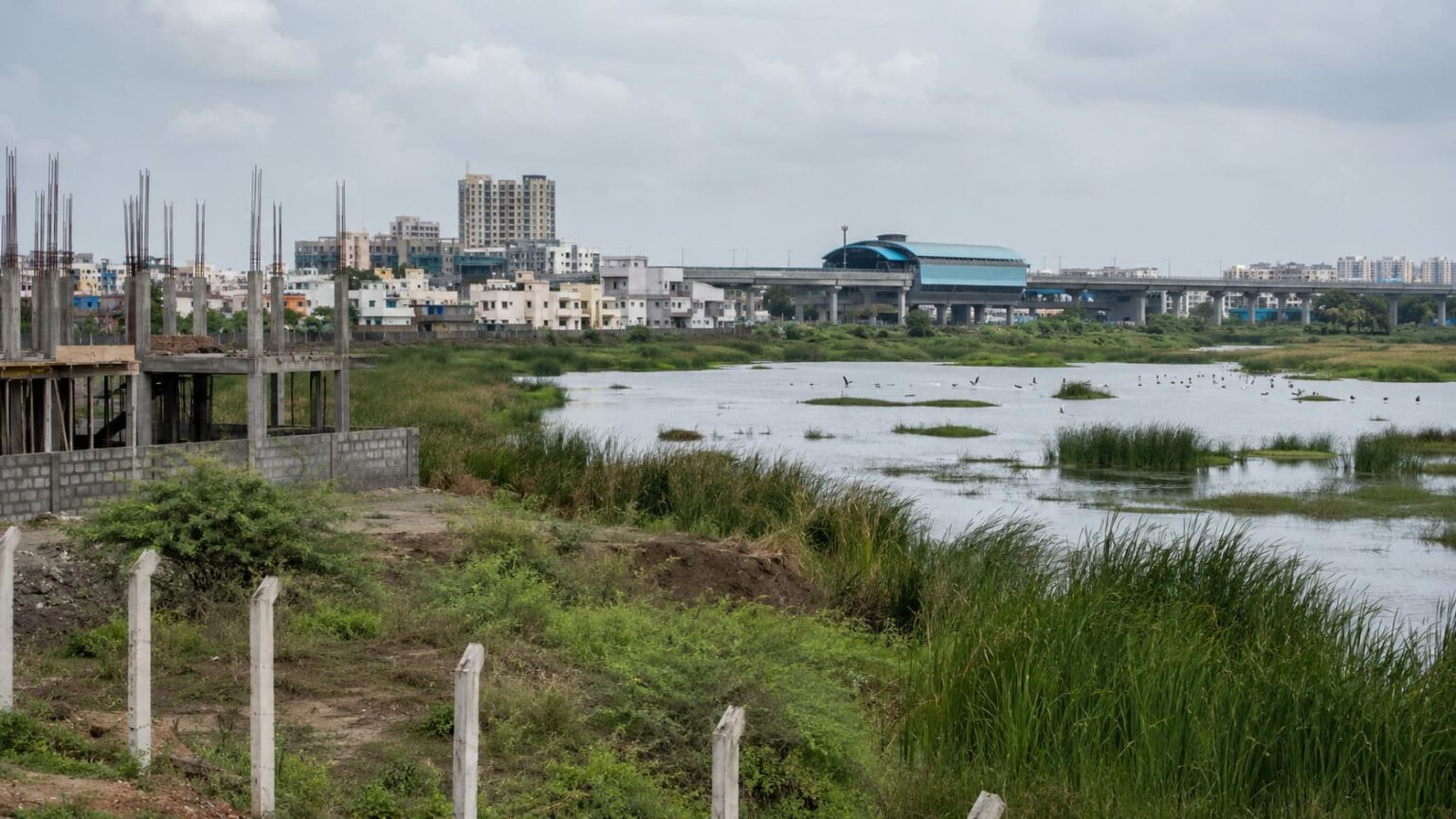
The Pallikaranai Marsh, one of Chennai’s most important wetlands, has now become the center of a major real estate and infrastructure dispute. A planning approval freeze around the Pallikaranai Ramsar site has reportedly affected more than one lakh patta landowners across South Chennai, with CREDAI Chennai urging the Tamil Nadu government to review the blanket 1-km development restriction.
The issue is not about opposing wetland protection. The concern raised by property owners and real estate bodies is about whether a uniform 1-km restriction can be applied without final survey-level demarcation (drawing exact boundaries), public consultation, and clear development guidelines. According to reports, the Chennai Metropolitan Development Authority (CMDA) stopped granting planning approvals within the Ramsar site boundary and the 1-km zone of influence following directions connected to the National Green Tribunal (NGT).
What Is the Pallikaranai Ramsar Freeze?
Pallikaranai Marsh was declared a Ramsar site (a wetland of international importance) in 2022. It is widely seen as Chennai’s last major freshwater wetland and plays a major role in flood control, groundwater recharge, and pollution filtration. The marsh drains a large catchment area and acts as a natural flood buffer for South Chennai.
The dispute began after restrictions were imposed around the Ramsar site and its 1-km influence zone. CREDAI Chennai says the freeze has stopped or delayed building approvals, no-objection certificates (NOCs), individual plot applications, completion certificates, redevelopment permissions, and loan processing for many properties in the affected belt.
The Trigger: Brigade Project Cancellation
The current 1-km blanket freeze was accelerated by the state’s cancellation of the ₹2,000-crore Brigade Morgan Heights township in Perumbakkam. Authorities revoked the 1,250-unit project’s environmental clearance following activist protests that it encroached on the expanded Pallikaranai Ramsar buffer zone without mandatory Wetland Authority approval.
The environmentalists view the halt as a win for flood protection.
Brigade Group strongly objected to the cancellation, labeling it arbitrary, factually incorrect, and a breach of natural justice executed without a technical review or hearing. The developer maintains that the project rests entirely on private dry patta land held continuously since 1985—an argument backed by a 2025 State Environment Department press release acknowledging that final wetland boundaries remained legally undecided.
Brigade has officially paused work, begun refunding affected homebuyers, and appealed the revocation to the Supreme Court of India, turning the mega-project into the primary legal benchmark for South Chennai’s broader development crisis.
Areas Affected in South Chennai
The planning freeze reportedly affects several fast-growing areas in South Chennai, including parts of Velachery, Pallikaranai, Perungudi, Sholinganallur, and Perumbakkam. The 1-km influence zone covers about 3,358 hectares, or 8,397 acres with the restriction spreading across 12 urbanized localities in South Chennai.
These are not remote or undeveloped locations. Many of these areas already have homes, roads, civic facilities, commercial buildings, IT offices, transport links, and approved residential layouts. This is why the freeze has created anxiety among ordinary landowners, homebuyers, builders, financial institutions, and infrastructure agencies.
More Than 1 Lakh Patta Holders Face Uncertainty
CREDAI has claimed that more than one lakh patta holders are affected by the planning freeze. The issue has become serious because many of these owners have legally purchased land, taken bank loans, and planned construction based on earlier approvals or existing land-use expectations.
The 1-km restriction applies even to fully developed, high-value civic layouts. For instance, the restriction has blocked construction on a 2,400 sq. ft. plot within the established TNHB Sholinganallur Phase III layout. Although the ₹1-crore property is located in a fully developed area with existing blacktop roads, stormwater drains, and Metro water infrastructure, local authorities are withholding building permissions due to the blanket freeze. For many families, the issue is not just about a large real estate project. It is about land bought for personal housing, EMIs already being paid, and construction plans now stuck without clarity.
Why CREDAI Wants Scientific 1Delineation
CREDAI has said it supports the protection of Pallikaranai Marsh, especially the original 698-hectare Pallikaranai Swamp Reserve Forest notified in 2007. However, its concern is with the additional 550 hectares included when the marsh received Ramsar recognition in 2022, taking the protected area to 1,248 hectares. CREDAI claims this expansion has not been backed by enough ground verification, survey-number demarcation, statutory notification, and public consultation.
The real estate body has argued that the influence zone should not be fixed merely by drawing a 1-km radius on a map. The Solution Proposed by CREDAI and Builders:
Instead of a simple, arbitrary geometric circle drawn on a map, the buffer zones should be drawn based on:
Survey-Number Validation: Providing individual plot-level clarity on what is allowed and what is frozen.
Hydrological Flow & Topography: Mapping actual drainage channels and water flow.
Existing Land Use: Acknowledging pre-existing urban structures, civic roads, and legal layouts.
Metro Rail and Public Infrastructure Also Affected
One of the biggest concerns is that the freeze may not affect only private plots and residential projects. Some important public infrastructures also falls within the 1-km zone.
About 15 Chennai Metro Rail Phase II stations, two existing MRTS railway stations, and the proposed integrated transit hub at Sholinganallur fall within the notified 1-km zone. Chennai One, NIWE, NIOT, and ELCOT facilities lie within the influence zone. This makes the issue much larger than a builder-versus-environment debate.
Chennai Metro Phase II is one of the city’s most important transport upgrades, and Sholinganallur is a key interchange point for the OMR and South Chennai growth corridor. If uncertainty continues, it can delay not only housing projects but also transport-oriented development, station-area planning, and future infrastructure-linked investments.
CREDAI has also warned that large public investments, including Metro-related works, could face uncertainty if future urban growth around these corridors remains unclear. CREDAI is concerned that nearly ₹60,000 crore has already been invested in Chennai Metro Rail and that long-term planning uncertainty could affect financing confidence.
Impact on Banks, Loans and Redevelopment
The freeze has reportedly affected housing loans, construction loans, and project finance. Banks and housing finance companies are said to be delaying or withholding loan sanctions because of the uncertainty around approvals.
This directly affects individual homebuyers and landowners.
➡️A buyer who has already purchased a plot may not be able to begin construction.
➡️A family planning to redevelop an old house may not get approval.
➡️Builders with ongoing or proposed projects may face delays in completion certificates, fresh approvals, and finance release.
In short, the freeze has created a chain reaction:
approval uncertainty leads to loan uncertainty, loan uncertainty slows construction, and construction delays affect buyers, workers, businesses, and government revenue.
Economic Impact Claimed by CREDAI
Because banks and housing finance corporations are withholding loan approvals and halting project disbursements until clarity emerges, a major economic bottleneck has developed. CREDAI’s industry estimates show staggering potential losses:
| Impact Category | Estimated Value |
| Stuck Business Activity | ₹51,735 crore – ₹1,00,000 crore |
| Direct State Revenue Loss | Over ₹10,995 crore – ₹19,000 crore |
| Indirect Economic Impact | Approx. ₹8,795 crore |
These figures are claims made by CREDAI and should be viewed as industry estimates. However, they show the scale of concern within the real estate and infrastructure ecosystem.
Government and Wetland Authority Position
The Tamil Nadu State Wetland Authority has reportedly said that the Ramsar boundary and the final notified wetland boundary are not the same. The final boundary must go through ground-truthing (field checking), survey-number verification, stakeholder consultation, and statutory notification before it is finalized.
Currently, the National Centre for Sustainable Coastal Management (NCSCM) is waiting on finalized coordinates from the State Wetland Authority. Once these are delivered, they will map out the true zone of influence and compile an Integrated Management Plan (IMP) that defines regulated vs. prohibited activities. Until this statutory process finishes, the planning freeze remains an absolute blanket block.
Why Pallikaranai Marsh Must Still Be Protected
While the approval freeze has created hardship, Pallikaranai Marsh cannot be treated as ordinary vacant land. It is a critical ecological asset for Chennai. The marsh helps absorb floodwater, supports biodiversity, filters pollutants, and protects nearby urban areas from severe waterlogging.
Chennai has already seen the cost of poor wetland management during floods. Any future development around Pallikaranai must respect drainage channels, natural water flow, floodplains, and ecological sensitivity. The solution cannot be unchecked construction. At the same time, legally owned patta lands and existing urban settlements also need clear, fair, and lawful treatment.
What CREDAI Has Requested
CREDAI has urged the government to withdraw or review the blanket 1-km restriction until scientifically validated wetland boundaries are finalized. It has also asked for ground-truthing, hydrological assessment, drainage studies, land-use analysis, publication of survey maps, and formal approval of the Integrated Management Plan after stakeholder consultation.
Pending finalization, CREDAI has requested the authorities to resume processing existing planning approvals, plot applications, NOCs, housing loan cases, and project finance proposals.
The Bigger Question for Chennai
The Pallikaranai issue raises a serious urban planning question: how can Chennai protect its wetlands without freezing large parts of an already urbanized city?
A blanket restriction may be easier to enforce, but it can create hardship if it includes legally developed layouts, public infrastructure, Metro stations, research institutions, and civic facilities. On the other hand, ignoring wetland protection can worsen flooding, damage biodiversity, and create long-term environmental risk.
The practical solution lies in a scientifically mapped, survey-number-based approach. The government must clearly identify the wetland boundary, the actual influence zone, restricted areas, regulated areas, and permissible activities. This will help protect Pallikaranai Marsh while giving landowners, banks, builders, and infrastructure agencies the clarity they urgently need.
The Pallikaranai Freeze, has given a critical “buyer beware” warning for the market: homebuyers and investors must now rigorously check if a property falls within the expanded marshland or its 1-km buffer to avoid frozen approvals and blocked loans.
- Delineation is the precise process of mapping, describing, or drawing the exact physical boundaries or borders of an area. ↩︎