

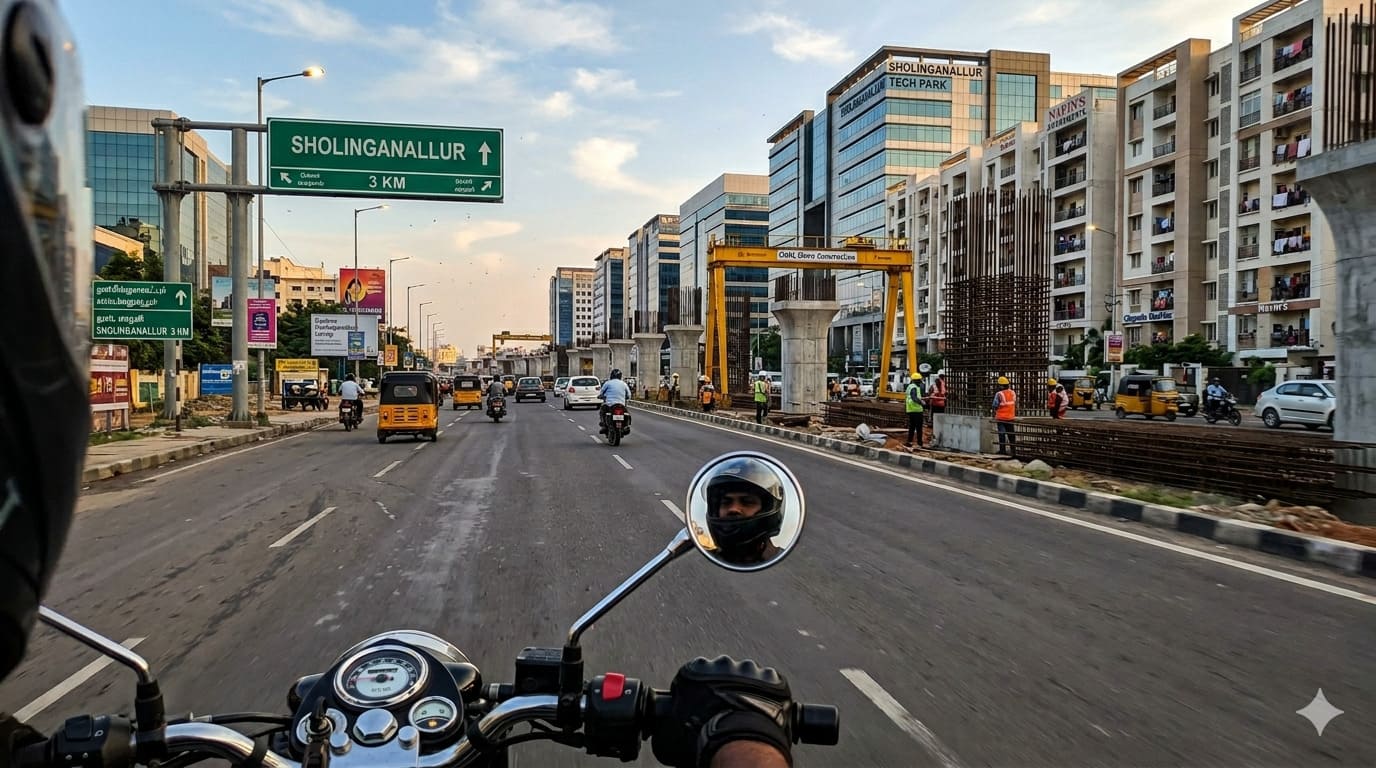
The Evolution of Old Mahabalipuram Road into a Mature Real Estate Powerhouse
Once considered a speculative stretch, the Old Mahabalipuram Road (OMR) has firmly transitioned into Chennai’s most structured and high-performing real estate corridor. Anchored by IT/ITES expansion and Global Capability Centres (GCCs), OMR now represents a stable, employment-driven property market rather than a volatility-prone investment zone.
As of 2026, OMR is not just growing—it is maturing into a self-sustaining urban ecosystem, combining residential, commercial, and social infrastructure into a tightly integrated corridor.
Market Composition & Demand Drivers: Employment-Led Growth
The OMR corridor stands apart because its demand is fundamentally tied to job concentration rather than speculative sentiment.
- Residential Dominance: South Chennai (centered around OMR) contributes nearly 38% of total residential sales (Q1 2026).
- Commercial Strength: Chennai’s office stock is projected to reach 100 million sq. ft., with OMR and South-West zones holding ~80% of Grade-A space.
- GCC Expansion: Continuous influx of multinational back-office and R&D centers ensures sustained housing demand.
The Rise of the “Work-Live” Model
Modern homebuyers are reshaping demand patterns:
- Increased preference for 3BHK & 3.5BHK units (+15% demand growth)
- Focus on 5–7 km proximity to workplaces
- Dedicated workspace/home office becoming standard
This shift is pushing developers toward integrated township models, blending residential, retail, and co-working spaces.
Capital Appreciation & Investment Outlook (2026–2036)
OMR has moved from speculative spikes to predictable, stable capital appreciation, making it attractive for long-term investors.
| Location | 2026 Estimated Value | 2036 Growth Projection | Key Driver |
|---|---|---|---|
| Sholinganallur | ₹50 Lakhs | ~120% | Metro + IT Hub |
| Navalur | ₹38 Lakhs | ~123% | Mid-income housing demand |
| Kelambakkam | ₹15 Lakhs | ~200% | Early-stage investment |
Key Investment Signals
- Annual appreciation: 5–7% (stable and consistent)
- Metro Influence:
- 20–30% price rise already seen near stations
- Expected 40% surge post-operations
- Land Banking Opportunity: Southern micro-markets offer high ROI entry points
Comparative Analysis of OMR Micro-Markets
To understand where to park your capital, it is essential to look at the corridor in three distinct segments. While Upper OMR offers stability, the “Lower” stretches are where the highest ROI is currently projected.
| Micro-Market Segment | Key Localities | Avg. Price (per sq. ft.) | Primary Growth Driver | Best For |
| Upper OMR | Perungudi, Tharamani | ₹11,000 – ₹14,500 | Adjacency to Adyar & City Core | Rental Income / HNI Luxury |
| Mid OMR | Sholinganallur, Navalur | ₹6,500 – ₹9,000 | Metro Phase II & GCC Clusters | End-Users & Families |
| Lower OMR | Kelambakkam, Thiruporur | ₹3,500 – ₹5,000 | Peripheral Ring Road & Entry Value |
Rental Yield Surge: OMR Leads South India
OMR is currently Chennai’s strongest rental-performing corridor, driven by a constant influx of professionals.
- Standard Yield: 2.5% – 3.2%
- OMR Premium Segments: Up to 4.5% yield
- Co-living spaces
- Managed student housing
Rental Growth Trends (2026)
- 8–10% rental increase in Q1 alone
- Driven by:
- Return-to-office mandates
- Limited ready-to-move inventory
- High tenant density near IT parks
This makes OMR ideal for dual-income investors (rent + appreciation).
Infrastructure Catalysts Transforming OMR
Chennai Metro Phase II
The Madhavaram–SIPCOT corridor will:
- Cut travel time drastically
- Integrate OMR with North Chennai
- Trigger major real estate value unlocking
Peripheral Ring Road (PRR)
- Expands Chennai’s growth boundary southward
- Enhances accessibility to Kelambakkam & Thiruporur
- Boosts land investment viability
Social Infrastructure Boom
OMR has evolved into a complete urban ecosystem:
- International schools
- Multispecialty hospitals
- Premium retail & entertainment hubs
This eliminates the earlier dependency on central Chennai.
Risks, Constraints & Market Realities
Despite strong fundamentals, OMR is not without challenges:
Short-Term Constraints
- Metro construction causing traffic congestion
- Temporary lifestyle disruptions in certain stretches
Micro-Market Variability
- Flood-resilient zones command 3–5% premium
- Infrastructure quality varies significantly within short distances
Premium Market Saturation
- Early OMR zones (Perungudi, Tharamani) nearing price ceiling
- Better suited for rental income than rapid appreciation
Key Due Diligence Essentials
For Property Owners: Sale Readiness
- Ensure buildings are evaluated and all revenue records (patta, chitta, FMB, approvals) are clear and updated to enable smooth transactions.
- Look out for profitable and genuine joint ventures to increase the land value.
For Developers & Buyers: Flood Risk Check
- Verify if the property lies in flood-prone zones and assess drainage and past waterlogging risks.
- Do a Coastal Regulation Zone check
- Conduct soil testing to confirm land stability and safe construction feasibility.
- Compare guideline and market values to avoid pricing errors and ensure compliant transactions.
Conclusion: OMR’s Shift from Growth Corridor to Urban Core
The Old Mahabalipuram Road is no longer an emerging hotspot—it is Chennai’s most structured and dependable real estate corridor.
- End-users: Benefit from proximity to jobs and urban lifestyle
- Investors: Gain stable appreciation + strong rental yields
- Developers: Focus on integrated, future-ready communities
With metro connectivity, expanding infrastructure, and sustained employment growth, OMR is positioned to remain Chennai’s real estate backbone for the next decade.