

Can a mother redevelop a property partly owned by her minor son?
This question recently came before the Supreme Court of India in Shephali Chakraborty v. State of West Bengal, 2026 INSC 621.
The District Court said No.
The Calcutta High Court also said No.
But the Supreme Court said Yes, because in the facts of this case, the proposed redevelopment was found to be more beneficial to the minor than simply retaining an undivided share in vacant or jointly held land.
The judgment is important for property owners, developers, builders, buyers and families dealing with inherited property where a minor has a share.
Case Details at a Glance
| Particulars | Details |
|---|---|
| Case Name | Shephali Chakraborty v. State of West Bengal |
| Court | Supreme Court of India |
| Date of Judgment | 03 June 2026 |
| Main Law Involved | Section 8, Hindu Minority and Guardianship Act, 1956 |
| Main Issue | Whether a mother could get court permission to enter into a redevelopment agreement involving her minor son’s share in immovable property |
| Supreme Court Decision | Permission allowed, with safeguards |
Background of the Case
The property in dispute originally belonged to Nagendra Nath Das, the minor’s paternal great-grandfather.
Over time, shares in the property passed down through the family. One share came to Bela Chakraborty, the minor’s grandmother. After her death, her share was divided among her children.
One of her sons was Basudeb Chakraborty, the father of the minor child. Basudeb passed away on 25 January 2018, leaving behind his wife Shephali Chakraborty and their son Master Basab Chakraborty, who was a minor.
Because the minor inherited a share in the property, his mother could not deal with that share freely. She needed court permission before entering into any transaction affecting the minor’s immovable property.
The Redevelopment Agreement
In 2022, the family members decided to give the property for redevelopment to M/s Shivam Estates and Developers.
Under the redevelopment arrangement, the owners were to receive:
- a share in a residential flat, and
- monetary consideration.
For the appellant mother and her minor son, the agreement involved a share in a first-floor flat and a monetary payment of ₹10 lakh.
The mother approached the District Court seeking permission to proceed with the redevelopment agreement because her minor son had a share in the property.
Why Court Permission Was Required
The case mainly revolved around Section 8 of the Hindu Minority and Guardianship Act, 1956.
Under this provision, a natural guardian can manage the minor’s property, but the guardian cannot deal with the minor’s immovable property without prior permission of the court in certain cases.
This includes transactions such as:
- sale,
- mortgage,
- charge,
- gift,
- exchange,
- transfer,
- long lease, or
- any arrangement that affects the minor’s immovable property rights.
The purpose of this rule is simple: a minor cannot fully protect his or her own legal and financial interests. So, the law requires the court to step in and examine whether the transaction is truly beneficial to the child.
Why the Lower Courts Rejected the Request
The mother first approached the District Judge, Darjeeling, seeking permission for the redevelopment. The District Court rejected the application, holding that she had not adequately demonstrated how the proposed redevelopment would benefit the minor and had only made general assertions about future advantages and better use of the property.
She then challenged the decision before the Calcutta High Court, Circuit Bench at Jalpaiguri, which agreed with the District Court and upheld the rejection. As a result, both the District Court and the High Court refused permission for the redevelopment.
What the Supreme Court Said
The Supreme Court reversed both decisions.
The Court held that the lower courts had taken a narrow and technical view of the matter.
The Supreme Court said that while dealing with a minor’s property, the real question is not whether the application is perfectly worded. The real question is whether the proposed transaction gives an evident advantage to the minor.
By evident advantage it means that the court must ensure that the proposed transaction provides a clear, real and practical benefit to the child, not merely a convenience for adults.
In this case, the Court found that a share in a constructed residential flat and monetary consideration would be more beneficial to the minor than simply retaining an undivided share in vacant or jointly held land.
Safeguards Ordered by the Supreme Court
The Supreme Court did not give unconditional permission.
The Court allowed the redevelopment only with safeguards.
The key safeguards were:
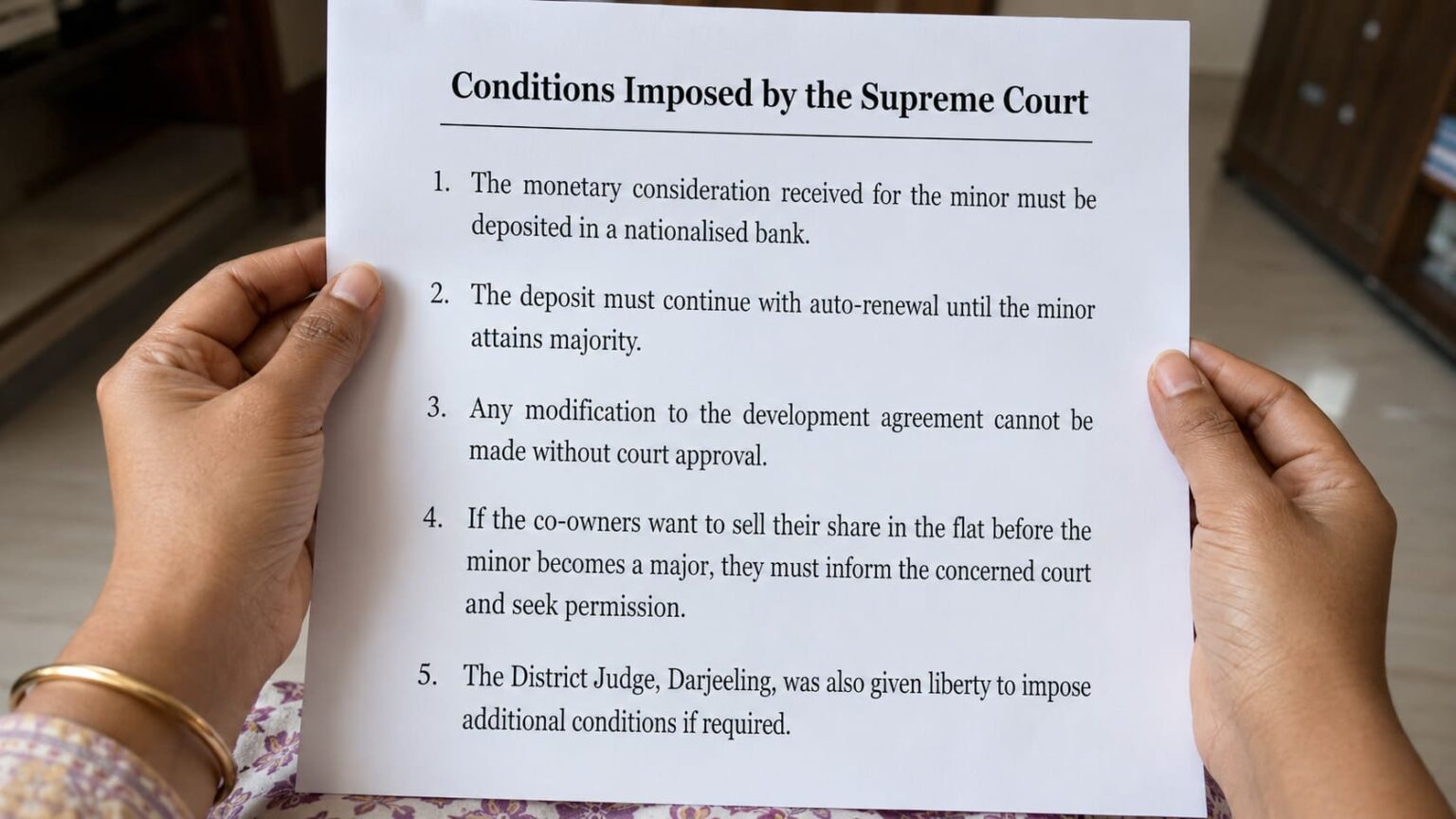
- The monetary consideration received for the minor must be deposited in a nationalised bank.
- The deposit must continue with auto-renewal until the minor attains majority.
- Any modification to the development agreement cannot be made without court approval.
- If the co-owners want to sell their share in the flat before the minor becomes a major, they must inform the concerned court and seek permission.
- The District Judge, Darjeeling, was also given liberty to impose additional conditions if required.
These safeguards show that the Supreme Court was not giving unrestricted power to the mother. It was allowing the transaction only because it benefited the minor and because the minor’s interest was protected.
Why the Supreme Court Allowed the Redevelopment
The Supreme Court looked at the practical benefit of the transaction.
A minor’s undivided share in a jointly held land may not give any immediate or useful benefit. It may only remain a paper share, especially when several family members are involved.
On the other hand, the redevelopment agreement would give the minor:
- a share in a residential flat,
- monetary consideration,
- a more usable property asset,
- better value from the existing land,
- and protection through court-imposed conditions.
For this reason, the Supreme Court held that the redevelopment arrangement was beneficial to the minor in the facts of this case.
Court Protection of Minors and Effect of Unauthorized Transactions
The Supreme Court explained that courts act as protectors of minors under the principle of parens patriae, meaning they have a duty to safeguard the interests of those who cannot fully protect themselves. When a minor’s property is involved, the court must independently assess whether the proposed transaction genuinely protects the child’s welfare and property rights.
The Court also clarified that if a natural guardian deals with a minor’s immovable property without the required court permission, the transaction is not automatically void. Instead, it is voidable at the instance of the minor, meaning the minor may challenge it after attaining majority. This makes compliance with legal requirements crucial for developers, buyers and banks, as transactions involving a minor’s share may otherwise face future legal challenges.
Key Takeaways and Practical Implications
For Parents or Guardians : This judgment does not mean that a parent or guardian can freely sell, transfer or redevelop a minor’s property, nor does it make court permission a mere formality. The Supreme Court’s decision was based on the specific facts of the case and the clear benefit shown to the minor.
In every case involving a minor’s immovable property, courts must examine whether the transaction is necessary, beneficial to the minor, adequately safeguarded, and protective of the minor’s future rights before granting permission.
For Property owners, developers, buyers and banks : The ruling is particularly important for redevelopment and inherited property transactions. One must carefully verify whether any minor has a share in the property and whether the required court permission has been obtained. They should also ensure that the minor’s entitlement is properly recorded and protected, and that the transaction includes adequate safeguards.
For real estate transactions, the message is clear:
If a minor has a share in property, do not ignore it. Ignoring a minor’s interest in property can create serious title risks and may expose the transaction to legal challenges even after the minor attains majority. S
So, Check the title, get assistance from legal experts to get legal permission where required, and ensure that the minor’s interest is properly protected.