

In Tamil Nadu, Patta is a land revenue record issued by the Revenue Department. For individual house plots, Patta is issued per owner. However, for apartments and flats, ownership works differently due to shared land and vertical construction.
Most flat buyers assume they must receive an individual Patta in their name. This assumption is incorrect and often leads to unnecessary panic or misinformation during resale or loan processing.
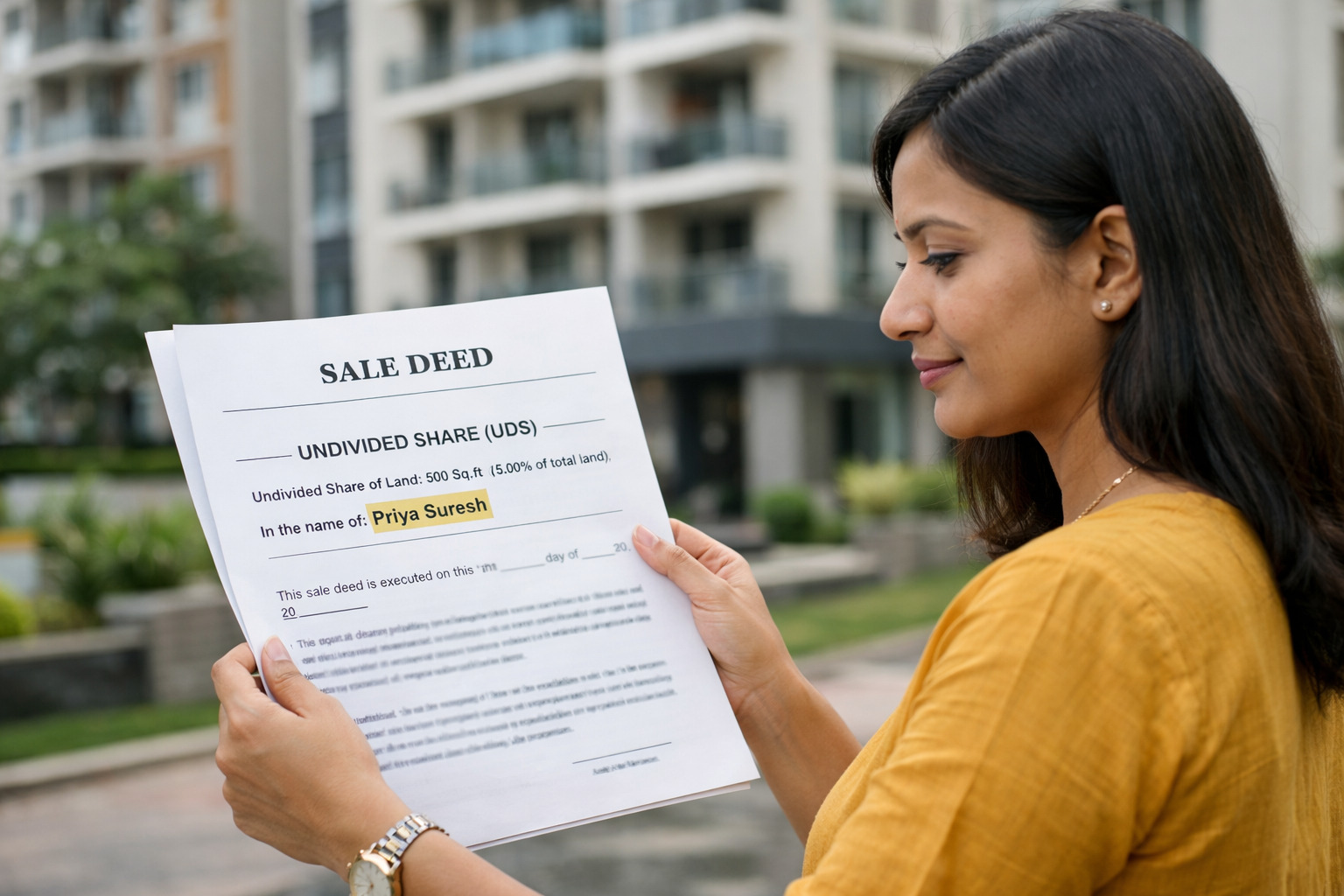
Individual Patta is not a mandatory document for apartment flat owners in Tamil Nadu; ownership is legally established through the registered sale deed and Undivided Share (UDS) of land.
Flat Owners Usually Do Not Get Individual Patta
In apartment projects, the land is not subdivided flat-wise. Instead:
- The entire land parcel is held under one common Patta
- Each flat owner owns a fraction of the land, known as Undivided Share (UDS)
Your legal land ownership is represented through:
- Sale Deed mentioning UDS
- Parent land Patta (common for the entire apartment)
- Encumbrance Certificate reflecting UDS transfer
This structure is legally valid and standard practice in Tamil Nadu.
Undivided Share (UDS) and Why It Matters More Than Patta
UDS is the real land ownership right of a flat owner. It determines:
- Your legal claim on the land
- Your share during redevelopment
- Compensation eligibility in acquisition cases
- Long-term asset value of the flat
If UDS is clearly defined and legally transferred, absence of an individual Patta is not a defect.
Joint Patta Scenarios in Apartments
In some cases, especially older apartments:
- Patta may carry multiple owner names
- Or remain in the builder’s name, with UDS sold to buyers
This does not invalidate ownership, provided:
- Sale Deeds are registered
- UDS is properly conveyed
- No conflicting claims exist in revenue records
When Can Individual Patta Exist for Each Unit?
Individual Patta per unit is rare and applies mainly to:
- Row houses
- Villa developments
- Low-rise projects with legally subdivided land parcels
Regular multi-storey apartments approved by CMDA or DTCP generally cannot have flat-wise Pattas.
What Flat Buyers Should Verify Instead of Chasing Patta
Flat buyers should focus on the following legal checks:
- UDS extent and survey number match
- Parent land Patta is clear and continuous
- Encumbrance Certificate shows UDS transfer
- Approved building plan from competent authority
- Completion Certificate / Occupancy Certificate where applicable
These factors matter far more than individual Patta availability.
Common Misconceptions That Mislead Flat Buyers
- “No Patta means illegal flat” – False
- “Banks won’t approve loans without Patta” – False
- “Each flat must have its own Patta” – False
Banks and courts rely on registered title, UDS, and approvals, not flat-wise Patta.
How Verified.RealEstate Helps Flat Buyers
Verified.RealEstate assists buyers by:
- Verifying UDS calculation and legal validity
- Checking parent Patta and land records
- Cross-verifying EC, approvals, and revenue history
- Identifying hidden risks before purchase or resale
This prevents disputes, loan delays, and future redevelopment conflicts.
Frequently Asked Questions
1. Does every apartment builder have a Patta?
Yes, the parent land of any legally built apartment must have a Patta.
2. Do flat owners get individual Patta in Tamil Nadu?
No, individual Patta is not mandatory for flat owners; ownership is through UDS.
3. If the Patta is in the builder’s name, is it a problem?
No, as long as UDS is fully sold and registered, builder-name Patta is normal.
4. Will a large apartment have a joint Patta in all owners’ names?
No, large apartments usually have one common Patta, not owner-wise Pattas.
5. In redevelopment, what matters more than Patta?
Clear UDS, clean title flow, and owner consent matter more than Patta.
6. During government acquisition, who receives compensation?
Compensation goes to flat owners based on UDS, not the Patta holder.