

Cantonment areas in India represent some of the most serene, secure, and structurally preserved real estate zones. However, buying, selling, or leasing property inside a Cantonment area is drastically different from standard real estate transactions.
If you are looking to purchase, lease, or rent property within a Cantonment area in Tamil Nadu, understanding the specific military-municipal governance structures is critical to preventing legal disputes or losing your investment.
This comprehensive guide breaks down how Cantonments are governed, details the active areas in Tamil Nadu, and provides a breakdown of the complex land administration rules you must navigate.
What is a Cantonment Area?
A Cantonment is a permanent military station established by the government where troops are quartered, training operations take place, and military infrastructure is housed.
Unlike typical Indian cities managed by municipal corporations under state laws, Cantonments feature mixed civilian-military populations and are governed by Cantonment Boards. These boards function as local municipal bodies but operate under the direct administrative control of the Union Ministry of Defence (MoD), executing central laws rather than state statutes.
Active Cantonment Areas in Tamil Nadu
Under the Cantonments Act, 2006, Tamil Nadu features two active, officially notified Cantonments:
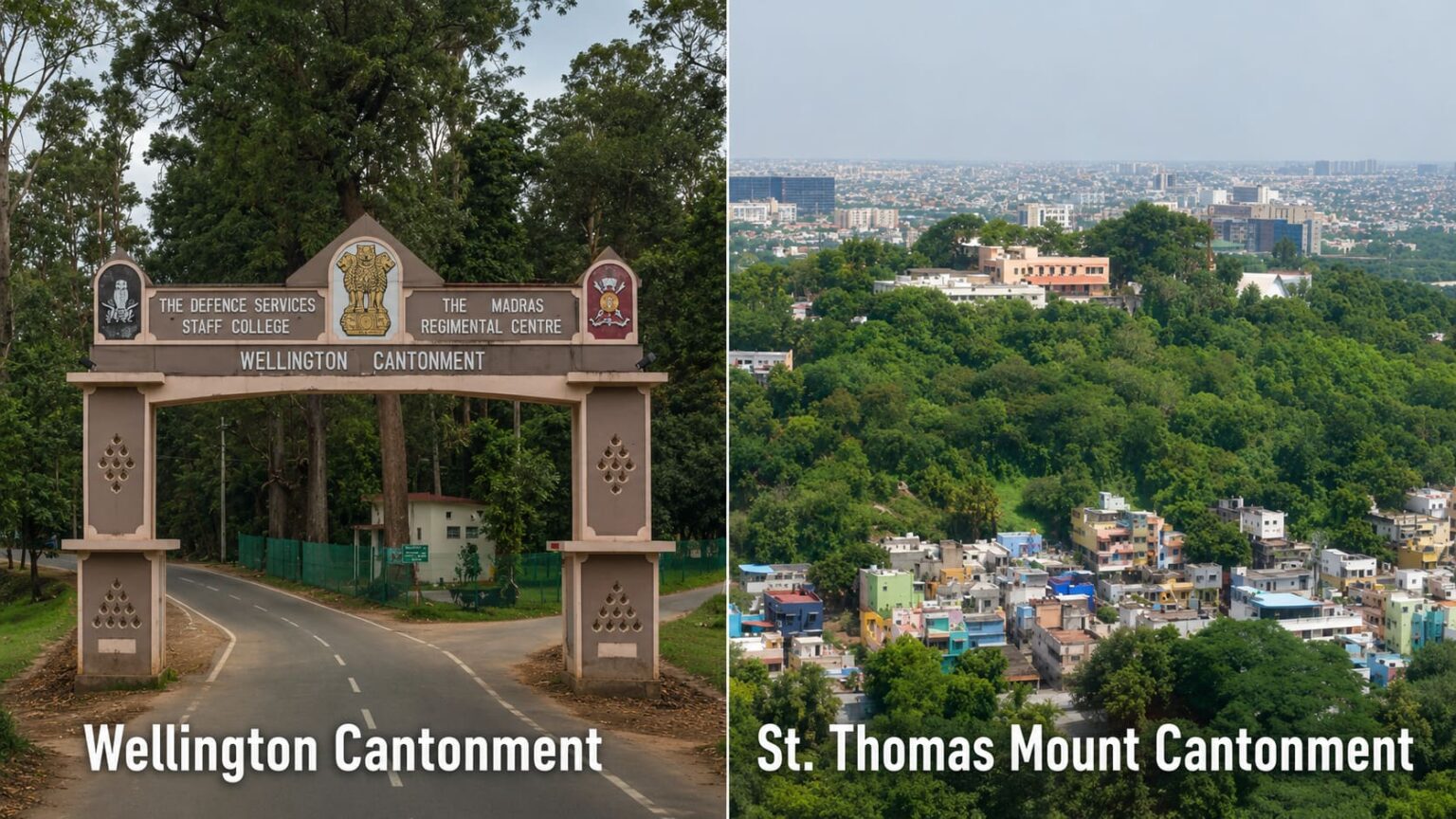
1. St. Thomas Mount-cum-Pallavaram Cantonment (Chennai)
Established in 1774, this is the second-oldest cantonment in India. Spanning nearly 2,900 acres across parts of Chennai, it accommodates major military tactical zones alongside an urban civilian population of over 61,000 residents across 7 structural wards.
2. Wellington Cantonment (The Nilgiris / Coonoor)
Located in the scenic Western Ghats, Wellington is a world-renowned hill-station cantonment. It serves as the historic headquarters of the Madras Regiment and the elite Defence Services Staff College (DSSC).
Important Real Estate Note: The neighborhood of Trichy (Tiruchirappalli) features an area popularly called “Cantonment.” While historically managed by the military, its civilian administration has been fully handed over to the state-run Trichy City Corporation. It no longer operates under the Ministry of Defence rules detailed below.
The Specialties of Living in a Cantonment
Properties in Cantonment zones are highly sought after because they offer premium civic benefits rarely seen in chaotic urban centers:
- Immaculate Sanitation: They consistently rank at the top of national cleanliness surveys (Swachh Survekshan) due to strictly enforced public waste laws.
- Green Spaces and Heritage Architecture: Massive tree canopies, open parks, and low-density colonial bungalows are tightly protected against aggressive commercial high-rise redevelopment.
- Balanced Local Governance: The Cantonment Board operates on a unique 50-50 administrative partnership. Half of the board consists of democratically elected civilian representatives, while the other half consists of nominated military officers—headed by a senior military official as Board President.
Understanding Cantonment Land Classifications
Before attempting to buy, lease, or rent property in a Cantonment, you must verify the land’s entry in the General Land Register (GLR). The Cantonment Land Administration Rules, 1937 meticulously break all land down into distinct legal categories:
Class A Land (Active Military)
Reserved strictly for tactical operations, military training, fortifications, and barracks. Private individuals have zero access to Class A land.
Class C Land (Municipal & Public Utilities)
Class C lands are vested directly in the Cantonment Board to run public infrastructure (e.g., roads, schools, hospitals, waterworks, and public parks).
- Can you buy Class C land? No. Neither civilians nor military personnel can ever buy Class C land.
- Can you lease it? The absolute maximum access permitted is a temporary commercial license or a fixed-term rental stall constructed by the Board to run local businesses. Any private modification or unauthorized construction here is classified as a public encroachment, triggering immediate demolition.
Class B Land (Civilian, Leasehold, and “Old Grants”)
Class B land is the only segment of a Cantonment area available for civilian residential housing, commercial markets, renting, or leasing. However, it is governed by rigid restrictions split into specific sub-categories:
                          ┌──────────────────────────┐
                          │   Cantonment Land (GLR)  │
                          └─────────────┬────────────┘
                                        │
         ┌──────────────────────────────┼──────────────────────────────┐
         ▼                              ▼                              ▼
   Class A Land                  Class C Land                   Class B Land
(Active Military Only)        (Municipal Utilities)         (Civilian Use Zone)
 * Strictly Off-limits         * Unbuyable                    * Residential & Commercial
                               * Fixed-Term Stalls Only       * Subject to Strict Rules
                                                                       │
                                        ┌──────────────────────────────┴──────────────────────────────┐
                                        ▼                                                             ▼
                                 Class B-3 Land                                                Class B-4 Land
                        (Old Grants & Residential Leases)                            (Vacant Commercial Allotments)
                         * Soil owned by Central Gov.                                 * Issued via public auction
                         * Occupancy rights only                                      * Long-term lease (30-90 yrs)
                         * Mutation requires DEO sanction                             * Reverts to Gov. upon expiry
Critical Rules for Property Transactions, Buying, and Leasing
If you want to transact real estate on Class B land, standard state-level registry laws (Patta/Chitta) are completely secondary to central defense estate protocols. You must account for the following legal constraints:
1. The “Old Grant” Dilemma & Absolute Ownership
Much of the private property found inside St. Thomas Mount or Wellington operates on an “Old Grant” or long-term lease framework derived from colonial laws.
- The Soil is Not Yours: When you “buy” an Old Grant bungalow, you are only buying the physical building or the occupancy rights—the absolute ownership of the land underneath remains vested with the Central Government.
- The Right of Resumption: Under the terms of an Old Grant, the Government of India retains the permanent legal right to “resume” (reclaim) the land at any time for active defense projects, providing a notice window and compensation only for the building, not the land value.
2. Mandatory Sanction from the Defence Estates Officer (DEO)
You cannot simply sign a sale deed at a local sub-registrar’s office and move in.
- Any transfer of leasehold rights, inheritance updates, or ownership restructuring requires a formal process called “Mutation” through the office of the Defence Estates Officer (DEO).
- Transfers executed without explicit written permission from the DEO are legally invalid, rendering your transaction null and void.
3. Rigid Building Bye-Laws & FSI Caps
Thinking of adding an extra floor, installing a balcony, or initiating a modern structural renovation?
- Under the Cantonments Act, you must submit formal building plans and secure written permission from the Cantonment Board before touching the structure.
- Security Obstruction Laws: The military maintains a strict veto on construction near strategic installations, airfields, or defense lines. Building heights are aggressively capped, and the Floor Space Index (FSI) is strictly restricted. Unsanctioned constructions are subject to rapid summary demolition.
4. Banned Commercial Conversions
If a property’s lease document specifies “Residential Use Only,” you cannot open a retail shop, hotel, or clinic inside it. Unilateral commercial conversion of a residential lease without written approval from the Ministry of Defence constitutes a direct breach of the lease terms, empowering the board to forfeit your tenancy immediately.
The Digital Shift: eChhawani Portal
To skip the paperwork, the Ministry of Defence launched the eChhawani portal (https://echhawani.gov.in). However, buyers must know a critical distinction: it handles Property Tax Mutation, not a state Patta. Because the Central Government owns Cantonment land, you won’t get a Tamil Nadu Patta or Chitta here.
Instead, under Section 81 of the Cantonments Act, 2006, you must use eChhawani to update the Board’s tax records whenever a property changes hands via sale, inheritance, or gift. Simply log in with your mobile number, enter your Property Tax ID (PTIN), upload your ownership proofs, and download your digitally signed Mutation Certificate.
Pro Tip for Investors: The Freehold Policy Change
Normally, when you have a house in a Cantonment bazaar area (known as an “Old Grant” property), you only own the physical building. The ground it sits on belongs completely to the military, and the government can legally take the land back whenever they need it.
To give residents more freedom, the Government of India allows people who live in these specific bazaar zones to apply for a “Freehold” conversion.
If you pass their background checks and pay a one-time fee (a conversion premium) to the Ministry of Defence, the land becomes 100% yours forever.
Why this matters:
Easy Loans: Standard banks will happily give you home loans or mortgages, which they usually refuse to do for regular Cantonment properties.
No Fear: The government can no longer take the land back from you.
Freedom to Sell: You can buy, sell, or build on it just like normal city land.
The Future of Cantonments: The De-Notification Wave
The administrative landscape of Cantonments is currently undergoing its biggest historic shakeup since independence. Under a phased national policy, the Ministry of Defence is systematically de-notifying and excising civilian zones from active Cantonment boundaries, carving them out to be merged with adjoining state municipalities. Once finalized, this massive transition will completely rewrite the local real estate playbook, radically changing how property is handled in both of Tamil Nadu’s historic military zones:
What Will Happen in St. Thomas Mount (Chennai)?
Because St. Thomas Mount holds a huge civilian population, its 7 civilian wards are being sliced away from the core military base.
- The Transition: These civilian areas will be absorbed directly into the Tambaram Municipal Corporation and the Greater Chennai Corporation. The operational handover is actively progressing as the Central and State governments finalize asset distribution and staff integration.
- The Property Impact: Once the merger is complete, the restrictive Cantonments Act, 2006 will cease to apply here. Property owners will no longer need to chase the Defence Estates Officer (DEO) for “Mutation permissions.” Instead, building approvals will fall under standard Tamil Nadu state rules (CMDA/DTCP). This will dramatically ease construction rules, lift rigid height caps, and make it easy for commercial banks to issue home loans—likely triggering a significant surge in property values.
What Will Happen in Wellington (The Nilgiris)?
Wellington presents a completely different, highly sensitive challenge. Because it houses critical, top-tier institutions like the Defence Services Staff College (DSSC) and the active Madras Regiment, drawing a clear line between “purely civilian” pockets and “military tactical” zones is incredibly difficult.
- The Transition: While a few isolated civil bazaars may eventually see partial administrative handovers to local Nilgiris district bodies, the vast majority of Wellington will remain tightly under active military command control as an official military station.
- The Property Impact: Do not expect a real estate boom or relaxed building laws here. To protect strategic defense infrastructure and the fragile ecosystem of the Western Ghats, strict central oversight, construction freezes, and rigid lease renewal terms will remain firmly in place for the foreseeable future.
The Bottom Line for Investors: While St. Thomas Mount is on the cusp of becoming a standard, high-value Chennai municipal zone, Wellington will largely remain an exclusive, tightly guarded military enclave. Always check the active status of the General Land Register (GLR) before moving forward with any transaction during this transition era.
Frequently Asked Questions (FAQs)
Can an NRI buy property in a Cantonment area?
NRIs can acquire residential or commercial property in India under FEMA guidelines, but because Cantonment land ownership stays with the Ministry of Defence, an NRI can only buy the leasehold or occupancy rights of Class B land, subject to strict prior clearance from the Defence Estates Officer (DEO).
Can a bank provide a home loan for a Cantonment property?
Most standard commercial banks are highly reluctant to fund properties held on an “Old Grant” or short-term lease basis because the land cannot be cleanly collateralized. Getting a home loan is generally only feasible if the property has been officially converted into Freehold land.
What happens if a Cantonment lease expires?
If a long-term lease expires, the property holder must apply to the Cantonment Board / DEO for a lease renewal. If the renewal is rejected, or if the property holder refuses to pay the updated market-rate lease premium, the land along with all structures built on it legally reverts to the Central Government.