

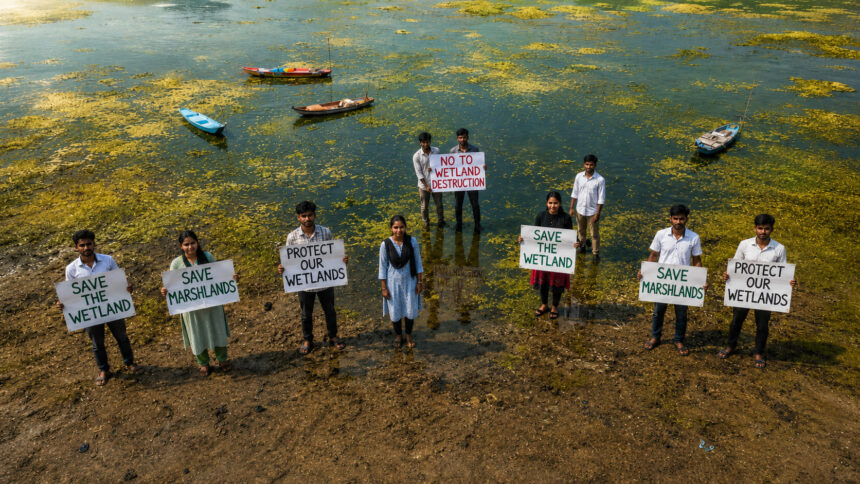
Nearly 30 youth organisations joined the “March for the Marshlands” in Chennai on July 25, opposing the Mamallan Reservoir project and demanding protection for the coastal wetland identified for its construction. The protesters urged the Tamil Nadu government to halt the project and conduct an independent scientific assessment before allowing further work.
The Mamallan Reservoir Project
The Mamallan Reservoir was proposed by the Tamil Nadu Water Resources Department and formally launched by the previous DMK government led by M.K. Stalin in January 2026.
Planned in the Kovalam sub-basin near Nemmeli in Chengalpattu district, the reservoir would extend across parts of Tiruporur and Thirukazhukundram taluks, between East Coast Road and Old Mahabalipuram Road.
- Estimated project cost: approximately ₹342.60 crore
- Project area: roughly 5,100 acres
- Proposed daily supply: up to 170 MLD, or 17 crore litres
It was planned to serve nearly 13 lakh residents across Chennai’s rapidly expanding southern suburbs, spanning from Sholinganallur to Thiruporur. It also aims to capture surplus monsoon runoff, strengthen water security, and reduce seawater intrusion.
The reservoir was initially assessed at around ₹471 crore in the project’s environmental report, but the cost announced when construction was launched was ₹342.60 crore.
To now more about it : Read https://community.verified.realestate/article/a-%e2%82%b9471-crore-coastal-reservoir-near-kovalam-is-set-to-transform-chennais-southern-water-security/
The Tamil Nadu Water Resources Department divided the work into phases/packages and invited contractors through competitive tendering for this project.
For Phase 1, Package 1, covering the reservoir’s eastern and southern sides:
- Tender value was approximately ₹164.61 crore.
- The tender was published in November 2025.
- P&C Projects Pvt. Ltd. was subsequently awarded a contract reported at about ₹166.9 crore.
- The contractor was reportedly given 24 months to complete this package.
However, as the project has moved from proposal to execution, it has also drawn growing scrutiny from environmental groups, local residents and youth organisations. While the government presents the reservoir as a critical infrastructure project to address Chennai’s long-term drinking water needs, concerns have emerged over the ecological nature of the proposed site.
What is officially described as a development zone is, according to critics, part of a sensitive coastal landscape that plays a key role in the region’s natural drainage and biodiversity systems.
Protesters Say the Site Is a Living Wetland
The protesters argue that the project site is not vacant or unused land, but a functioning tidal marsh and coastal wetland ecosystem.
They fear that converting the brackish marsh into a freshwater reservoir would disturb the natural mixing of freshwater and seawater, affecting fish, prawns, crabs, birds and other species dependent on the wetland.
A fisherman from Kovalam said wetlands protect coastal communities and cities and should not be destroyed in the name of climate resilience.
Fishing Livelihoods Could Be Affected
The marshlands serve as fishing and breeding grounds for communities living around Kovalam and adjoining coastal villages.
Protesters warned that changes in water flow and salinity could reduce fish and prawn populations and threaten the livelihoods of fishing families. They also argued that Irulars, Dalits and other marginalised communities could bear the environmental and economic costs while the reservoir’s benefits are supplied to urban areas elsewhere.
Concerns Over Buckingham Canal and Flooding
One of the major allegations is that reservoir bunds and structures may obstruct the Buckingham Canal and natural coastal drainage routes.
Opponents fear that blocking or restricting these channels could increase waterlogging and flood risks during intense monsoon rainfall. They also warn that permanently converting a tidal marsh into an artificial freshwater storage area could cause irreversible ecological damage.
Protesters Demand an Independent Study
The youth organisations are not simply opposing additional drinking-water supply for Chennai. They want the government to prove that the project will not damage the wetland, increase flooding or destroy local livelihoods.
They have demanded an independent study covering:
- tidal and floodwater movement;
- impact on Buckingham Canal;
- fish-breeding and fishing areas;
- changes in salinity and groundwater;
- effects on birds and wetland biodiversity; and
- alternative locations or water-supply solutions.
The Mamallan Reservoir has now become an important environmental test for the present Tamil Nadu government. The central question is whether Chennai’s need for drinking water can be addressed without destroying a natural wetland that already provides flood protection, biodiversity and livelihoods to coastal communities.