

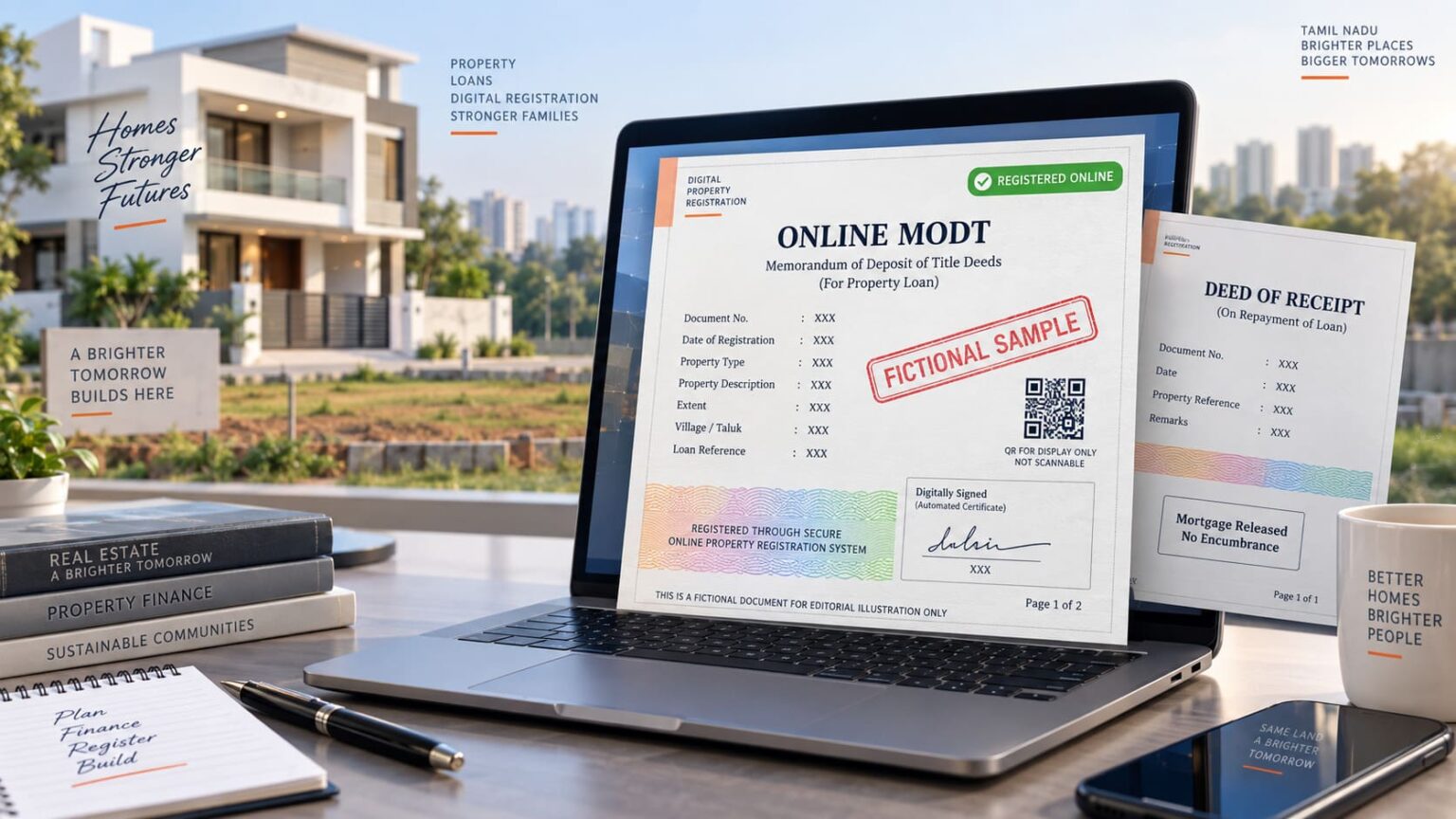
From 15 September 2026, banks and financial institutions in Tamil Nadu must use the state’s presence-less registration system for two important property-loan documents: the Memorandum of Deposit of Title Deeds (MODT) and the Deed of Receipt.
The rule was implemented as a part of Phase II of the “Anywhere Registration” initiative under Project STAR 3.0.
What Is an MODT?
When a person takes a property-backed loan, the original title documents are usually deposited with the bank as security. A Memorandum of Deposit of Title Deeds, commonly called an MODT, officially records that the property has been offered as security for the loan.
The registered MODT creates a public record of the lender’s mortgage interest and should appear in the property’s Encumbrance Certificate (EC).
For a separate step-by-step explanation of the process, read our complete guide to registering a mortgage without possession online in Tamil Nadu.
What Is a Deed of Receipt?
A Deed of Receipt is registered after the borrower fully repays the secured loan. It records that the bank has received the outstanding amount and that the mortgage liability has been released.
Loan repayment alone may not remove the mortgage entry from the EC. The bank must complete the required release documentation and register the Deed of Receipt.
For the complete procedure, read our step-by-step guide to the presence-less online registration of Deposit of Title Deeds (MODT) in Tamil Nadu.
The Online Update
Earlier, borrowers and bank representatives could be required to visit the Sub-Registrar Office to register these documents. Under the new system, banks and financial institutions must submit them electronically without requiring a physical visit for registration.
Registered documents will include:
- The registering authority’s digital signature
- A QR code on every page
- Digital verification and document storage
- An electronic record of the mortgage transaction
However, presence-less registration does not mean that original title deeds become entirely digital. Banks may still physically hold the original property documents until the loan is closed.
Why Is This Important for Property Buyers?
One purpose of the new rule is to ensure that registered mortgages are properly reflected in Encumbrance Certificates. This can help buyers and banks identify whether a property is already mortgaged and reduce the risk of the same property being offered as security to multiple lenders.
After a loan is closed, property owners should:
- ✅Collect the loan-closure letter or no-dues certificate.
- ✅Obtain all original title documents from the bank.
- ✅Confirm that the Deed of Receipt has been registered.
- ✅Download a fresh EC and check whether the mortgage release is recorded.
- ✅Verify the document number, survey number and property description.
Check the EC Before Buying
An EC is an important part of property verification, but it is not complete proof of ownership. Buyers must also verify the title documents, ownership chain, pending loans, court disputes and property particulars.
The Verified.RealEstate EC Analyzer can help users examine an Encumbrance Certificate and understand important entries, including registered mortgages and release documents. It should be followed by proper legal and title due diligence before purchasing the property.
The Key Takeaway
Tamil Nadu’s new online-registration rule can make mortgage registration faster, more traceable and easier to verify. For owners, the most important step is to ensure that both the MODT and the later Deed of Receipt are correctly reflected in the EC. Otherwise, a repaid loan may continue to appear as an unresolved mortgage during a future sale or loan application.
Disclaimer: This article provides general information based on the registration update effective from 15 September 2026. Procedures may vary depending on the lender and transaction. Property owners and buyers should confirm the latest requirements with the concerned bank, Registration Department or a qualified legal professional.