

High-Tension (HT) power lines play a major role in powering cities, but they can be a nightmare for private landowners. When high-voltage lines run across a land parcel, statutory safety buffers kick in—making it illegal to construct houses, shops, or factories underneath. While the location might look prime on a map, the high-voltage wires overhead can instantly strip away its development rights and wipe out its market value.
If you own or plan to buy property with power lines overhead, here is what you need to know about safety rules, value loss, and your legal rights.
What Is a Right-of-Way Buffer Zone?
A Right-of-Way (RoW) buffer zone is a mandatory safety corridor around high-tension power lines. Local city planning offices and electricity boards strictly enforce this zone.
No one can build houses, shops, warehouses, or high structures inside this buffer area. The goal is simple: prevent electric shocks, avoid wire accidents, and give power companies room to repair cables.
How Power Line Safety Zones Work on the Ground
A safety corridor around power lines has two main measurements:
- Side-to-Side Buffer (Width): A safe area extending equally on both sides from the center of the power line. No permanent buildings, roofs, or tall structures are allowed inside this zone.
- Height Buffer (Clearance): The required minimum gap between the ground (or any surface below) and the lowest point where the wire hangs.
Mandatory Safety Distances in India
| Power Line Type | Total Safety Buffer Width | Distance Needed on Each Side |
| 11 kV / 33 kV Lines | 15 metres | 7.5 metres |
| 66 kV Lines | 18 metres | 9 metres |
| 132 kV Lines | 27 metres | 13.5 metres |
| 220 kV Lines | 35 metres | 17.5 metres |
| 400 kV Lines | 46 – 52 metres | 23 – 26 metres |
(Note: The total width represents the full non-buildable strip, measured equally outward from the center wire of the power line.)
When multiple HT lines cross a single land parcel, these combined safety margins strip away most of the buildable space.
Understanding Safety Zones Near High-Tension Power Lines
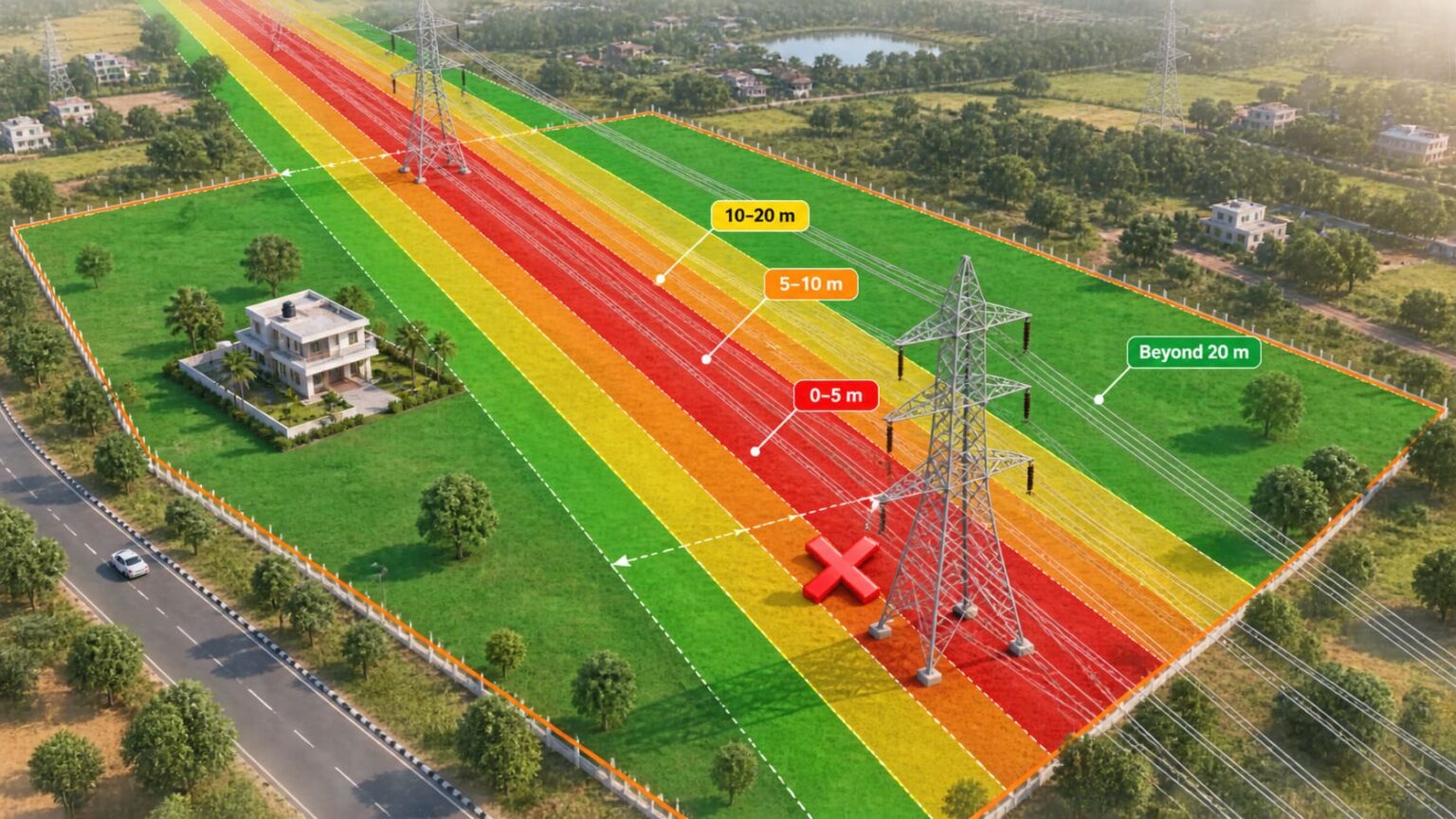
In addition to the total voltage buffer, planning authorities and state electricity boards evaluate construction safety using four specific risk zones based on physical proximity to high-voltage wires:
- Danger Zone (0 – 5 metres): Construction is strictly banned due to extreme electrocution and electrical arcing hazards. No permanent or temporary structures are allowed inside this perimeter.
- High Risk Zone (5 – 10 metres): Construction requires special clearance from state electricity boards. Building height limits, safety barriers, and strict site inspections are mandatory.
- Caution Zone (10 – 20 metres): Requires careful technical review for height caps and electromagnetic field (EMF) exposure before starting any development.
- Safe Zone (Beyond 20 metres): Standard municipal building approvals apply without extra utility clearances or special electricity board restrictions.
How Power Lines Destroy Land Value
- Building Plan Rejections: Local municipal bodies will reject house or warehouse layout plans if structures enter the safety zone.
- Lack of Bank Loans: Most banks refuse home loans or project finance for plots crossed by high-voltage wires.
- Loss of Buying Demand: Institutional buyers and home seekers usually avoid encumbered lands due to safety risks and low usable space.
- Loss of Land Price: Depending on line voltage, land under high-tension towers can lose 40% to 85% of its real market price.
Can You Stop Power Line Construction on Your Land?
Under Indian law, individual property rights yield to major public utilities. Under Section 164 of the Electricity Act 2003 and Section 10 of the Indian Telegraph Act 1885, power companies do not need prior landowner approval to erect lines.
However, you still have rights:
- File an Official Objection: If you submit a formal objection, the utility company cannot force construction. They must take the case to the District Magistrate (DM) for a ruling.
- Request Line Rerouting: You can ask power engineers to move lines to the outer boundary of your plot rather than through the center.
- Claim Land Compensation: The law requires power companies to pay money for occupying your ground and reducing your land value.
Financial Compensation Rules
Landowners retain ownership of the deed, but the government pays for the loss of land utility:
- Tower Footprint Area: Up to 100% of the government land rate for the area taken up by tower legs.
- Right-of-Way Corridor: Financial compensation for land directly under wire paths (typically 30% to 60% of land value depending on urban or rural locations).
- Crop and Tree Damage: Direct cash payments for destroyed crops, plants, or cut trees during construction.
Key Takeaway for Land Investors
Never buy a land plot based only on location or paper valuations. Always complete thorough site checks:
- Check aerial views and physical ground realities before paying advance money.
- Measure the net usable area after removing power line safety zones.
- Verify utility corridors with local urban planning offices.
The High Tension Line Proximity Check can be done on the Verified.RealEstate platform. This tool is an interactive, map-based utility tool built to assess if a plot of land in Tamil Nadu is affected by nearby High-Tension (HT) power lines and electricity grid infrastructure.
Users can pin any GPS location or search a survey plot to instantly trace nearby 11 kV, 33 kV, 110 kV, 220 kV, or 400 kV power feeder corridors and substations.
Based on safety norms under the Indian Electricity Rules (1956) and Central Electricity Authority (CEA) guidelines, the tool automatically groups the distance between a plot and nearby power lines into four color-coded risk levels. This clearly shows buyers and landowners exactly where construction is allowed on the property.
Proper checks today prevent locked-up, un-sellable assets tomorrow.