

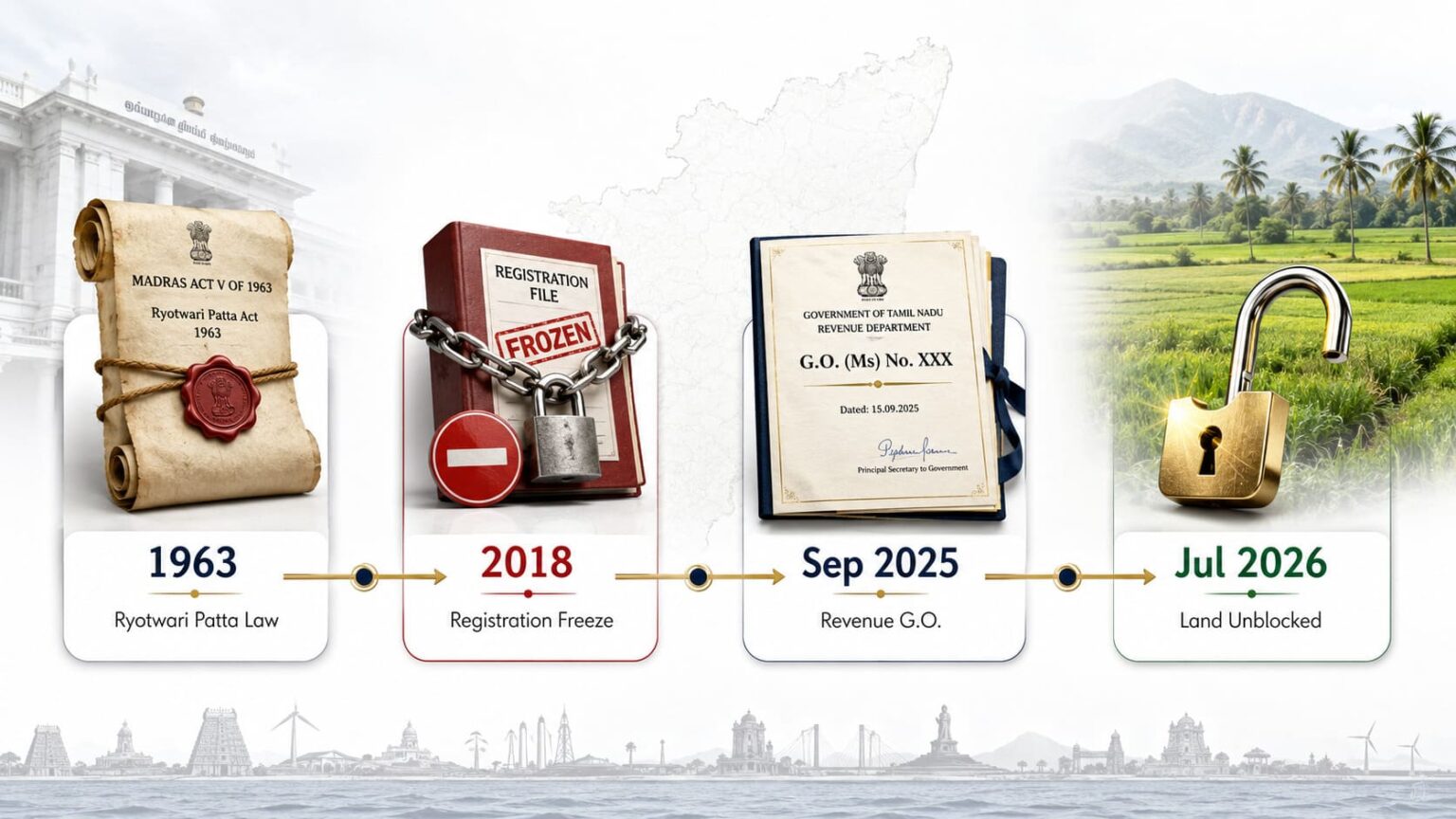
The Karur Inam Land Case is one of Tamil Nadu’s most talked-about land rights disputes. It affects thousands of everyday landowners, farmers, and four historic temples across Karur district.
For years, thousands of families held legal government land titles (known as Ryotwari Pattas). Yet, they could not sell, mortgage, build on, or transfer their own property because the land was frozen on the government’s registration portal.
This complete guide breaks down what happened, how the government unblocked 3,085 acres in July 2026, and what it means for landowners today.
What is an Inam Land?
To understand the dispute, it helps to start with the history:
- Inam Lands: Centuries ago, kings and rulers granted tax-free land grants called Inams. Some grants were given directly to temples (Devadanam), while others were given to individuals who farmed the land or provided services to the community.
- The Problem: Over time, records became complicated. It was often unclear whether a piece of land belonged strictly to the temple deity or to the individual family farming it for generations.
The 1963 Minor Inams Act: Fixing Title Ownership
To resolve ownership conflicts across Tamil Nadu, the state government passed the Tamil Nadu Minor Inams (Abolition and Conversion into Ryotwari) Act, 1963.
Under this law, specialized Settlement Officers inspected lands across the state:
- Temple Grants: If the land genuinely belonged to a temple for its rituals and maintenance, a Ryotwari Patta was issued in the name of the Temple Deity.
- Occupant Rights: If individuals had legally cultivated or occupied the land for decades, a Ryotwari Patta was granted directly to the Individual Landowner.
Once issued, a Ryotwari Patta became a permanent, legally binding title deed.
2018–2025: The “Prohibitory Module” Freeze
Around 2018–2019, the Hindu Religious and Charitable Endowments (HR&CE) Department began cross-referencing modern revenue records with old pre-1980 register books.
To protect temple assets, officials sent bulk requests to sub-registrars across Tamil Nadu. They added thousands of land survey numbers into the Section 22-A Prohibitory Module of the Tamil Nilam registration portal.
What happened to private landowners?
- Zero Guideline Value: Land values were set to ₹0 on government portals.
- Frozen Transactions: Sub-registrars refused to register sales, gifts, partitions, or mortgages.
- Statewide Impact: An estimated 13 lakh acres across Tamil Nadu were caught in this blanket freeze, leaving nearly 30 lakh citizens unable to access property loans or sell their land.
September 30, 2025: The Key Revenue G.O.
Recognizing that thousands of valid titleholders were suffering, the Tamil Nadu Revenue Department issued a crucial Government Order (G.O.) on September 30, 2025.
The September 2025 G.O. established a High-Powered Committee chaired by the Chief Secretary of Tamil Nadu.
The G.O. ruled that blanket, unilateral blocking of Ryotwari Patta lands without formal investigation was arbitrary and improper. It established a clear rule:
- The New Process: HR&CE cannot block lands simply by sending a letter. Every parcel must be verified by a committee.
- Legitimate Pattas Must Be Cleared: If a citizen holds a valid 1963 Ryotwari Patta, their land must be removed from the prohibitory list.
- Illegal Occupations Must Be Taken to Court: If HR&CE believes a patta was obtained fraudulently, they must file a legal appeal before a Revenue Divisional Officer (RDO) rather than imposing an informal ban.
July 2026: Unblocking 3,085 Acres in Karur
Karur District Collector C. Muthukumaran and a joint team of Revenue and HR&CE officials reviewed blocked lands across 15 Sub-Registrar Offices in Karur.
The July 9, 2026 Directive: Unblocking 3,085 Acres
Following recommendations by Karur Collector C. Muthukumaran, the HR&CE Department officially issued a directive on July 9, 2026, removing the registration ban on 3,084.95 acres across 471 survey numbers.
Key Details of the Order:
- Beneficiaries: ~3,390 Ryotwari Patta holders (~10,000 families).
- Scope: Covers 15 Sub-Registrar Offices in Karur District.
- Temples Involved:
- Sri Vikrutheeswarar Temple (Venjamangudalur) – 2,533.65 acres
- Sri Balasubramaniaswamy Temple (Pugalimalai) – 214.29 acres
- Sri Kalyanapasupatheeswarar Temple (Karur) – 204.52 acres
- Sri Raveeswarar Temple (Kuppuchipalayam) – 132.49 acres
Note: The government did not transfer temple lands to private individuals. It simply removed an administrative block on lands where legitimate Ryotwari Pattas had already been issued to the public decades ago.
5. Current Status & Legal Challenge
While the administrative blockade has been cleared on Tamil Nilam:
- Activists filed Public Interest Litigations (PILs) in the Madurai Bench of the Madras High Court, alleging potential misuse.
- The state government filed a counter-affidavit confirming that these 471 survey numbers contain valid, legally settled individual pattas and are separate from disputed temple properties.
- Deity Land Protection: Direct, unalienable temple lands (Devadanam)—such as the 507 acres in Vennaimalai—remain strictly blocked and under court-ordered protection against encroachers.
Summary Timeline
- 1963: Settlement Officers issue Ryotwari Pattas to eligible occupants and temples.
- 2018: HR&CE blocks Inam survey numbers on the Tamil Nilam portal.
- Sept 30, 2025: Revenue G.O. declares arbitrary registration blocks improper.
- July 9, 2026: Government issues order unblocking 3,085 acres in Karur for 3,390 patta holders.
- Present: Madras High Court reviews the order to balance individual patta rights with temple assets.