

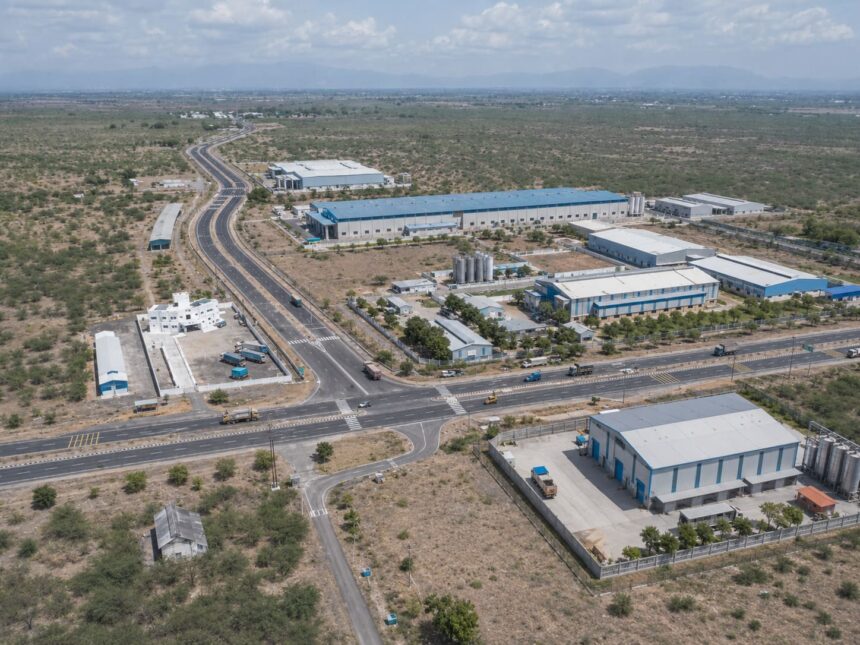
The PM MITRA (Prime Minister Mega Integrated Textile Region and Apparel) Parks scheme is a flagship initiative launched by the Ministry of Textiles, Government of India. With a total financial outlay of ₹4,445 crore, the program’s core objective is to position India as a leading global hub for textile manufacturing and exports by developing world-class, large-scale industrial infrastructure.
The entire scheme is anchored around the Prime Minister’s holistic “5F” Vision:
- Farm (Raw Cotton Production)
- Fibre (Spinning & Processing)
- Factory (Weaving & Garment Manufacturing)
- Fashion (Apparel Designing)
- Foreign (Global Exports)
Historically, India’s textile sector has been highly fragmented, with spinning happening in one state, weaving in another, and garmenting elsewhere. This geographic separation adds massive logistics costs and delays. PM MITRA solves this structural bottleneck by forcing the entire textile value chain into a single location by focusing only on Yarn, fabric, processing, finishing, garments, technical textiles, MMF, knitwear.
Out of dozens of competitive bids from state governments across the country, the Central Government finalized just seven strategic locations across India—including Maharashtra, Gujarat, Madhya Pradesh, Uttar Pradesh, Telangana, Karnataka, and Tamil Nadu (Virudhunagar).
The Virudhunagar Industrial Hub: A Macro Overview
The development of the PM MITRA Park at Kumaralingapuram in the Virudhunagar district marks a major milestone in Tamil Nadu’s industrial growth story. Managed through a Special Purpose Vehicle (SPV) jointly led by the State and Central governments, this specific park is designed to absorb massive domestic and foreign direct investments (FDI).
Land and plot details
Spread over a contiguous 1,052 acres, the Virudhunagar PM MITRA Park involves a total project layout of ₹1,894 crore. Official data from the State Industries Promotion Corporation of Tamil Nadu (SIPCOT) highlights two staggering metrics that underscore the project’s scale:
- Allotable Industrial Area: 600.83 acres explicitly dedicated to manufacturing units and plot cost as ₹55.32 lakh per acre.
- Employment Potential: The generation of 1 lakh (100,000) direct and indirect jobs, heavily empowering local youth and women.
The land allotment policy says land can be leased for a maximum of 99 years, while buildings can be leased for 45 years. The same policy says allotment will be based on the approved master plan and layout, with a transparent, objective criteria-based process.
Key Highlights of the Kumaralingapuram PM MITRA Park
A mega-integrated ecosystem requires a hyper-specific blend of logistics, nearby raw materials, skilled labor availability, and environmental sustainability. The site at Kumaralingapuram offers the distinct advantages required to make this mega project a success.
1. Large Contiguous Land Parcel for an Integrated Value Chain
A standard textile factory can survive on a small 5-acre industrial plot, but an integrated PM MITRA ecosystem needs vast acres of uninterrupted space.
The 1,052 acres at Kumaralingapuram allow SIPCOT to create distinct, highly organized zones all under one umbrella:
- Upstream Facilities: Spinning mills and high-capacity weaving units.
- Downstream Facilities: Advanced knitwear centers, apparel manufacturing floors, and technical textile lines.
- Shared Ecosystem Support: Quality testing laboratories, certification centers, design studios, large-scale warehousing, and dedicated worker housing hostels.
By grouping these steps geographically, the physical movement of fabric from a spinning mill to a dyeing unit to a tailoring floor happens via internal industrial roads rather than public highways, dropping logistics friction effectively to zero.
2. Multi-Modal Logistical and Export Connectivity
Connectivity is another major reason why Kumaralingapuram makes sense. The site is located in Virudhunagar district with access to important transport links.
According to SIPCOT, the park is around 50 km from Madurai Airport, 100 km from Thoothukudi Port, 22 km from Virudhunagar and 50 km from Madurai.
This matters because textile industries depend heavily on logistics. Yarn, fabric, chemicals, machinery, finished garments and export containers need regular movement. Easy access to road networks, airport facilities and Thoothukudi Port can help reduce delays and improve export movement.k to load finished apparel into containers and clear customs locally, putting goods on cargo ships destined for global markets with minimal turnaround times.
3. Located in the Pulse of Tamil Nadu’s Textile Belt
A new industrial park fails if it operates in geographical isolation. The Kumaralingapuram project acts as a central node feeding off and supporting Tamil Nadu’s world-famous, pre-existing textile clusters:
- Tiruppur: India’s undisputed capital for knitwear and ready-made garments.
- Karur & Erode: Powerhouses for home textiles, weaving, and fabric printing.
- Coimbatore & Salem: Known historically for advanced spinning machinery, yarn production, and textile engineering.
- Rajapalayam & Dindigul: Famous for premium spinning mills and high-quality combed yarn.
Being close to these legacy markets ensures that companies setting up in the park have immediate access to specialized maintenance vendors, machinery parts, seasoned textile traders, and an experienced pool of industrial labor.
4. Direct Synergy with Virudhunagar’s Cotton Crop Base
Bridging the gap between the agricultural farm and the industrial factory is a core pillar of the PM MITRA ideology. Virudhunagar is an important cotton-growing district.
According to crop and soil profiles published by the Tamil Nadu Agricultural University’s (TNAU) Krishi Vigyan Kendra, the district is defined heavily by its vast tracts of black soil. Because black soil features excellent water-retention properties, it serves as the natural foundation for the region’s rainfed cotton-based farming systems. By anchoring the mega park here, industrial yarn producers are positioned closer to raw cotton yields, stabilizing prices for local farmers while reducing raw material procurement costs for factories.
World-Class Infrastructure and Green Utilities
To speed up company operations, SIPCOT has designed the Kumaralingapuram site with advanced industrial utilities that meet international corporate compliance standards.
1. The “Plug-and-Play” Advantage
For both large multinational apparel brands and domestic Micro, Small, and Medium Enterprises (MSMEs), building a factory from scratch causes massive delays. The park features plug-and-play facilities, meaning pre-built factory sheds, robust internal roads, 24/7 high-voltage power sub-stations, and high-capacity water lines are ready on arrival. Businesses can simply install their machinery and begin production immediately.
2. Absolute Focus on Environmental Sustainability
Textile wet processing—such as dyeing, bleaching, washing, and finishing—is heavily chemical-intensive. Global fashion brands will not buy from factories that pollute local water tables. To address this, the park integrates mandatory eco-friendly infrastructure:
- CETP with ZLD: A centralized Common Effluent Treatment Plant operating with Zero Liquid Discharge technology ensures that 100% of industrial wastewater is treated, recycled, and fed back into production, releasing zero hazardous waste into the surrounding environment.
- Circular Utilities: Centralized sustainable steam boilers, solid waste management systems, and a heavy emphasis on green renewable energy integration to lower the carbon footprint of manufacturing.
Economic Equalizer for Southern Tamil Nadu
For decades, major industrial developments in Tamil Nadu have favored northern and western zones like Chennai, Sriperumbudur, Coimbatore, and Hosur. The establishment of the PM MITRA Park in Virudhunagar acts as an economic catalyst for the southern districts, bringing wealth, infrastructure, and urban development down the map.
The project is moving forward at a rapid pace and is well past the initial planning phase. Official updates from the Press Information Bureau (PIB) confirm:
- 100% Land Acquisition: The entire 1,052-acre block has been successfully acquired.
- Approvals Cleared: Statutory environmental clearances and administrative approvals are fully secured.
- DPR Approved: The ₹1,894 crore Detailed Project Report has received official clearance.
- Work Underway: Initial phase infrastructure development works valued at ₹364 crore have been allotted to contractors and are physically progressing on-site.
Conclusion
The PM MITRA Textile Park in Kumaralingapuram, Virudhunagar, represents a highly calculated logistical and economic blueprint for India’s apparel sector. By combining massive acreage, short transport routes to major maritime ports, a rich regional cotton agricultural base, and sustainable zero-liquid-discharge infrastructure, the site offers the exact ecosystem needed to capture global apparel markets.
As the park ramps up operations, it will solidify Tamil Nadu’s position as a global manufacturing leader, driving the nation’s textile exports forward while transforming the economic reality of thousands of families across southern Tamil Nadu.