

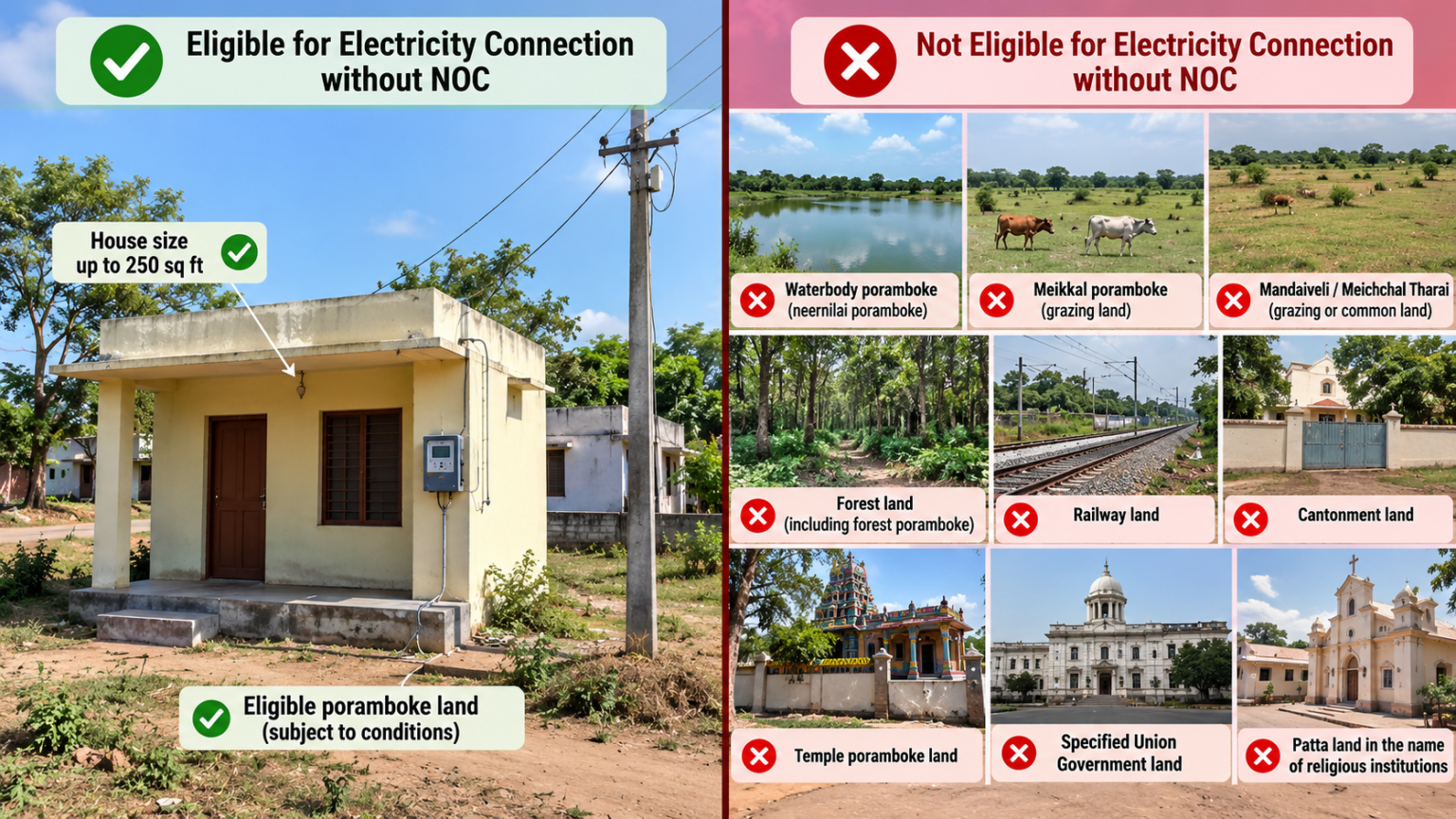
The Tamil Nadu government has relaxed the requirements for obtaining domestic electricity connections for eligible houses located on certain categories of poramboke land. Under Government Order (Ms) No. 100, dated September 16, 2026, houses with a built-up area of up to 250 sq ft can obtain electricity connections without a No Objection Certificate (NOC) from the concerned government department, subject to prescribed conditions.
The Tamil Nadu Power Distribution Corporation Limited (TNPDCL) issued implementation instructions to its senior officials on October 7, 2026, following the government order and the corporation’s proceedings dated September 24, 2026.
The relaxation is expected to help eligible households that have faced difficulties obtaining authorised electricity connections because of the NOC requirement. However, the relief is subject to land-classification checks, documentation requirements and other conditions. It does not grant ownership rights or regularise occupation of government land.
Why Has Tamil Nadu Relaxed the NOC Requirement?
Residents living on poramboke land have faced difficulties obtaining electricity connections. The practical challenge was that the applicants had to obtain an NOC from a government officer not below the rank of Deputy Tahsildar under Regulation 27(12) of the Tamil Nadu Electricity Distribution Code.
Revenue officials sometimes refused to issue an NOC, as it was outside their direct allocation scope, while the electricity department required it to approve the connection, leaving residents stuck. High-profile cases—such as families in Thanakottiyammal Thottam and Muthureddy Thottam in T. Nagar, Chennai—faced decades of prolonged difficulties obtaining authorized power meters due to these strict land classification hurdles.
The September 2026 order waives the NOC requirement for eligible houses while retaining safeguards to protect excluded land categories and existing land rights.
The Rules Before the September 2026 Government Order
As discussed above, before the September 2026 order, Regulation 27(12) of the Tamil Nadu Electricity Distribution Code generally required an NOC, an indemnity bond and double security deposit for electricity connections on poramboke land.
Although an alternative procedure existed in 2001, the NOC requirement created difficulties for some residents. The new order waives the NOC for eligible houses, subject to specified conditions. The important note is that getting the electricity connection does not prove or confer the ownership title of the land.
The key change is the relaxation of the NOC requirement for a limited category of eligible households. The other safeguards continue to apply as prescribed.
Who Is Eligible for an Electricity Connection?
- Maximum House Size: The relaxation applies exclusively to small residential dwellings with a built-up area not exceeding 250 square feet.
- Tariff Category: Connections will be billed under Low Tension Tariff IA(3) – Poromboke, matching the standard rates of regular LT-IA domestic connections.
- Compulsory Undertaking: Applicants must submit an indemnity bond (Form 6) and a formal undertaking acknowledging that the connection can be disconnected and occupants may be evicted if the government requires the land or if a legal dispute arises.
Meeting the house-size requirement alone does not guarantee approval. The classification of the land is a key factor in determining eligibility.
Which Categories of Land Are Excluded?
The relaxation does not apply to houses situated on the categories of land specified as excluded under the government order and related instructions. These include:
- Waterbody and watercourse poramboke (Neernilai poramboke).
- Meikkal poramboke, classified as grazing land.
- Mandaiveli and Meichchal Tharai, associated with grazing or common open land.
- Forest land, including forest poramboke.
- Railway land and specified Union Government land.
- Cantonment land.
- Temple poramboke land.
- Patta land registered in the name of religious institutions.
Residents should not assume that every house situated on government-owned land will qualify. The applicable land classification must be established from the relevant revenue records.
What Tariff Will Applicants Have to Pay?
Eligible connections will be classified under a separate consumer category called Low Tension Tariff IA(3) – Poromboke.
Although the connection will have a separate classification for administrative and billing purposes, electricity consumption will be charged at the same tariff as regular domestic LT-IA connections.
Applicants must also pay the applicable connection charges and security deposit. The prescribed security deposit for this category is twice the normal security deposit.
The separate category will help TNPDCL identify and monitor these connections distinctly from ordinary domestic connections.
What Documents and Undertakings Are Required?
Applicants must follow the prescribed application procedure and submit the required documents.
Step-by-Step Application Process
- Land Classification Verification: The TNPDCL Electricity Section Officer verifies land classification using Tamil Nilam revenue records or through confirmation from the Village Administrative Officer (VAO).
- Online Application: Applicants submit an online application under Form 1.
- Undertaking & Indemnity Bond: Applicants furnish an indemnity bond (Form 6) and an explicit undertaking agreeing to disconnection and eviction if required by authorities.
- Fee Payment: Applicants pay applicable connection charges alongside a security deposit charged at twice the standard rate.
- Final Inspection & Approval: Power supply is released once departmental verifications confirm the land is clear of excluded classifications.
The undertaking is an important safeguard. Applicants must acknowledge that the electricity connection does not confer ownership rights over the land and that the occupants may be required to vacate if the government requires the land or a relevant dispute arises.
The electricity supply may also be disconnected in such circumstances.
Applicants should confirm the prescribed forms and submission procedure with their local TNPDCL office before applying.
Do Houses Exceeding 250sq.ft. Still Need an NOC?
Houses that are bigger than 250 square feet still have to follow the old rules. This means they cannot use the new relaxation and must get a formal No Objection Certificate (NOC) from a government officer (such as a Deputy Tahsildar) before they can apply for an electricity connection.
Does This Grant Property Ownership or Patta?
No. Obtaining an electricity connection under this scheme does not grant ownership rights, patta, or legal title to the land. The signed undertaking openly states that the connection can be stopped and occupants evicted if the government reclaims the land or a dispute arises.
TNPDCL to Monitor Implementation Every Three Months
To ensure that the relaxation is implemented consistently, TNPDCL has directed its chief engineers and superintending engineers to communicate the instructions to field-level officials.
The corporation has also prescribed quarterly monitoring of applications and connections provided under the scheme.
The reports must include:
- The number of applications received.
- The number of electricity connections provided.
- The number of applications pending.
These details must be compiled district-wise and taluk-wise. Reports are to reach the Chief Engineer (Commercial) by the fifth day of the month following the end of each quarter.
For example, a report covering October to December would be due by January 5.
This monitoring mechanism is intended to track implementation, identify pending applications and ensure that the instructions reach officials responsible for processing applications.
Key Takeaways for Poramboke Land Residents
- Eligible households can obtain domestic electricity connections without an NOC, subject to the prescribed conditions.
- Houses must meet the 250 sq ft limit, eligible land classification and documentation requirements.
- Electricity connection does not grant patta or ownership rights. Land regularisation must be pursued separately under applicable revenue rules.n.