

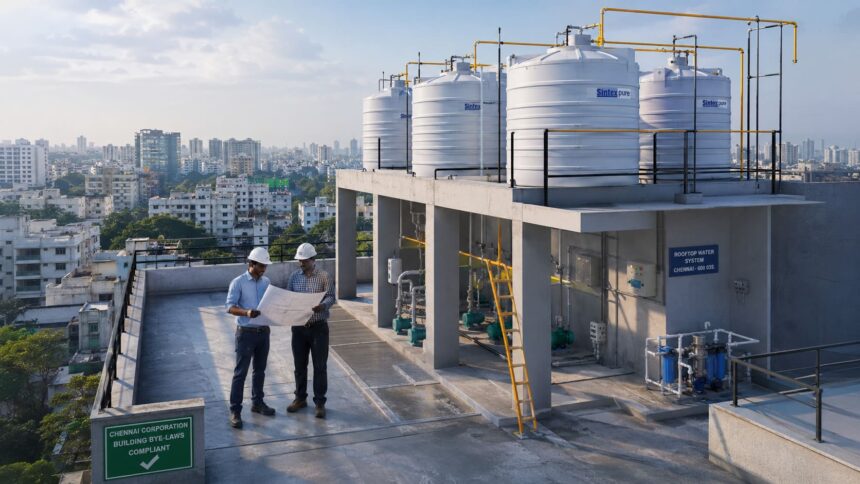
The Chennai Metropolitan Development Authority permits modifications in the location and orientation of Overhead Tanks (OHTs), subject to compliance with approved development norms.
Builders may revise tank positioning or layout arrangements as long as the approved structural and planning standards remain unaffected.
Additional Charges for OHT Size Increase
If the size or storage capacity of the overhead tank is increased:
- Additional development charges may apply
- The expanded portion may be treated under non-FSI area considerations
Authorities may evaluate the revised structural and utility impact before granting approval.
What “Non-FSI Area” Means
FSI = Floor Space Index.
Certain service structures are excluded from FSI calculations, but:
- Their dimensions are still regulated
- Excessive increase may attract scrutiny or charges
Why OHT Regulations Matter
Overhead tanks directly affect:
- Structural load calculations
- Water distribution planning
- Terrace space utilization
- Maintenance access
- Utility infrastructure design
Unauthorized expansion may create planning deviations and structural concerns.
Compliance Requirements for Builders
Builders must ensure:
- Structural stability compatibility
- Proper waterproofing systems
- Safe maintenance access
- Compliance with approved utility layouts
- Adherence to sanctioned development conditions
Major deviations may require revised planning approval from the competent authority.
Importance of Proper OHT Planning
These regulations help maintain:
- Structural safety
- Efficient water management
- Utility infrastructure compliance
- Transparent development control mechanisms
Proper OHT planning also improves long-term operational efficiency in residential developments.
Overhead Tank Compliance Assessment with BuildScope
Using BuildScope by Verified.RealEstate, builders and property owners can assess overhead tank (OHT) compliance by evaluating applicable height restrictions, setback requirements, development classification, and utility planning norms based on plot dimensions, road width, and proposed building parameters under CMDA/DTCP regulations.