

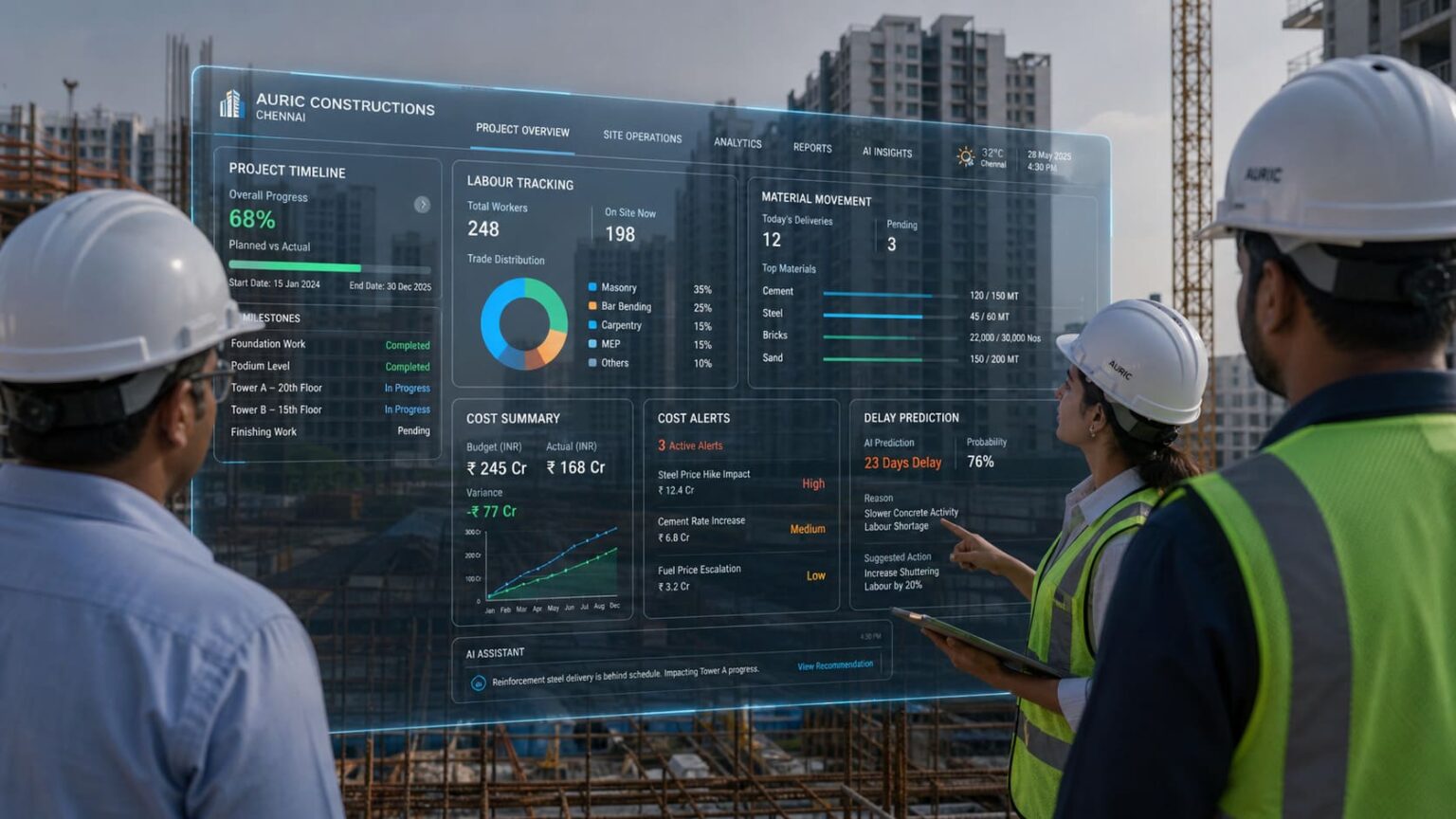
For decades, the Chennai real estate market has been haunted by two persistent ghosts: project delays and budget overruns. Whether it’s a luxury high-rise on OMR or a commercial hub in Guindy, the script is often the same—labor shortages, material lags, and unforeseen rework push delivery dates back by months.
However, a technological shift is currently underway. Top-tier Chennai developers are no longer relying solely on manual supervision; they are integrating AI-powered construction management platforms to transform “bricks and mortar” into “bits and data.”
The New Players: Slate Technologies, DRA Homes, and Casagrand
The movement gained significant momentum with the entry of Slate Technologies, a US-based AI firm, into the Chennai market. Major developers like DRA Homes and Casagrand have already signed on to integrate these “digital brains” into their workflows.
For instance, DRA Homes is implementing this tech across a massive 3.3 million sq. ft. of development, impacting nearly 2,000 workers and 100 technical staff. The goal? To move away from reactive fixes and toward predictive management.
How AI Converts Construction Data into Cost Control
The core problem in construction is “siloed data”—schedules, labor reports, and cost sheets are often handled by different teams. Modern AI solves this by creating Unified Data Access, auto-linking systems like Procore, P6, and Autodesk to ensure one single source of truth.
It is a common misconception that AI is here to design buildings or replace site engineers. In reality, AI acts as a sophisticated control system.
Here is how these specific AI features are optimizing Chennai’s building sites:
- Predictive Anomaly Detection: Instead of finding out about a delay weeks later, AI identifies “hidden risks” and triggers Risk-based Alerts. If a foundation pour in a Perungudi project is lagging, the system notifies the team instantly based on predetermined threat thresholds.
- The “Lessons Learned” Database: Chennai construction often suffers from repeating the same mistakes across different sites. AI analyzes historical project data to preserve institutional expertise, ensuring that a costly error made in an Anna Nagar project is never repeated in Navallur.
- Auto-Linking & Learning Systems: One of the most tedious tasks is matching site photos to the master schedule. An Auto-linking Engine does this automatically, while a Learning Decision System captures human feedback to improve the AI’s predictive accuracy over time.
- Visual Knowledge Maps: Project managers no longer have to dig through spreadsheets. Interactive interfaces and Weekly Insight Digests allow teams to explore issues by category and stay aligned on every project pivot.
The Result: 20–30% Faster Delivery?
By identifying “critical path” threats and optimizing resource allocation, these tools help builders avoid the “rework trap.” Globally, this technology has helped reduce construction timelines by 20% to 30%. In a market like Chennai, where a six-month delay is often viewed as “normal,” such a reduction is a game-changer for homebuyer trust and developer liquidity.
Beyond the Site: AI in Pre-Construction
The push for efficiency starts even before the first brick is laid. Tools like LandLens by Verified.RealEstate are helping Chennai developers navigate the complexities of land acquisition.
Through features like Build Scope, developers can use AI to instantly calculate:
- FSI (Floor Space Index) and height limits.
- Setbacks and parking requirements.
- Legal due diligence and title risks.
By automating these “pre-construction” hurdles, builders can avoid the approval surprises and transaction risks that often stall projects before they even begin.
What This Means for Homebuyers and Investors
For homebuyers and investors, AI adoption can bring more confidence into the property market.
If builders use AI properly, projects may become more predictable, timelines may improve, and cost overruns may reduce. This can lead to better delivery discipline and improved trust between developers and buyers.
At the same time, buyers and investors should also use AI-backed property verification tools before entering a transaction. A project that looks attractive on paper may still carry legal, approval, ownership, access, or buildability risks.
The Bottom Line
AI in construction is still evolving, but its direction is clear. Chennai builders are beginning to understand that cost control is not only about negotiating cheaper materials or pushing labour harder. True cost control comes from better planning, better coordination, better risk prediction, and faster decision-making.
As AI tools become more common, the real estate industry may become more transparent, data-driven, and accountable.