

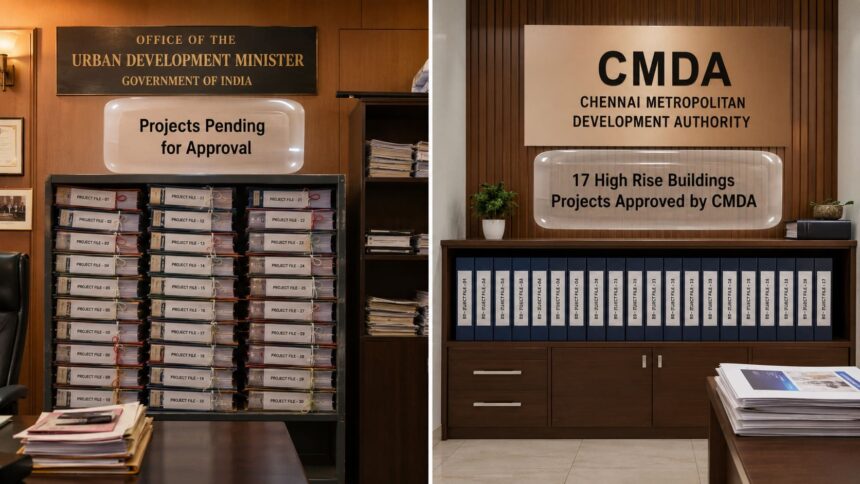
The Chennai Metropolitan Development Authority (CMDA) has approved around 17 high-rise building proposals within barely a month of receiving greater approval powers. The number is equal to the total high-rise approvals issued by the authority during the whole of 2024, indicating a significant acceleration in the planning process.
Ministerial Approval Requirement Removed
Previously, proposals for high-rise buildings exceeding 18.3 metres in height had to pass through two main levels:
- The proposal was examined by a committee chaired by the CMDA Member Secretary.
- Even after committee clearance, the file had to be forwarded to the Tamil Nadu government for final approval by the minister, who served as CMDA chairman.
Under the new system, CMDA can directly approve the proposals, so the files no longer need ministerial clearance. This is expected to reduce such delays.
This change was introduced through a Housing and Urban Development Department government order G.O. (Ms) No.126 dated June 15, 2026. The amendment followed CMDA’s request for greater authority under the Tamil Nadu Combined Development and Building Rules, 2019.
This revised system removes the need for a separate ministerial-level approval after CMDA scrutiny.
Approval Numbers Show a Sharp Rise
CMDA approved 66 high-rise proposals in 2021, followed by 58 in 2022 and 30 in 2023. The number dropped to 17 in 2024 and just nine in 2025.
However, following the recent rule change, nearly 17 proposals were cleared within about a month. Several applications had reportedly remained pending for years under the earlier approval system.
CMDA Member Secretary Rahul Nadh said removing the government-level approval stage could save around two months in the processing of high-rise applications.
Developers Expect Faster Project Clearances
The real estate industry has welcomed the reform, as it removes one administrative layer and may help developers begin projects sooner. Faster planning approvals could also reduce financing costs and prevent prolonged project delays.
However, the change does not exempt developers from obtaining other mandatory permissions.
Developers must still obtain all applicable statutory permissions, which may include:
- Environmental clearance
- Airport Authority or aviation-related clearance
- Fire and rescue services clearance
- Traffic and infrastructure-related approvals
- Other permissions depending on the project’s height, size, location and use
Verified Real Estate assists developers in coordinating and obtaining these statutory approvals, helping them in ensuring a smoother and hassle-free project approval process.
What the Reform Means for Chennai Real Estate
The rapid clearance of 17 high-rise proposals suggests that the new system could improve the ease of doing business in Chennai’s construction sector. It may also encourage developers to take up larger residential, commercial and mixed-use projects across the metropolitan region.
The long-term impact will depend on whether CMDA can maintain faster approval timelines while ensuring that projects continue to comply with planning, safety, infrastructure and environmental regulations.