

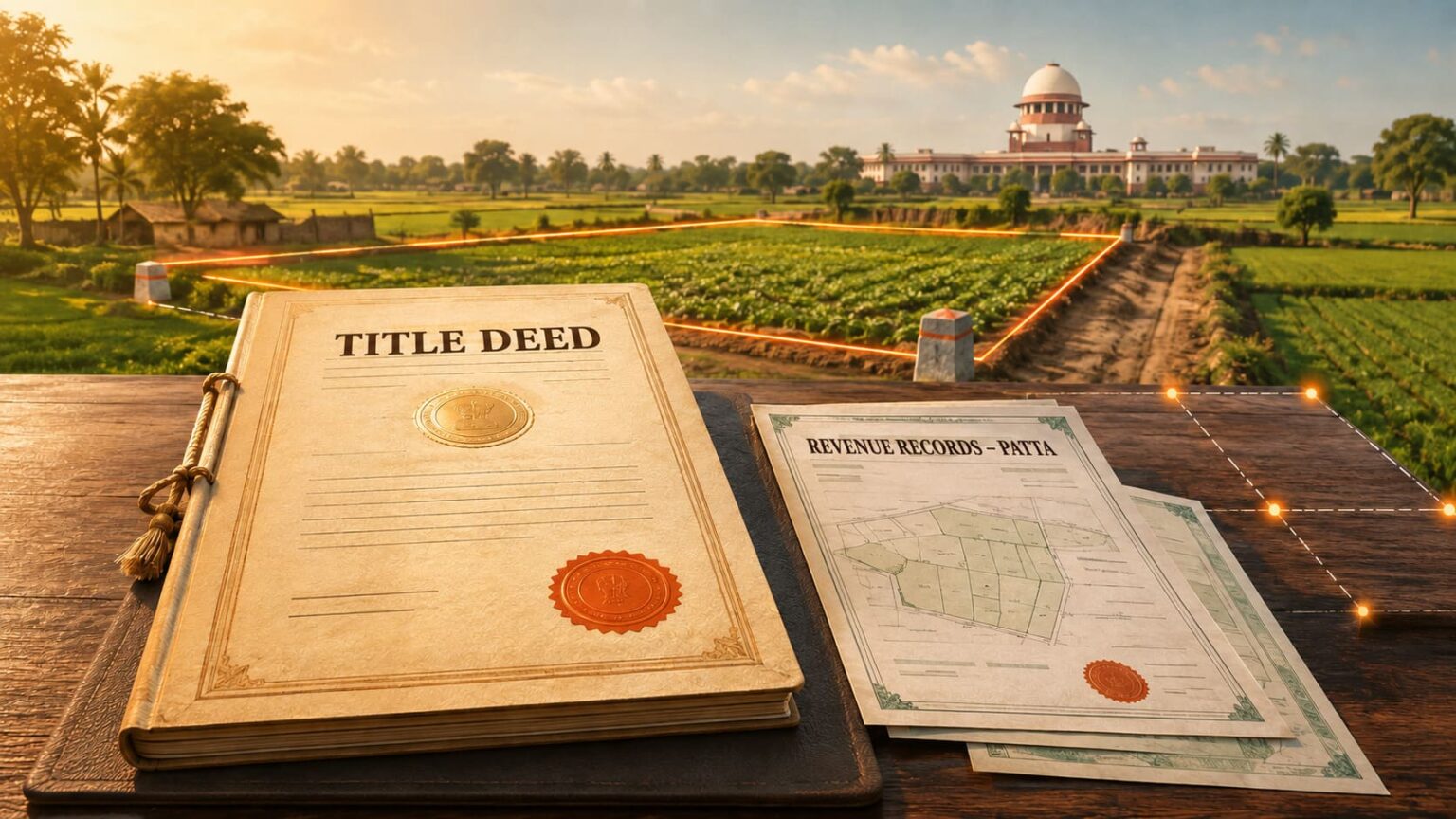
A recent Supreme Court judgment has delivered an important reminder for property owners and legal heirs: mutation neither creates ownership nor takes it away.
In Jamnabai & Others v. Vasudev & Others, the Court restored the property rights of legal heirs whose predecessor’s name had been removed from the revenue records many years earlier.
What Was the Property Dispute?
The dispute concerned approximately 12.41 acres of agricultural land in Indore originally owned by Bhagwansingh.
After his death, the property was inherited equally by his two sons:
- Ramprasad – ½ share
- Vasudev – ½ share
Ramprasad later moved away from the property. His family, however, continued receiving agricultural produce from the land.
In 2008, Ramprasad’s legal heirs discovered through a newspaper notice that Vasudev was attempting to sell part of the property. After obtaining the revenue records, they found that Ramprasad’s name had been completely removed.
One portion had been mutated in Vasudev’s name and another in the name of Vasudev’s son, Jaswant.
Was There a Valid Relinquishment?
Vasudev claimed that Ramprasad had voluntarily surrendered his property rights in 1990. He relied on revenue proceedings and an alleged written consent document.
However, the courts found several problems with this claim:
- The alleged document did not clearly identify the property.
- It did not mention any consideration.
- It was not a registered relinquishment deed.
- Ramprasad’s signatures were disputed.
- No independent witness properly proved its execution.
- The evidence surrounding the document was inconsistent.
The Supreme Court held that the persons claiming relinquishment had failed to prove that Ramprasad legally surrendered his ownership.
Mutation Is Not a Transfer of Ownership
The Supreme Court clearly reiterated that an entry in a revenue record is mainly maintained for fiscal and administrative purposes.
A mutation order cannot replace a:
- registered sale deed;
- gift deed;
- settlement deed;
- partition deed;
- release or relinquishment deed; or
- valid court decree.
The Court explained that the revenue record must follow the legal ownership. It cannot create ownership by merely recording one person’s name in place of another.
Therefore, removing Ramprasad’s name from the records did not automatically extinguish his share.
What Happened to Ramprasad’s Share?
Ramprasad’s ½ share passed to his five legal heirs—his wife, son and three daughters.
Each heir was therefore entitled to:
½ ÷ 5 = ¹⁄₁₀ of the entire property
The Trial Court recognised their rights. The First Appellate Court confirmed the decision after examining additional evidence.
The Madhya Pradesh High Court later reversed these findings. However, the Supreme Court held that the High Court had exceeded the limited powers available to it in a second appeal under Section 100 of the Code of Civil Procedure.
The Supreme Court restored the earlier decree, recognised the heirs’ co-ownership and restrained the opposing parties from creating third-party rights until lawful partition.
Can One Co-owner’s Possession Defeat the Others’ Rights?
Not automatically.
When one co-owner occupies or cultivates a jointly owned property, the law normally treats that possession as being on behalf of all co-owners.
A co-owner living elsewhere does not lose ownership merely because they:
- did not cultivate the land;
- did not collect its income;
- did not live on the property; or
- did not have their name shown in the revenue record.
To establish that a co-owner was legally excluded, there must generally be a clear and hostile denial of that person’s ownership, exclusive possession and knowledge of the denial by the excluded co-owner.
In this case, no such open exclusion of Ramprasad was proved.
What Does This Mean for Tamil Nadu Property Owners?
In Tamil Nadu, patta and other revenue records are important for identifying possession, land classification and the person responsible for land revenue. However, a patta by itself is not the final source of ownership.
Property title must be verified through documents such as:
- registered parent deeds;
- sale, settlement, gift or release deeds;
- partition documents;
- legal-heir and succession records;
- court orders; and
- supporting possession and revenue records.
A person’s name appearing in the patta does not automatically make them the absolute owner when valid title documents show that others also have rights.
Do Not Ignore an Incorrect Patta or Mutation
Although a wrong mutation cannot legally cancel ownership by itself, it should never be ignored.
An incorrect entry may allow another person to attempt a sale, obtain approvals, claim compensation or create third-party interests. Correcting the record after such transactions may require lengthy civil litigation.
Property owners and legal heirs should regularly verify the patta, revenue records and encumbrance details and take prompt legal action when an unexplained change is found.
The Key Takeaway
A mutation or patta entry records property-related information—it does not independently transfer ownership. Legal title can be transferred or surrendered only through a valid transaction recognised by law.
Case Reference
Jamnabai & Others v. Vasudev & Others
Supreme Court of India
2026 INSC 900
Decided on 20 August 2026
Disclaimer
This article is intended only for general information and does not constitute legal advice. Property rights depend on title documents, succession, possession, limitation and the facts of each case. Anyone facing an incorrect patta, mutation or ownership dispute should consult a qualified property lawyer.