

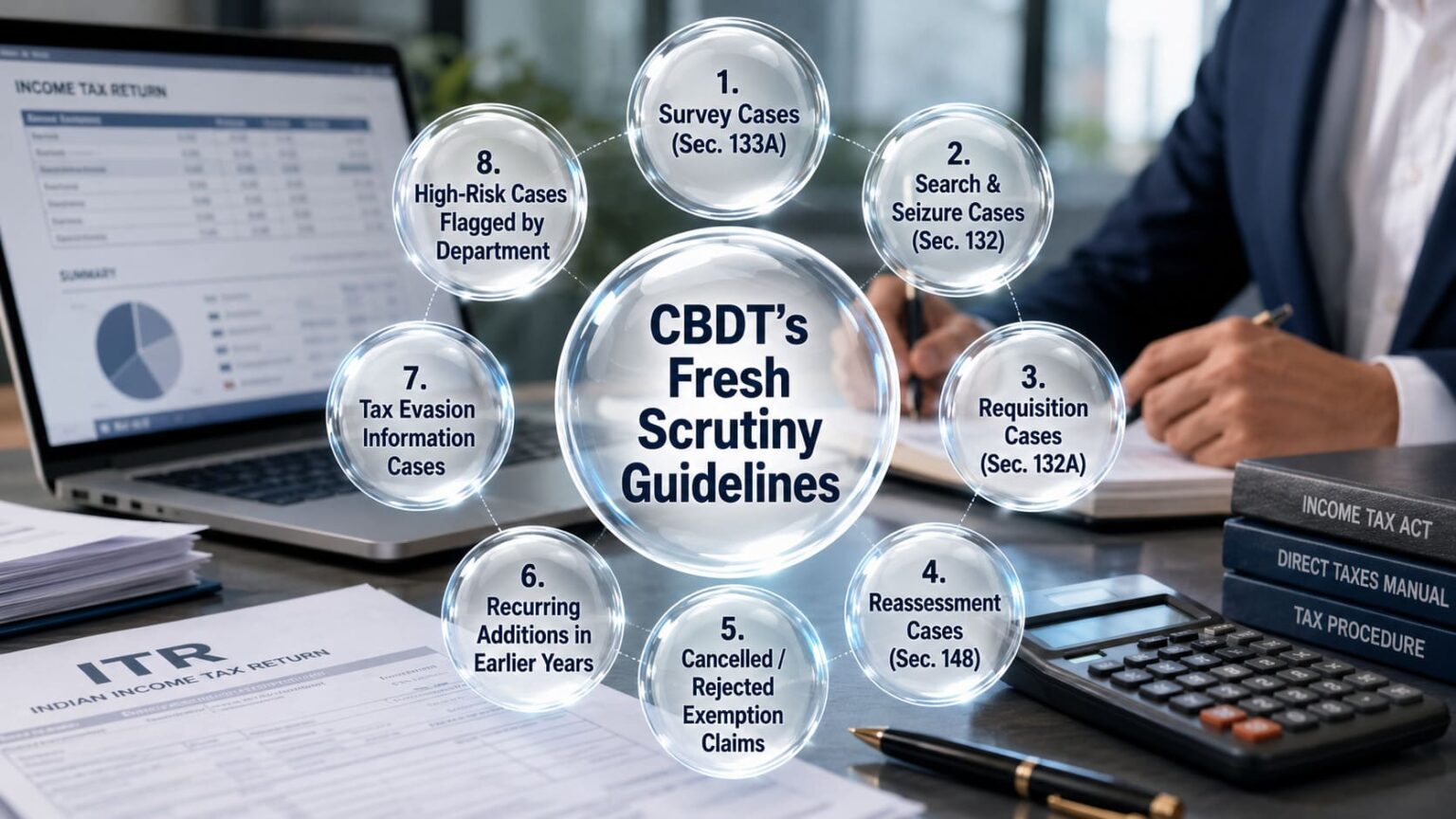
The Income Tax Department has issued fresh scrutiny guidelines for FY 2026–27. These guidelines explain which Income Tax Returns may be selected for complete scrutiny during the year. The latest CBDT instruction applies to returns filed during FY 2025–26, and the deadline for serving notice under Section 143(2) for such returns is 30 June 2026.
For taxpayers, this does not mean every return will be checked. But it clearly shows that the department is focusing more on cases involving tax evasion information, past disputes, searches, surveys, exemption misuse and mismatched records.
What Is ITR Scrutiny?
ITR scrutiny means the Income Tax Department wants to examine your return in detail. This may happen when the department finds a serious issue, mismatch, past dispute, or information suggesting that income may not have been fully reported.
In simple words, scrutiny is not just a routine check. It is a detailed review where the taxpayer may be asked to explain income, deductions, bank transactions, property sales, business receipts, capital gains or exemption claims.
CBDT’s Fresh Scrutiny Guidelines for FY 2026–27
The Central Board of Direct Taxes has listed certain categories where returns may be selected for compulsory complete scrutiny. These include survey cases, search cases, reassessment cases, cancelled exemption claims, recurring additions in earlier years and cases where specific tax evasion information has been received from investigation or regulatory agencies.
This means the department is not only relying on random checks. It is focusing on returns where there is already a stronger reason to examine the taxpayer’s records.
Who Can Face Compulsory ITR Scrutiny?
A taxpayer may face compulsory scrutiny if the case falls under one of the specified categories.
These cases may be selected for compulsory ITR scrutiny:
- High-risk cases flagged by the department based on available records, past proceedings or verified information.
- Survey cases where a survey under Section 133A was conducted on or after 1 April 2024.
- Search and seizure cases under Section 132.
- Requisition cases under Section 132A, where books, documents or assets are requisitioned by the department.
- Reassessment cases where a notice under Section 148 has been issued.
- Trust or institution cases where exemption is claimed even after registration was cancelled, rejected or not granted.
- Recurring addition cases where the same tax issue has resulted in repeated additions in earlier assessment years.
- Tax evasion information cases where specific information is received from investigation, intelligence, enforcement or regulatory authorities.
AIS or TDS Mismatch Alone May Not Always Mean Compulsory Scrutiny
One important clarification is that a return filed in response to a Section 142(1) notice based only on AIS, SFT or TDS information may not automatically be selected for compulsory scrutiny unless it also falls under the specific tax evasion information category.
This is important because many taxpayers receive notices due to data mismatches. A mismatch should still be corrected or explained properly, but not every mismatch automatically becomes a complete scrutiny case.
Why Property Transactions Can Attract Tax Questions
Property buyers and sellers need to be careful because property-related data is visible to the tax department through registration records, bank transactions, TDS filings, SFT reporting and AIS entries.
A scrutiny risk may arise when there is a mismatch in sale value, stamp duty value, capital gains calculation, source of funds, loan repayment, cash deposit or TDS deduction on property purchase.
For example, if a property is sold but the capital gain is not properly shown in the ITR, or if the purchase value does not match the taxpayer’s declared income and bank records, the department may ask for an explanation.
What Taxpayers Should Check Before Filing or Responding
Taxpayers should cross-check their ITR with AIS, Form 26AS, TIS, bank statements, capital gains records, property documents, rent receipts, loan statements and TDS certificates.
For property-related cases, it is also safer to keep sale deed copies, payment proofs, loan sanction letters, source of funds, stamp duty details, purchase history, improvement cost bills and capital gains working papers ready.
This is where proper property due diligence also matters. Before buying or selling property, platforms like Verified.RealEstate can help users review title, encumbrance, guideline value, patta, approvals and other property-linked records, which can later support cleaner documentation during financial or tax review.
What To Do If You Receive an ITR Scrutiny Notice
Do not ignore the notice. Read the section mentioned in the notice, check the response deadline and collect the exact documents asked for.
If the notice is under Section 143(2), it means your return has been selected for scrutiny. If a further notice under Section 142(1) is issued, it may ask for detailed documents and explanations. A careless or incomplete reply can create more problems.
The better approach is simple: reply on time, give only relevant documents, explain mismatches clearly and take help from a tax professional if the amount or issue is serious.
One-Line Explanation of Income Tax Sections Mentioned
- Section 143(2): A scrutiny notice issued when the Income Tax Department wants to examine your return in detail and verify whether income, loss, deductions or tax paid are correctly reported.
- Section 142(1): A notice asking the taxpayer to file a return, provide documents, or give additional information needed for assessment.
- Section 143(1): An initial processing/intimation of the ITR where basic calculation errors, tax payable, refund or mismatch adjustments may be shown.
- Section 143(3): The final scrutiny assessment order passed after the department examines the return, documents and explanations.
- Section 133A: A survey provision allowing income tax authorities to visit a business place or premises to inspect books, cash, stock and records.
- Section 132: A search and seizure provision used when the department conducts an income tax raid to find undisclosed income, assets, books or documents.
- Section 132A: A requisition provision where the tax department can call for books, documents or assets already seized or held by another authority.
- Section 148: A reassessment notice issued when the department believes income has escaped assessment and the earlier return needs to be reopened.
- Section 144B: A faceless assessment provision where scrutiny assessment is handled electronically without regular physical interaction with the officer.
- Section 139: The main provision dealing with filing of Income Tax Returns.
- Section 139(9): A defective return notice issued when the ITR has mistakes or missing information that must be corrected.
- Section 245: A notice used when the department proposes to adjust an existing refund against an old pending tax demand.
Abbreviations Used in the Article
- ITR: Income Tax Return — the form filed by a taxpayer to report income, deductions, tax paid and tax payable.
- CBDT: Central Board of Direct Taxes — the main authority that administers direct tax laws in India.
- FY: Financial Year — the 12-month period for income and tax calculation, usually from 1 April to 31 March.
- AY: Assessment Year — the year after the financial year, when income earned in the financial year is assessed.
- AIS: Annual Information Statement — a detailed tax information report showing income, TDS, SFT transactions, interest, dividends, property transactions and other reported financial data.
- TIS: Taxpayer Information Summary — a simplified summary of the information available in the AIS.
- TDS: Tax Deducted at Source — tax deducted before payment is made, such as salary, rent, interest, contractor payment or property purchase payment.
- TCS: Tax Collected at Source — tax collected by the seller from the buyer on certain specified transactions.
- SFT: Statement of Financial Transactions — reporting of high-value transactions such as property purchases, large deposits, investments or credit card payments.
- AO: Assessing Officer — the income tax officer responsible for examining and assessing a taxpayer’s return.
- PAN: Permanent Account Number — the unique tax identification number issued by the Income Tax Department.
- Form 26AS: A tax credit statement showing TDS, TCS, advance tax, self-assessment tax and certain reported transactions linked to the taxpayer’s PAN.
- Capital Gains: Profit earned from selling a capital asset such as land, building, shares or mutual funds.
- Stamp Duty Value: The value adopted by the registration department for stamp duty calculation, often used by the tax department for property-related checks.
- TAN: Tax Deduction and Collection Account Number — the number required by persons or entities responsible for deducting or collecting tax at source.