

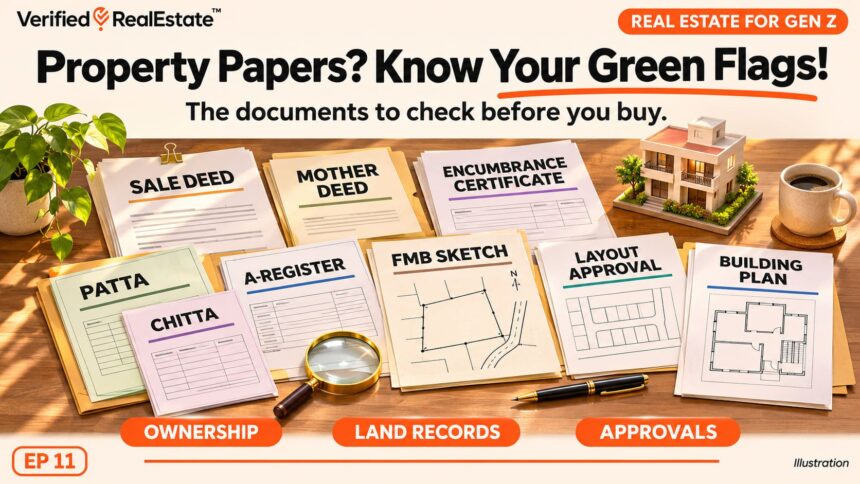
REAL ESTATE FOR GEN Z | EP 11 By Verified.RealEstate
In EP 10, we explored about Patta and the four things to check before buying land.
Now, let’s talk about the other documents you shouldn’t ignore.
Found your dream plot in Chennai? Great location, good price, and the seller says, “All documents are clear!”
Sounds perfect, right? 👀
But here’s the thing: A property can look perfect on the outside and still have problems in its paperwork.
Before you pay that advance, let’s unpack the documents that actually matter.
1. Ownership Documents — Who Really Owns This Property?
These documents help you understand who owns the property and how it reached the current seller.
| Document | What does it tell you? |
|---|---|
| Sale Deed | Who bought the property, from whom, and the details of the registered sale |
| Parent Documents (Mother Deed) | Shows the property’s ownership history over the years, including previous owners and how the property was transferred |
| Encumbrance Certificate (EC) | Registered transactions and encumbrances found for the property during the searched period |
Encumbrance: A legal claim or liability attached to a property, such as a mortgage, that may affect its ownership or transfer.
Gen Z tip: Just because someone is selling a property doesn’t automatically mean they have the legal right to sell it. Check the ownership history!
2. Land Records — What Does the Government Record Say?
These documents help you identify the land, its recorded holder, area and boundaries.
| Document | What does it tell you? |
|---|---|
| Patta | Whose name is recorded against the land, along with survey and land details |
| Chitta | Shows whose name is recorded for the land, its area and whether it is classified as wet or dry land. |
| A-Register | A government village land record showing the survey number, land size, classification and other revenue details. |
| FMB Sketch (Field Measurement Book) | A government survey drawing showing the land’s shape, boundaries and measurements. |
| TSLR Extract | Similar land-record information for properties covered by the town survey system |
Gen Z tip: Your plot’s survey number and subdivision should match the relevant documents. Even a small difference deserves attention.
3. Approval Documents — Is the Development Properly Approved?
Owning land and having permission to develop it are two different things.
| Document | What does it tell you? |
|---|---|
| Layout Approval (CMDA/DTCP) | Confirms that the layout has planning approval from the relevant authority, including its plot divisions and roads. |
| Building Plan Approval | Shows the approved building design, including its floors, dimensions and permitted construction. |
| TNRERA Registration Details | Registration and disclosed project information for developments covered by RERA |
Gen Z tip: A Patta doesn’t mean your plot has layout approval. And layout approval doesn’t automatically mean you can construct any building you want.
Let’s Make It Simple!
Imagine you’re buying a 1,200 sq. ft. plot near Tambaram.
Before paying the advance, you should know:
- Sale Deed: Does the seller have valid ownership documents?
- Parent Documents: Can you trace how the property reached the seller?
- EC: Are there any relevant registered transactions or encumbrances you need to investigate?
- Patta and land records: Do the name, survey details and land area match?
- FMB Sketch: Does the survey number and the measurements record match the plot being shown to you?
- Layout Approval: Is your plot part of the approved layout?
Remember, these documents work together. No single document guarantees that a property is safe to buy.
And not every property needs the same documents. A plot, flat and independent house each require different checks.
The Bottom Line
Don’t let a beautiful property distract you from its paperwork.
Ask for the documents, verify them and get the ownership and approvals checked before committing your money.
A little homework today can save you a massive headache tomorrow.
Your next move? VRE got you.
Up Next — EP 12: Sale Deed vs Mother Deed — How Do You Know Who Really Owns the Property?