

Why Mumbai Is Seeing More Redevelopment Now
Mumbai has very little vacant land left for large-scale development. At the same time, many old housing colonies, slum clusters and ageing layouts are located in prime areas where the existing infrastructure is outdated and land is underutilised. This is why redevelopment has become one of the biggest real estate themes in Mumbai in recent years.
Instead of expanding only towards the outskirts, authorities are now pushing for large cluster redevelopment within the city. The idea is to rehouse existing residents, create better civic infrastructure, unlock valuable urban land and allow developers to build saleable space in return. This model is now attracting large corporate groups, including Reliance, Adani and JSW.
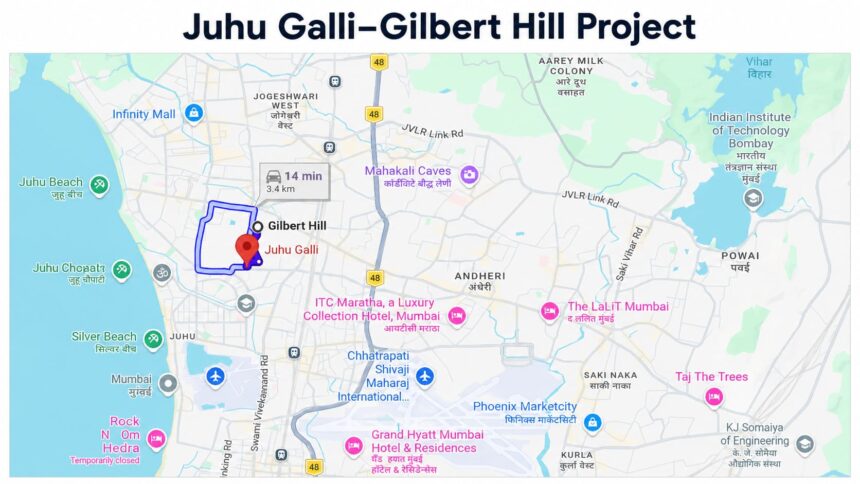
The latest major development is Reliance’s entry into Mumbai’s slum redevelopment sector through the Juhu Galli–Gilbert Hill project in Andheri West.
Reliance Wins 101-Acre Mumbai Redevelopment Bid
A consortium led by Reliance has won the bid to redevelop the Juhu Galli–Gilbert Hill slum cluster in Andheri West, Mumbai. The project is spread across approximately 101.36 acres, making it one of the largest slum redevelopment projects in Mumbai.
The winning consortium is led by Reliance 4IR Realty Development, the real estate arm of Reliance Industries. Mahadev Realtors Juhu, linked to Aspect Realty, is also part of the consortium.
This marks Reliance’s formal entry into Mumbai’s large-scale slum redevelopment space, an area that has recently started attracting major corporate developers because of new policy changes, large land parcels and high-value redevelopment opportunities.
Project Location: Juhu Galli–Gilbert Hill, Andheri West
The redevelopment project is located in the Juhu Galli–Gilbert Hill belt of Andheri West, one of Mumbai’s most valuable western suburb locations.
Andheri West is already a major residential and commercial hub. It has strong connectivity, access to metro corridors, proximity to Juhu, Versova, Lokhandwala and key commercial zones.
Because of this, a large 101-acre redevelopment project in this area can significantly influence future housing supply, road planning, civic facilities and real estate pricing in the surrounding neighbourhoods.
How Big Is the Project?
The Juhu Galli–Gilbert Hill redevelopment project covers around 101.36 acres. Reports state that the area includes thousands of existing slum tenements, existing Slum Rehabilitation Authority (SRA) buildings, public facilities, markets, institutions and other civic uses.
This means the project is not a simple construction exercise. It is a complex urban renewal project involving rehabilitation, eligibility verification, temporary relocation, transit rent, infrastructure planning and phased redevelopment.
More Than 28,000 Rehab Homes Expected
One of the most important parts of the project is the rehabilitation component. The Reliance-led redevelopment is expected to provide more than 28,000 rehabilitation homes for eligible slum dwellers living in the Juhu Galli cluster.
Under Mumbai’s slum redevelopment model, eligible residents are rehoused in permanent rehabilitation buildings. In return, the developer receives development rights and can build a saleable component, subject to the rules and approvals of the Slum Rehabilitation Authority and other planning authorities.
For residents, the key issues will be eligibility, size of rehab flats, temporary rent, construction timeline and the quality of final rehabilitation buildings.
Why Reliance’s Entry Matters
Reliance winning this redevelopment bid is important because Mumbai’s redevelopment market is no longer limited to traditional real estate developers. Large corporate groups are now entering the sector because the scale of these projects is much bigger than before.
Earlier, slum redevelopment in Mumbai was often handled by smaller and mid-sized developers. Many such projects faced delays due to consent issues, fragmented land ownership, disputes over eligibility, lack of funding and difficulty in managing transit arrangements.
With large corporate developers entering the space, the government appears to be pushing for bigger, more structured redevelopment models. However, bigger names do not automatically guarantee smoother execution. These projects still depend heavily on approvals, resident cooperation, transparent eligibility checks, timely rent payments and proper construction planning.
Policy Push Behind Large Cluster Redevelopment
Recent policy changes in Maharashtra have made large cluster redevelopment more attractive to major corporate groups. A framework introduced in November 2025 allows redevelopment of slum clusters above 50 acres with relaxed consent requirements and additional development rights.
These incentives help explain why companies such as Reliance, Adani and JSW are entering Mumbai’s redevelopment sector, as the government pushes for larger, area-based urban renewal projects.
SRA CEO Mahendra Kalyankar called the Juhu Lane tendering process a “watershed moment” in Mumbai’s redevelopment journey and said participation from leading corporate groups showed confidence in the government’s vision and SRA redevelopment framework.
That statement matters because it shows the government wants this project to become a model for future cluster redevelopment projects in Mumbai.
Temporary Rent and Performance Guarantee
For the Juhu Galli project, Reliance is required to cover temporary rent for residents during the redevelopment period. Reports state that Reliance must pay around ₹700 crore over two years towards temporary rent, along with an additional rent deposit and a performance guarantee of around ₹100 crore.
This is a crucial part of the project because transit rent is one of the biggest pain points in redevelopment. If rent payments are delayed, residents face serious hardship and the project can easily get caught in disputes.
A clear rent mechanism, timely payment and transparent communication with residents will be essential for the success of this project.
Why the Government Is Pushing Large Cluster Redevelopment
Mumbai’s redevelopment push is linked to three major problems.
👉 First, many old colonies and slum settlements are located on prime land but lack proper infrastructure, open spaces and planned civic facilities.
👉Second, individual building redevelopment often leads to patchy development. One building gets redeveloped, another remains old, roads stay narrow and the neighbourhood does not improve as a whole.
👉Third, large cluster redevelopment allows the government and planning authorities to redesign an entire area together. This can include better roads, open spaces, utilities, social infrastructure and planned housing.
This is why large land parcels above 50 acres have become important in recent redevelopment policies. The government wants to attract stronger developers who can handle large projects, fund transit rent and complete rehabilitation at scale.
What Residents Should Watch Carefully
Residents in any large redevelopment project should not look only at the name of the winning developer. They must carefully track the actual terms of rehabilitation.
Important points include:
- Whether the resident is officially counted as eligible
- Size of the rehabilitation flat
- Temporary rent amount and payment schedule
- Transit accommodation arrangement
- Timeline for vacating and re-entry
- Corpus fund or maintenance support
- Final building plan and amenities
- Treatment of shops, commercial units and public facilities
- Whether all approvals are properly obtained
- Whether the project is being executed in phases
In large redevelopment projects, the announcement is only the first step. The real test begins during implementation.
Possible Impact on Andheri West Real Estate
The Reliance Mumbai redevelopment bid could significantly influence Andheri West by adding rehabilitation housing, new infrastructure and saleable residential space. However, such large projects take years and may face delays.
Buyers and investors should wait for approved plans, RERA registrations and clear timelines before drawing conclusions.
Other Major Mumbai Redevelopment Bids Won by Adani and JSW
Reliance is not the only large corporate group entering Mumbai’s redevelopment space. MHADA recently finalised winners for three major cluster redevelopment projects covering a total of 206.49 acres:
- Bandra Reclamation (98.27 acres): Won by Adani Properties in one of Mumbai’s most premium and strategically located areas.
- Adarsh Nagar, Worli (34.33 acres): Also awarded to Adani Properties, with the project expected to influence future premium housing supply in Worli.
- SVP Nagar, Andheri West (73.89 acres): Won by a JSW-led consortium comprising Hanura Realty, Chandak Realtors, Premsagar Infra Realty and Vantier Realty; this project is separate from Reliance’s Juhu Galli–Gilbert Hill redevelopment.
Conclusion
Reliance’s win for the 101-acre Juhu Galli–Gilbert Hill redevelopment project in Andheri West marks its entry into Mumbai’s slum redevelopment sector and is expected to deliver over 28,000 rehabilitation homes.
Alongside major redevelopment wins by Adani and JSW in Bandra Reclamation, Worli and SVP Nagar, the project highlights how redevelopment is becoming a key driver of Mumbai’s future real estate growth.