

Anil Kumar Gupta v. Laxmi Devi & Ors. | CS(OS) 447/2021 | Delhi High Court | Judgment dated 29 May 2026
Can a parent orally gift a floor of a house to one child and create a valid ownership right?
Can a family claim that a property was divided decades ago without a registered partition document?
The Delhi High Court has addressed both questions in Anil Kumar Gupta v. Laxmi Devi & Ors., a significant property dispute concerning inheritance, relinquishment deeds, an alleged oral partition and an alleged oral gift of immovable property.
Justice Vikas Mahajan held that the defendants failed to establish the alleged oral partition and rejected the claim that the first and second floors of the property had been orally gifted to the plaintiff’s deceased brother. The Court ultimately recognised Anil Kumar Gupta’s 5/6th share in the property and the legal heirs of his deceased brother’s collective 1/6th share, while directing further proceedings for partition by metes and bounds.
The Delhi High Court’s records show that the suit had been pending since 2021, with earlier proceedings addressing the pleadings, evidence and interim protection concerning the property.
The Property Dispute: How Did It Begin?
The dispute concerned a residential property measuring approximately 324.2 square yards at Model Town-III, Delhi.
The property had originally been purchased by Jagdish Prasad Gupta, the father of the plaintiff, through a registered sale deed dated 24 July 1959.
Jagdish Prasad Gupta subsequently died intestate, meaning he died without leaving a Will. His wife also died intestate.
The family consisted of two sons and four daughters. Following the deaths of the parents, the children became entitled to shares in the property under the applicable succession law.
The plaintiff, Anil Kumar Gupta, initially had a 1/6th share.
The dispute arose because he subsequently relied upon registered relinquishment deeds executed by his sisters in his favour.
How Did Anil Kumar Gupta Claim a 5/6th Share?
The plaintiff’s case was that the six children inherited 1/6th share each.
Four sisters subsequently relinquished their respective interests in his favour through registered relinquishment deeds dated:
- 3 December 2011
- 22 February 2018
As a result, the plaintiff claimed:
Original share: 1/6th
+ shares relinquished by four sisters: 4/6th
= 5/6th share
The Court accepted this position. The registered relinquishment deeds had not been successfully challenged by the defendants.
The remaining 1/6th share was held collectively by the legal representatives of the plaintiff’s deceased brother, Ashok Kumar Gupta.
The Defendants’ Defence: “The Property Was Already Partitioned”
The legal representatives of Ashok Kumar Gupta contested the plaintiff’s claim.
Their principal defence was that the property had already been orally partitioned during the lifetime of Jagdish Prasad Gupta.
According to their version:
- the ground and mezzanine floors had gone to Anil Kumar Gupta; and
- the first and second floors had gone to Ashok Kumar Gupta.
They also claimed that the first and second floors had effectively been gifted by the father to Ashok Kumar Gupta.
If this argument had been accepted, it would have substantially undermined the plaintiff’s claim to a 5/6th share in the entire property.
The Court therefore had to examine whether there was credible evidence of such an oral partition and whether an oral gift could legally transfer ownership of the immovable property.
Why Did the Delhi High Court Reject the Alleged Oral Partition?
The defendants were required to establish their assertion that the property had been orally partitioned.
However, the Court found that the evidence produced by them was insufficient.
Defendant Witness -1 and Defendant Witness-2, who were family members of late Ashok Kumar Gupta, gave evidence supporting the alleged oral partition; however,
- DW-1 admitted who was just was only approximately six months old when the alleged partition took place. He admitted during cross-examination that:
- the oral partition did not take place in his presence, and
- he learned about it from his father.
- DW-2 was approximately nine years old at the alleged time of partition and had no documentary proof of the partition.
The Court therefore found their testimony insufficient to establish the alleged oral partition, particularly in the absence of supporting documentary evidence. The Court observed that, apart from their statements, there was no convincing evidence establishing that the alleged oral partition had actually taken place.
A Crucial Contradiction
The defendants’ own version also created a significant problem.
On one hand, they claimed that Jagdish Prasad Gupta had already divided the property between his two sons.
On the other hand, they acknowledged that the four sisters still had interests in the property and that arrangements had been made for them to relinquish those interests.
The Court found that this position was inconsistent with the claim that the entire property had already been divided between the two sons.
The first relinquishment deed was executed in 2011. The Court noted that this itself indicated that the sisters continued to have shares in the property at that time, weakening the assertion that the property had already been completely partitioned between the two brothers.
The Court also noted that the relinquishment deeds had not been challenged by the defendants.
Can Immovable Property Be Gifted Orally?
This was the central legal issue highlighted by the judgment.
The defendants claimed that Jagdish Prasad Gupta had orally gifted the first and second floors to Ashok Kumar Gupta.
The Court rejected this argument by referring to Section 123 of the Transfer of Property Act, 1882.
🎇For a gift of immovable property, Section 123 requires the transfer to be effected through a registered instrument, signed by or on behalf of the donor and attested by at least two witnesses.
The Delhi High Court therefore held that an oral gift could not transfer ownership of the immovable property in the circumstances of the case.
The Court relied, among other authorities, on the Supreme Court’s decision in Gomtibai v. Mattulal, (1996) 11 SCC 681, which emphasises the requirement of a registered instrument for a gift of immovable property.
In simple terms:
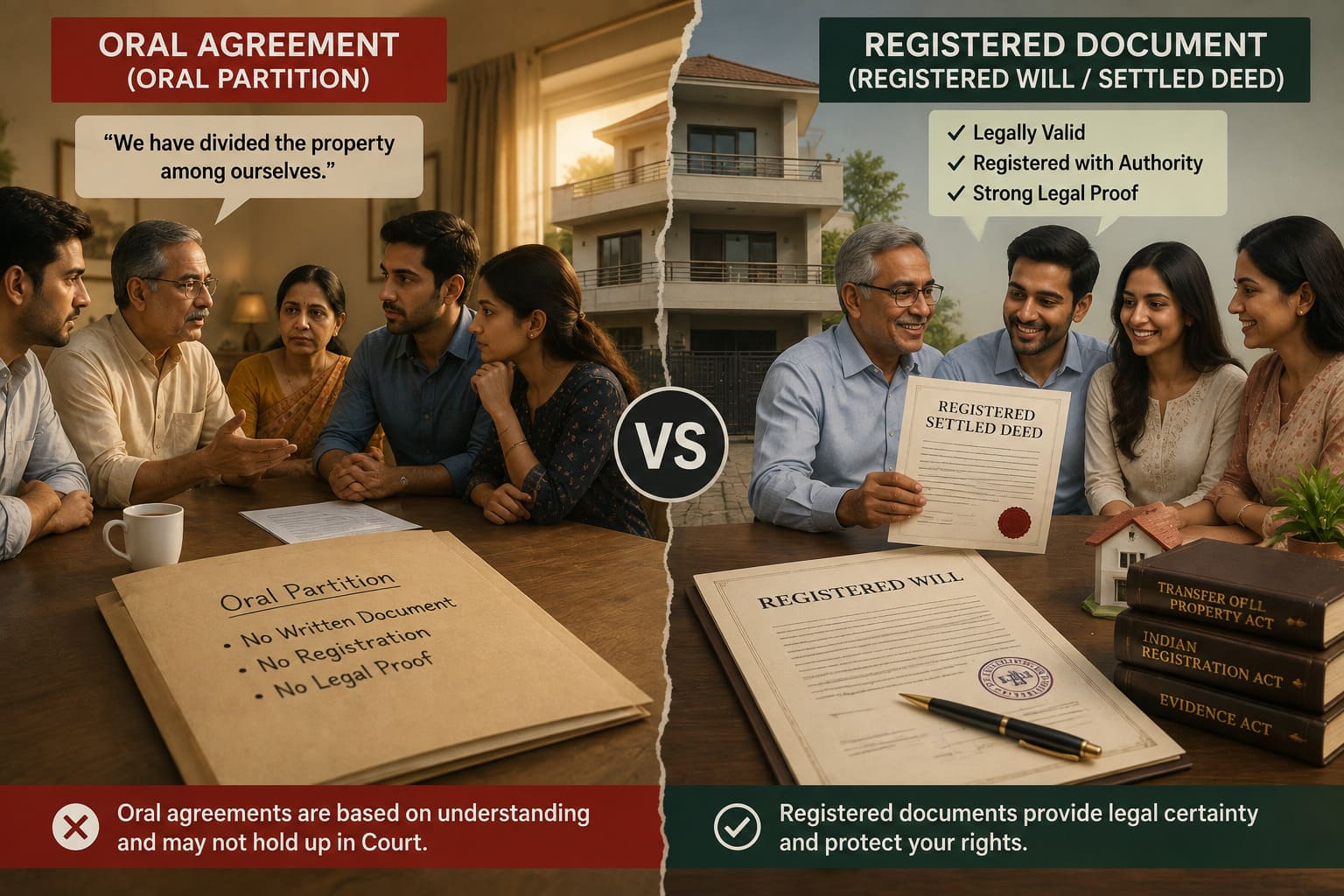
A verbal statement such as “I am giving this floor to my son” is not, by itself, a substitute for the legally required registered gift instrument for an immovable property gift.
That distinction can become extremely important when property is later inherited and the next generation disputes the original owner’s alleged intentions.
The Court’s Decision
After considering the pleadings and evidence, the Delhi High Court concluded that the defendants had failed to establish:
- the alleged oral partition; and
- the alleged oral gift of the first and second floors.
The Court therefore recognised the plaintiff’s 5/6th share and the legal representatives of Ashok Kumar Gupta as collectively holding the remaining 1/6th share.
The Court passed a preliminary decree of partition and directed that the property be examined for division by metes and bounds. A Local Commissioner was appointed to examine whether such physical division was feasible.
A preliminary decree determines the respective rights and shares of the parties. Metes and bounds refer to the precise boundaries and measurements used to identify and demarcate the specific portion of property allotted to each party.
What Does This Judgment Mean for Property Owners?
The judgment carries a strong practical message for families holding inherited property.
- Do not rely solely on oral promises
- A gift of immovable property requires proper documentation
- Relinquishment deeds can materially change inheritance shares
- An old family arrangement can become a title dispute
- Living on a particular floor of a house for many years does not, by itself, establish legal ownership of that floor
.Where title is disputed, courts examine the legal documents, succession, evidence of partition, transfers and other relevant circumstances.
Oral Partition vs Oral Gift: An Important Distinction
The judgment does not mean every oral family partition is invalid. The defendants failed to prove the particular partition they alleged.
- An oral partition concerns whether it occurred and was sufficiently proved.
- By contrast, Section 123 of the Transfer of Property Act requires a registered instrument for gifts of immovable property.
Thus, the two propositions should not be treated as identical.
To conclude :
When ownership changes, document it properly. A verbal family understanding may last for years—but a title dispute can last even longer.
Frequently Asked Questions
Can a parent orally gift a house or floor to a child?
Generally, no. A gift of immovable property requires a registered instrument under Section 123 of the Transfer of Property Act.
Can an oral family partition be claimed in court?
Yes, but it must be proved with credible evidence.
Did the Delhi High Court physically divide the property?
No. It passed a preliminary decree and appointed a Local Commissioner.
Why were the relinquishment deeds important?
They supported the plaintiff’s claim to the additional 4/6th share.