

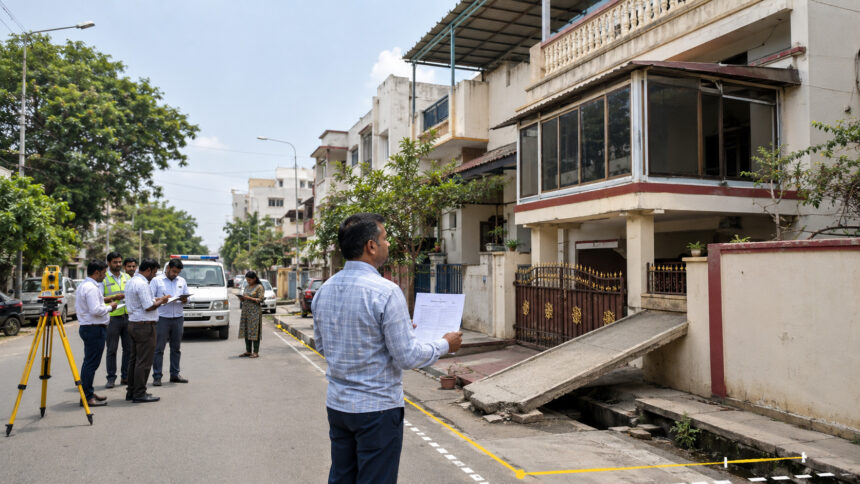
Many property owners believe that once a building is completed and occupied, it is safe from enforcement action. However, authorities across Tamil Nadu continue to issue notices and, in some cases, order demolition of structures that violate planning regulations, encroach upon public land, or deviate from approved building plans.
The issue recently gained attention after discussions around house ramps, extensions, and road encroachments raised questions about when authorities can legally intervene. While demolition is often seen as a last resort, property owners should understand that several types of violations can trigger enforcement proceedings.
What Can Lead to a Demolition Notice?
One of the most common reasons is the construction of buildings without obtaining the required planning permission. Authorities may also act when a building differs substantially from the approved plan.
🚩This includes:
- constructing additional floors,
- reducing mandatory setbacks,
- increasing the built-up area beyond approved limits, or
- changing the approved usage of a property.
Homeowners often make alterations believing they are minor improvements. However, enclosed balconies, extended staircases, covered terraces, front ramps, compound wall extensions, car porch expansions, and projections into setback areas can all become violations if they are not covered by the sanctioned plan.
🚩Another major trigger is encroachment on public land like
- Structures extending into roads,
- footpaths, road margins, drainage channels, parks,
- water bodies, or
- government land frequently attract notices from local authorities.
Such encroachments may interfere with public access, infrastructure projects, flood mitigation measures, or road widening schemes.
Why Are Road Encroachments Taken Seriously?
Road margins and footpaths are public assets intended for transportation and pedestrian movement. Even small encroachments can create long-term urban planning issues.
A ramp constructed beyond a property’s boundary, a staircase projecting into a road margin, or a compound wall occupying a portion of public land may appear insignificant to an individual owner. However, when such encroachments become widespread, they reduce road width, obstruct pedestrians, affect drainage systems, and complicate future infrastructure projects.
Courts have repeatedly held that public land cannot be appropriated for private use merely because the encroachment has existed for several years.
Important Cases That Highlight the Issue
A recent Madras High Court case involving alleged encroachments on a public road examined complaints regarding structures extending into road-margin areas. The Court emphasized the role of local authorities in identifying and addressing encroachments affecting public roads.
In another 2026 case, the Madras High Court observed that even religious structures cannot claim immunity if they occupy public streets. The Court reiterated that public roads belong to the public and encroachments may be removed following due process.
The Court has also dealt with several cases involving waterbody encroachments. In one such matter concerning encroachments around a pond, authorities were directed to conduct surveys, identify violations, issue notices, and proceed with removal in accordance with law. The case underscored that while due process must be followed, unauthorized occupation of public resources cannot be allowed to continue indefinitely.
Tamil Nadu planning authorities have similarly initiated action against unauthorized constructions under the Tamil Nadu Town and Country Planning Act. In several cases, notices have been issued for deviations from approved plans, unauthorized floors, and constructions undertaken without planning permission.
These proceedings can ultimately lead to locking, sealing, or demolition orders if violations remain unaddressed.
Chennai Sees Renewed Focus on Encroachments
Chennai has witnessed several enforcement actions against unauthorized constructions in recent years.
In the Janapriya Builders case in T. Nagar, the Madras High Court allowed CMDA to proceed against the unauthorized portions of a commercial building after they were locked and sealed.
Similarly, CMDA’s enforcement records show notices issued against residential and commercial properties in areas such as Alwarpet and T. Nagar for deviations from approved plans. These cases highlight that additional floors, unauthorized extensions, setback violations, and deviations from sanctioned drawings can ultimately lead to locking, sealing, and even demolition proceedings if not rectified
Can Authorities Demolish a Structure Immediately?
In most situations, the answer is no.
Authorities are generally expected to follow a legal process before taking demolition action.
This typically includes
- identifying the violation,
- issuing a notice,
- providing the property owner an opportunity to explain or rectify the issue, and
- passing a final order.
Courts have consistently emphasized the importance of following the principles of natural justice before taking coercive action.
However, once the legal process has been completed and the violation is established, authorities have the power to remove unauthorized structures, particularly those affecting public land or violating planning regulations.
What Property Owners Should Keep in Mind
Before undertaking any modification, homeowners should verify whether the proposed work complies with approved plans and local development regulations. Even seemingly harmless additions such as balcony enclosures, front ramps, terrace rooms, staircase extensions, compound wall projections, or car parking covers can attract scrutiny if they violate sanctioned drawings or encroach upon public space.
A demolition notice is rarely the result of a single day’s action. More often, it is the culmination of planning violations, unauthorized construction, or encroachments that have remained unresolved.
To Sum Up:
By ensuring that construction is carried out in accordance with approved plans and applicable regulations throughout the project lifecycle can help property owners avoid costly disputes, enforcement proceedings, and potential demolition orders in the future.